









Training an artificial intelligence model takes more than feeding it a large dataset and waiting for accuracy to improve. A production-ready system starts with a clearly defined problem, data that can be used legally and safely, a model suited to the task, and an evaluation plan that defines what good performance actually means.
Businesses also have more options than they did a few years ago. Many AI projects do not require training a model from scratch. Teams can start with a pretrained model, fine-tune it for a specialized task, add retrieval to supply current enterprise information, or rely on prompt engineering when the underlying model already has the necessary capabilities.
The right path depends on the problem, available data, risk, budget, and required level of control. This guide explains the full process, from deciding whether training is necessary to preparing data, evaluating performance, deploying the model, and governing it in production.
- Key takeaways
- What is AI model training?
- What are the main types of AI models?
- Do you need to train an AI model?
- How to train an AI model in 9 steps
- How businesses use trained AI models
- Key challenges and risks in AI model training
- Privacy, ethics, and AI governance
- Where prompt engineering fits into AI development
- Best practices for training and deploying AI models
- Bottom line
Key takeaways
- AI model training is an iterative lifecycle: Teams define the problem, prepare and govern data, choose a model and training method, train and evaluate it, then monitor its performance after deployment. (Jump Section)
- Training from scratch is only one option: Fine-tuning, parameter-efficient fine-tuning, retrieval-augmented generation (RAG), and prompt engineering can be more practical when a suitable pretrained model already exists. (Jump Section)
- Production readiness requires more than model accuracy: Privacy, security, fairness, operational performance, regulatory requirements, and monitoring all affect whether an AI system is safe and useful enough to deploy. (Jump Section)
What is AI model training?
AI model training is the process of using data to adjust a model so it can recognize useful patterns and produce appropriate outputs when presented with new inputs.
Depending on the application, those outputs might be a predicted sales figure, a fraud alert, a product recommendation, an image classification, or generated text. Training changes the model's internal parameters based on patterns it identifies in examples. Inference happens later, when the trained model applies what it learned to new data.
Training differs from simply programming a fixed set of rules. A rules-based application might be explicitly told to flag transactions that meet certain conditions. A machine learning model can instead learn combinations of characteristics associated with suspicious transactions from historical examples.
Training quality depends on much more than the algorithm. Poorly framed objectives, unrepresentative data, data leakage, unsuitable metrics, and weak production monitoring can undermine an otherwise sophisticated model.
What are the main types of AI models?
AI models can be categorized in different ways, and the categories sometimes overlap. For a business evaluating how to build an AI system, it is useful to start with the kind of problem the model needs to solve.
Model family | Common tasks | What to consider |
| Linear and logistic models | Numerical prediction, probability estimation, classification | Relatively efficient and interpretable but may struggle with highly complex relationships |
| Decision trees and ensembles | Classification, risk scoring, fraud detection, forecasting | Often effective with structured business data and nonlinear relationships |
| Neural networks | Vision, speech, language, and complex prediction | Can learn highly complex patterns but often require more data and compute |
| Foundation models | Language, code, image, audio, and multimodal tasks | Usually pretrained at scale and adapted rather than built from scratch for each business application |
Model selection should start with the problem, not whichever architecture currently receives the most attention. A forecasting task based on structured historical data may not need a large language model, while an enterprise assistant that must interpret documents and respond in natural language may benefit from a foundation model.
For a deeper look at these categories and how they differ, see the dedicated guide to AI model types.
Generative AI vs predictive AI
Another useful distinction is what the system is expected to produce.
Predictive AI analyzes available information to classify, estimate, rank, or forecast an outcome. Examples include fraud detection, equipment-failure prediction, customer churn modeling, and demand forecasting.
Generative AI produces new content such as text, images, audio, video, or code based on patterns learned during training. In business settings, it commonly powers assistants, summarization, document generation, software development, and knowledge-retrieval applications.
Predictive AI | Generative AI | |
| Primary goal | Predict, classify, rank, or forecast | Generate new content or responses |
| Typical output | Score, category, probability, numerical value | Text, image, audio, video, or code |
| Common enterprise examples | Fraud detection, forecasting, churn prediction | Knowledge assistants, summarization, code generation |
| Typical model strategy | Task-specific ML model or neural network | Often a pretrained foundation model plus prompting, retrieval, or fine-tuning |
| Evaluation focus | Error rates and task-specific metrics | Quality, factuality, safety, task success, and operational performance |
The categories describe how AI systems are used rather than mutually exclusive underlying architectures. A larger enterprise application can combine predictive and generative capabilities.
For a closer comparison of the two approaches and where each fits, see the guide to generative AI vs predictive AI.
Do you need to train an AI model?
Before collecting a large dataset or provisioning GPUs, determine whether the project requires model training at all.
Modern AI development gives organizations several ways to adapt technology to a business problem.
Approach | Changes model parameters? | Best suited for |
| Train from scratch | Yes | Problems requiring a custom model or capabilities unavailable in existing models |
| Full fine-tuning | Yes | Adapting a pretrained model to a specialized task or behavior |
| Parameter-efficient fine-tuning | Partially | Adapting large pretrained models while limiting the number of parameters that must be trained |
| RAG | No | Supplying a generative system with current, private, or domain-specific knowledge |
| Prompt engineering | No | Improving instructions, context, format, and task execution without modifying the model |
Training from scratch provides extensive control but usually requires the greatest investment in data, expertise, experimentation, and computing resources.
Fine-tuning starts with a pretrained model and continues training it on data relevant to a narrower task. Parameter-efficient fine-tuning, or PEFT, can reduce that burden by updating a relatively small set of additional parameters while leaving most of the base model unchanged. LoRA is one widely used PEFT method that keeps the pretrained weights frozen while training lower-rank adaptation matrices.
RAG addresses a different problem. Instead of teaching new information by changing model weights, a RAG system retrieves relevant information from an external knowledge source when a request arrives and provides that material as context for generation.
How to train an AI model in 9 steps
AI model development is rarely a one-way process. Evaluation may uncover problems with the data, model choice, features, labels, or original objective, sending a team back to an earlier stage.
Still, these nine steps provide a practical framework for taking an AI project from an initial business problem through production.
1. Define the problem and success criteria
Start with the decision, prediction, or task the model should support.
A vague objective such as "use AI to improve customer service" gives a development team little to optimize. A clearer objective might be to classify incoming support tickets by issue and route them to the correct queue within an acceptable error rate.
Define the expected inputs and outputs, who will use the result, what happens when the model is wrong, and what existing baseline the model needs to improve upon.
Success criteria should cover operational requirements as well as model quality. Latency, privacy, cost, explainability, safety, and the ability to override a decision may matter as much as a benchmark score.
2. Collect and govern the training data
Training data should represent the conditions the model is likely to encounter after deployment. Simply accumulating more information does not guarantee better results.
Common data sources include:
Data source | Typical use | Important checks |
| Internal business data | Forecasting, fraud detection, recommendations | Access rights, quality, retention, privacy |
| Public or open datasets | Research, prototyping, benchmarking | License, provenance, relevance |
| Licensed third-party data | Specialized domains or enrichment | Usage rights, quality, permitted training uses |
| Web-derived data | Language, market, or public information | Copyright, terms, provenance, duplication |
| Sensor and IoT data | Predictive maintenance, industrial AI | Calibration, missing data, distribution changes |
| Synthetic data | Data augmentation, simulations, rare scenarios | Realism, bias, coverage, validation against real data |
Data governance should begin before training rather than after a model has consumed sensitive or questionable material. Teams need to know where information came from, which permissions apply, whether personal or confidential information is present, and whether the training dataset can later be reproduced.
The issue also has regulatory implications. EU AI Act obligations applying to providers of general-purpose AI models include maintaining technical documentation, implementing a copyright policy, and publishing a summary of the content used to train the model. Those GPAI obligations began applying on August 2, 2025, while the European Commission's enforcement powers took effect on August 2, 2026.
Not every business deploying or modifying an AI model is treated as a GPAI provider, so organizations need to determine which obligations apply to their role and use case rather than assuming one set of requirements covers every AI project.
3. Clean, prepare, label, and split the data
Raw data normally requires preparation before it can be used for training.
Depending on the application, teams may need to remove duplicates, handle missing or invalid values, normalize numerical fields, transform categories, resize images, tokenize text, or assign labels for supervised learning.
Preparation should also look for important groups or scenarios that are poorly represented. A dataset can appear clean overall while still leaving a model unable to handle a particular language, customer segment, device type, location, or edge case.
The data should then be separated according to its role:
- Training set: Used to fit model parameters.
- Validation set: Used during development to compare versions and tune decisions such as hyperparameters.
- Test set: Reserved for independent evaluation of the final model.
The validation data does not need to be deliberately harder than the training data. The important point is that evaluation data remains separate and sufficiently representative of the conditions the model is expected to encounter.
Teams should also watch for data leakage, where information unavailable in a genuine production scenario leaks into training or evaluation. Duplicate records appearing across training and test datasets are one straightforward example. Leakage can make a weak model look much stronger than it really is.
4. Choose the model and adaptation approach
The problem definition and available data should guide the model choice.
Consider four areas:
- Task requirements: Is the system predicting a number, assigning categories, detecting anomalies, ranking options, processing language, analyzing images, or generating content?
- Data characteristics: Structured business records, images, audio, text, time-series data, and multimodal inputs can favor different model architectures.
- Operational constraints: Latency, explainability, privacy, model size, compute availability, and deployment environment can make a technically capable model impractical.
- Existing models: For generative AI in particular, determine whether a pretrained foundation model already provides most of the required capability. Prompting, RAG, or fine-tuning may eliminate the need to develop another model from scratch.
5. Choose the learning method and training infrastructure
The appropriate learning method depends on the type of data and feedback available.
- Supervised learning uses labeled examples that pair inputs with desired outputs. Classification and many forecasting applications use this approach.
- Unsupervised learning identifies structures or relationships in unlabeled data, such as groups of similar customers or unusual behavioral patterns.
- Semi-supervised learning combines a smaller amount of labeled data with a larger amount of unlabeled data. It can help when obtaining accurate labels is expensive or time-consuming.
- Self-supervised learning derives training signals from the data itself. It is particularly important in foundation-model pretraining, where vast quantities of unlabeled text, images, audio, or other data may be available.
- Reinforcement learning uses interactions and reward signals to improve sequences of decisions rather than learning only from static input-output pairs.
Infrastructure needs vary just as widely. Smaller models trained on structured data may work efficiently on CPUs, while deep neural networks and foundation models often benefit from GPUs or other accelerators.
Larger projects may also require distributed computing, high-throughput storage, experiment tracking, dataset versioning, and checkpoints.
Production constraints also belong in this decision. A model that fits within the training budget but cannot meet serving latency, throughput, or operating-cost requirements is not a good production choice.
6. Train and tune the model
Training is an iterative optimization process.
In a typical neural-network training loop, the model processes examples and generates predictions. A loss function measures the difference between those predictions and the desired outputs. The training process then calculates how the parameters contributed to the error and uses an optimizer to adjust them.
PyTorch's training documentation describes this basic cycle as making predictions on batches of training data, calculating prediction error, backpropagating that error, and updating model parameters through an optimizer.
Several terms commonly appear during training:
- Epoch: One complete pass through the training dataset.
- Batch: A subset of training examples processed together before parameters are updated.
- Learning rate: A hyperparameter controlling the size of the parameter updates.
- Optimizer: The algorithm used to change model parameters based on calculated gradients.
- Checkpoint: A saved model state that allows teams to resume training or compare versions.
More training is not automatically better. A model can overfit, performing extremely well on familiar training examples but failing to generalize to new data.
Hyperparameter tuning can improve results, but the goal should not be maximizing one convenient score. Teams should optimize against the metrics and constraints established at the beginning of the project.
7. Validate and evaluate performance
Validation helps determine whether development decisions are improving the model on data it did not directly train on.
The appropriate metrics depend on the task and the consequences of different errors. Accuracy alone can be misleading, particularly when one class is much less common than another.
Google's current machine learning guidance recommends selecting measures such as precision and recall according to the costs, benefits, and risks associated with false positives and false negatives.
Task | Useful evaluation measures | Example question |
| Classification | Precision, recall, F1, ROC-AUC, accuracy | Does the model detect enough fraud without blocking too many legitimate transactions? |
| Regression or forecasting | MAE, RMSE, task-specific error measures | How far are forecasts from actual demand? |
| Generative AI | Task success, groundedness, factuality, safety, human evaluation | Does the system answer correctly and use permitted information? |
| Production system | Latency, throughput, reliability, cost | Can the application meet its operational requirements? |
Evaluation should also examine relevant subgroups and scenarios separately. A strong aggregate score can conceal persistent failures affecting a smaller population or an important edge case.
Generative AI requires particularly multidimensional evaluation. An answer can sound fluent while being inaccurate, provide a correct fact in an unsafe context, or answer the question while ignoring required formatting or source restrictions.
8. Test the final model for production readiness
Once the team selects the strongest model, test it against data that was not used for training or validation. This provides a cleaner view of how well the model is likely to perform on new inputs.
Keep the test set independent. Repeatedly changing the model based on those results can lead teams to optimize for the test data instead of real-world performance.
Production testing should also cover the full application, including integrations, permissions, latency, security, failure handling, and human escalation.
What counts as production-ready depends on the stakes. A product recommendation system can tolerate different errors than a model used in medical, employment, or financial decisions, where stricter safeguards and oversight are necessary.
9. Deploy, monitor, and retrain
Deployment does not end the AI model lifecycle.
Real-world conditions change. Customer behavior evolves, attackers change tactics, product catalogs are updated, sensors deteriorate, economic conditions move, and language shifts. A model that passed testing months ago can become less useful even if its code remains unchanged.
Production monitoring should track relevant changes in inputs, model behavior, application performance, latency, errors, and business outcomes.
Teams should define retraining triggers rather than retraining simply because a calendar date arrives. A new model version may be needed when performance drops below a predetermined threshold, input distributions change materially, the business process changes, or enough representative new data becomes available.
Dataset and model versioning are equally important. Organizations need to know which data, code, configuration, and model version produced a given result so they can investigate problems and roll back a problematic release.
How businesses use trained AI models
The value of a trained model comes from what it enables a business to do differently or more efficiently.
Enterprise use case | Typical approach | What the model contributes |
| Fraud detection | Classification and anomaly detection | Scores or flags suspicious activity |
| Demand forecasting | Regression and time-series models | Estimates future inventory or resource requirements |
| Predictive maintenance | Sensor and time-series models | Identifies patterns associated with equipment problems |
| Recommendations | Ranking and recommender models | Prioritizes products, content, or actions |
| Document processing | NLP, vision, or multimodal models | Extracts, classifies, or summarizes information |
| Enterprise knowledge assistants | Foundation model plus RAG | Generates answers using approved organizational information |
| Software development | Pretrained code model, prompting, retrieval, or fine-tuning | Assists with code generation, explanation, testing, and related workflows |
For businesses, AI only makes sense if it improves the workflow enough to outweigh the added cost, complexity, risk, and oversight.
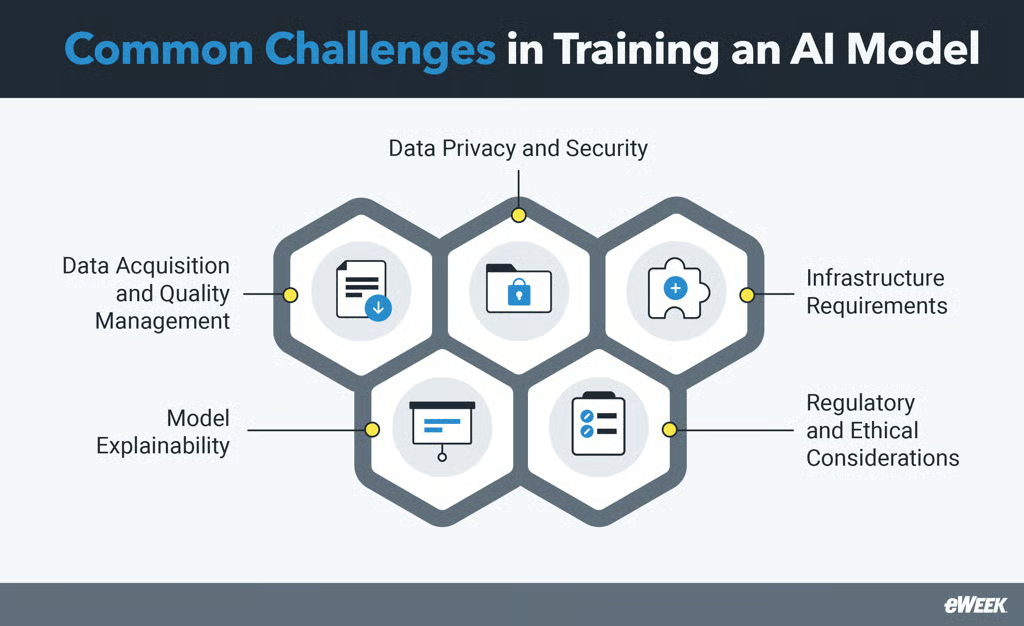
Key challenges and risks in AI model training
Model training introduces risks at almost every stage, from selecting the dataset to maintaining the finished system.
Poor or unrepresentative data
Models learn from the information available to them. Missing values, inconsistent labels, duplicate examples, outdated records, and unrepresentative populations can distort what a model learns.
Simply increasing dataset size will not automatically solve these problems. The data needs to cover the conditions and edge cases the model is expected to encounter.
Privacy, copyright, and data provenance
Training can create privacy and intellectual-property problems when organizations cannot establish where information came from or whether they have the right to use it.
Teams should maintain provenance records for internal, public, licensed, scraped, synthetic, and third-party data. Personal or confidential information may require minimization, access restrictions, de-identification, retention limits, or exclusion depending on the use case and applicable law.
Training-data transparency is now a formal requirement for certain model providers in the EU. The European Commission has published a template establishing a common baseline for summaries of content used to train general-purpose AI models.
Data poisoning and model supply-chain risk
Training data is also a security surface.
An attacker who can influence training information may try to insert examples designed to manipulate later model behavior. Organizations can also inherit risk when they use externally developed datasets, models, weights, or other components without understanding their provenance.
NIST's 2025 adversarial machine learning taxonomy covers poisoning, evasion, privacy, and other attacks affecting predictive and generative AI systems across the model lifecycle.
Organizations should restrict access to training pipelines, examine the origin of datasets and pretrained models, protect model artifacts, and treat third-party AI components as part of the technology supply chain.
Bias and unfair outcomes
No model becomes unbiased simply because its dataset has been cleaned.
A more realistic objective is to identify relevant sources of bias, measure whether performance differs across populations and situations, and mitigate the consequences appropriate to the use case.
A model can achieve strong overall performance while consistently failing for a smaller group. Teams should therefore determine which populations and failure cases require separate evaluation and when a decision should receive human review.
Explainability and accountability
Some models are easier to interpret than others, and different applications require different levels of explanation.
A recommendation engine may need enough observability for developers to diagnose poor recommendations. A system used in a high-impact decision may require much clearer documentation of its data, model version, decision factors, and review process.
Organizations should establish ownership before launch. Someone needs responsibility for model approval, incidents, monitoring, retraining decisions, and retirement.
Infrastructure and cost
Training costs include much more than accelerator time.
Data engineering, labeling, experimentation, storage, evaluation, security, deployment, monitoring, and skilled personnel can all represent substantial portions of an AI project's cost.
Generative AI systems also continue consuming compute after training as they respond to production requests.
A more complex model should therefore justify that complexity with measurable improvements. When a smaller model meets the requirement, it can reduce both operational cost and governance burden.
Privacy, ethics, and AI governance
Safe AI implementation requires controls throughout the lifecycle rather than an ethics review immediately before launch.
A practical governance process should establish who owns the system, which information it may use, which evaluations it must pass, how changes are approved, what gets logged, how incidents are handled, and when human intervention is required.
Regulatory requirements are also becoming more concrete. The EU AI Act's Article 50 transparency obligations began applying on August 2, 2026, including requirements affecting certain interactive AI systems and AI-generated or manipulated content. Separate rules apply to providers of general-purpose AI models.
Requirements differ by system, provider, deployer, jurisdiction, and use case. Organizations should map applicable obligations to their own role rather than reducing AI governance to one generic compliance checklist.
Ethical review should be similarly specific. Teams should ask who could be harmed by an incorrect result, which populations might receive worse outcomes, whether people can contest consequential decisions, when human review is necessary, and how the organization will discover problems after deployment.
For a deeper look at responsible AI, including ethics and governance, see the guide to AI ethics.
Where prompt engineering fits into AI development
Prompt engineering can improve how a generative AI system performs a task, but it is not the same as training the underlying model.
Prompts provide instructions, examples, context, constraints, or output requirements at the time the model is used. The base model's learned parameters normally remain unchanged.
Prompting can therefore be a sensible starting point when a pretrained model already understands the task. If the problem is missing, private, or rapidly changing information, RAG may be more appropriate. Fine-tuning becomes more attractive when a model's underlying behavior needs to change in ways that prompting and retrieved context cannot reliably accomplish.
The choice is not always either-or. Production systems can combine prompting, retrieval, and a fine-tuned model when the application requires all three.
For a closer look at how prompting works and when to use different techniques, see the prompt engineering guide.
Best practices for training and deploying AI models
Strong AI projects tend to share a few practical principles.
Start with the problem, not the model
Define what the system needs to accomplish before selecting an architecture, foundation model, or platform.
A simpler method that meets the requirement is usually easier to test, operate, explain, and govern.
Use the least disruptive adaptation method that works
Do not train or fine-tune a large model merely because the option exists.
Start with prompting when the base model already has the required capability. Add retrieval when the application needs controlled or changing knowledge. Modify model parameters when the behavior or specialization truly requires it.
Treat training data as a governed asset
Document provenance, permissions, transformations, labeling decisions, dataset versions, and known limitations.
Those records become especially important when teams need to reproduce a result, investigate an incident, retrain a model, or respond to questions about how the model was developed.
Define evaluation criteria before training
Choose metrics according to the business consequences of different mistakes.
Setting evaluation rules only after seeing model results makes it easier to select whichever metric makes the system look strongest rather than whichever one actually represents success.
Test failure modes, not only average performance
Evaluate difficult examples, edge cases, relevant subgroups, unexpected inputs, and situations where a wrong result would have disproportionate consequences.
Average performance alone does not show how a system behaves when it matters most.
Keep monitoring after launch
Training produces an initial model. Production monitoring determines whether that model remains useful as users, data, threats, and business requirements change.
Deployment plans should therefore include monitoring, ownership, escalation procedures, retraining criteria, and rollback options from the beginning.
Frequently asked questions
What is the first step in training an AI model?
The first step is to define the problem and determine how success will be measured.
Teams should know what inputs the model will receive, what output it needs to produce, who will use the result, and what types of errors are acceptable before collecting or preparing training data.
Can I train an AI model with my own data?
Yes, provided the data is relevant to the task and the organization has the necessary rights and permissions to use it.
Internal data should still be checked for privacy restrictions, confidential information, errors, bias, outdated records, and gaps in the situations the model needs to handle.
Do businesses need to train AI models from scratch?
No. Many enterprise AI projects can start with a pretrained model and adapt it using prompting, RAG, fine-tuning, or parameter-efficient fine-tuning.
Training from scratch becomes more relevant when existing models cannot meet the application's technical, control, licensing, privacy, or capability requirements.
What is the difference between training and fine-tuning?
Training from scratch develops a model's parameters using its initial training data. Fine-tuning starts with a pretrained model and continues training it on additional data to adapt it for a more specialized task or behavior.
Is prompt engineering a form of AI model training?
No. Prompt engineering changes the instructions or context supplied when a model is used. It does not normally modify the model's learned parameters.
Fine-tuning and other training methods, by contrast, change at least some of those parameters.
How much data do you need to train an AI model?
There is no universal minimum.
The amount depends on the task, model complexity, problem variability, the quality and representativeness of the examples, and whether the project starts from an existing pretrained model.
A relatively small high-quality dataset may be sufficient for one narrow application, while developing a large foundation model from scratch requires data and computing resources on a completely different scale.
How long does it take to train an AI model?
Training time can range from minutes or hours for relatively small models to much longer for large-scale deep learning and foundation-model projects.
Dataset size, architecture, hardware, number of experiments, hyperparameter tuning, and evaluation requirements all affect the timeline. Preparing and validating the data can also take longer than the training run itself.
How much does it cost to train an AI model?
There is no useful single figure because AI model training varies enormously in scale.
Costs can include data collection and preparation, labeling, compute resources, storage, engineering time, experimentation, evaluation, security, deployment, and monitoring.
Fine-tuning an existing model may require substantially fewer resources than building a large model from scratch, while prompting or RAG can address some use cases without training model weights at all.
How do you know when an AI model is ready for production?
An AI model is ready for production when it performs reliably on independent evaluation data and meets the operational and risk requirements of the use case. That means looking beyond benchmark scores to factors such as security, privacy, latency, reliability, cost, integration testing, rollback procedures, human oversight, and any applicable regulatory requirements.
For higher-risk applications, teams may also need subgroup testing and stricter review before deployment.
Bottom line
Learning how to train an AI model starts with recognizing that training is only one part of building a dependable AI system. A model needs to solve a clearly defined problem, learn from appropriate and governed data, and be evaluated against metrics that reflect what happens when it succeeds or fails.
For many businesses, the best route will not involve training from scratch. Pretrained models, fine-tuning, RAG, and prompt engineering offer different ways to adapt AI while balancing cost, control, data requirements, and complexity.
Deployment also creates an ongoing responsibility. Monitoring, security, privacy, documentation, human oversight, and governance determine whether a model that performed well during development remains useful and defensible once people begin relying on it.
For practical ways to improve how you structure instructions, add context, and guide model responses, see the prompt engineering cheat sheet on writing better AI prompts.