






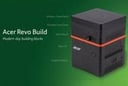

Acer wants to make it easier for PC users to build their own systems.
At the IFA 2015 consumer electronics event in Berlin, Acer officials showed off the first of its Revo Build Series—the M1-601—a modular system running Microsoft’s Windows 10 and powered by Pentium or Celeron processors from Intel. The interesting part is how consumers can put the system together.
Rather than having to dig into the chassis to put in hard drives or power sources, users can build a PC in a Lego-like fashion that can be quickly customized to their preferences.
The foundation of the system is the M1-601 base desktop system itself, a box with a 125-by-125 mm shape. Inside the main “block” are the processor, up to 8GB of DDR4 memory, an SD card slot, High Definition Multimedia Interface (HDMI) port, a DisplayPort and three USB 3.0 ports. It’s a computer in itself. Acer officials noted that the 8GB of system memory can be upgraded by loosening a screw.
However, users can customize it by adding blocks that offer different features. The blocks are connected via pogo pins and magnetic coupling—essentially snap them in place, and they are good to go. In addition, they’re just as easy to swap out. For example, if users want more than the 32GB of storage the machine offers, they can connect a block that offers a 500GB or 1TB portable hard drive.
There also will be blocks that hold a wireless power bank for wireless charging and an audio block with speakers and microphones, according to Acer officials. Other expansion blocks are in the works, such as one holding an external graphics unit that would boost what the main block offers, according to Acer officials.
The company will begin selling Revo Build PC in Europe, Africa and the Middle East in October, starting at about $224, then move it into China in December. It’s unclear if or when the system will reach the United States.
Other system vendors are looking for ways to make it easier for users to build their own systems. Razer early last year unveiled its Project Christine, which would enable consumers to build, customize or upgrade a gaming system in a modular fashion. In Razer’s initiative, each component is housed in a self-contained module that snaps into the system’s base.