







NEW YORK—Small and medium-sized businesses might have been low-tech operations in the distant past, but many of them today are apparently craving the same high-tech services that larger businesses also need to continue to thrive and grow to serve their customers.
Here’s a key example: More and more SMBs are taking advantage of 3D printing services that are being provided at 50 of The UPS Store locations across the country, and the demand for more such services has motivated the chain to increase the number of stores with 3D printers to 100 by the end of 2015.
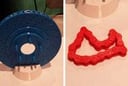
“This is another service that small business owners said they wanted and need,” Tani Sussman, a UPS Store franchise owner in Manhattan, told me here at the Inside 3D Printing Conference and Expo on April 16, held at the Javits Center. Sussman added a 3D printer in his store 18 months ago as part of a pilot project the company began, and he now has customers coming in every day asking to print out something for a development project, product prototype (pictured), experiment or other task.
“We have people come in with ideas written on napkins, and we are able to make a file and print it for them,” said Sussman. “This is taking the business process previously used for design and it’s slashing the price and time to make a design.”
Prices start at $30 for a 3D printed object, and customers can typically pick up the design the next day, he said.
Daniel Remba, the 3D printing product manager for The UPS Store, said the success of the pilot project led the chain to announce the program’s expansion last November. “The key differentiator for us is that we are doing this in our stores,” compared with other services that ship out such work, Remba told me.
Their main customers for the services are small businesses that are pushing new ideas, he said. “The small businesses do a lot of prototyping [of potential new products], but the challenge for them is not having someone local” to do it for them. That’s where The UPS Store got the idea to run the pilot and then expand it to twice as many franchise stores, he said.
The company uses Stratasys uPrint SE Plus 3D printers, which start at about $21,000 and allow 3D printing in a range of colors. On their own, few small businesses could afford to buy one of the machines, but with The UPS Store, they don’t have to buy one.
This is innovation at its best.
Small businesses sure have come far in terms of the technology they deploy and use. Now even they have Websites and social media presences and are working to incorporate more technology-driven innovations to help them grow.
The UPS Store is on to something here. After all, small businesses are the big businesses of the future. I hope this continues to catch on.