







- 10 Hot Software Development Trends of the 2000s
- Web Services/SOA
- The Rise of Open-Source Software
- Web becomes the No. 1 Development Platform
- The Emergence of Web Frameworks
- Web 2.0
- Simple Beats Complex
- The Rise of Scripting/Dynamic Languages
- The Developer Community Bifurcates
- Heterogeneity Rules
- The Emergence of Team Development
10 Hot Software Development Trends of the 2000s
10 Hot Software Development Trends of the 2000s By Darryl K. Taft
Web Services/SOA
Web services led the way to SOA (Service-Oriented Architecture), a re-emergence of established distributed computing mechanisms with new capabilities. SOA proved to be a gold mine for solution providers such as IBM, and a sorely needed fix for enterprise customers with integration woes. Many vendors hopped on the SOA bandwagon, including Digital Evolution, which changed its name to SOA Software.
The Rise of Open-Source Software
Open-source software reached critical mass in the past decade, with companies such as Red Hat being founded on the open-source Linux platform and other entrenched vendors such as IBM, Novell and Sun Microsystems cashing in on the open-source development model.
Web becomes the No. 1 Development Platform
Not bothering to take up with a particular vendor’s operating system platform, many developers decided to simply use the Web as the core development platform and to use standard Web technologies such as CSS, HTML and JavaScript to build applications that run on the Web. Palm’s WebOS is a good example of this trend.
The Emergence of Web Frameworks
With the Web as the development platform, the need for Web development frameworks became paramount.
Web 2.0
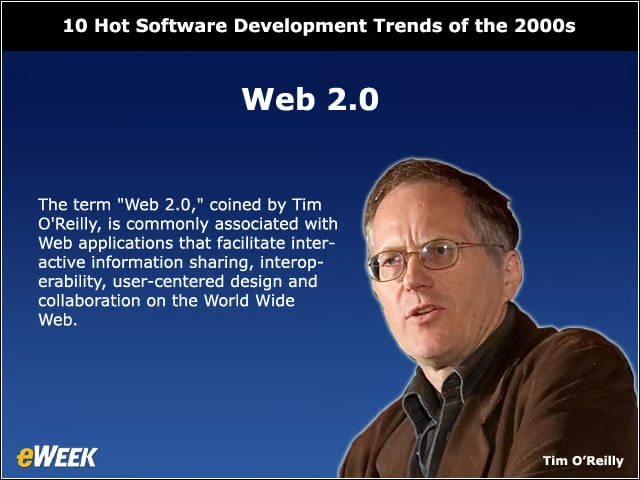
The term Web 2.0, coined by Tim O’Reilly, is commonly associated with Web applications that facilitate interactive information sharing, interoperability, user-centered design and collaboration on the World Wide Web.
Simple Beats Complex
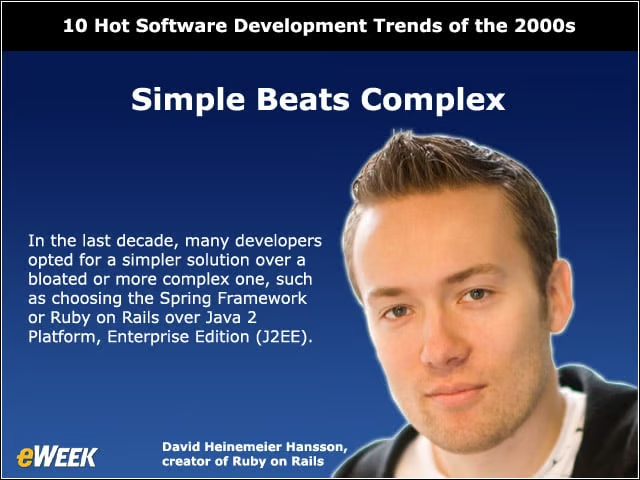
In the last decade, many developers opted for a simpler solution over a bloated or more complex one, such as choosing the Spring Framework or Ruby on Rails over J2EE (Java 2 Platform, Enterprise Edition).
The Rise of Scripting/Dynamic Languages
Over the last decade, scripting or dynamic languages came to the fore, with more and more developers adopting Ruby, PHP, Perl, Python and particularly JavaScript to build applications.
The Developer Community Bifurcates
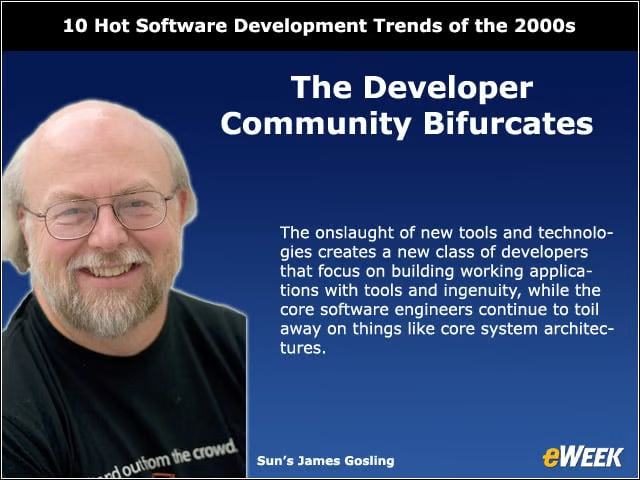
The onslaught of new tools and technologies creates a new class of developers that focus on building working applications with tools and ingenuity, while the core software engineers continue to toil away on things like core system architectures.
Heterogeneity Rules
No longer do issues such as which development platform a developer uses matter. Whether developers work with .NET or Java or whatever, what matters in the end is that heterogeneous systems can integrate with one another.
The Emergence of Team Development
After many years of trying, the 2000s became the decade when team development and ALM (application lifecycle management) began to really work effectively, particularly after Microsoft entered the space with Visual Studio Team System.