






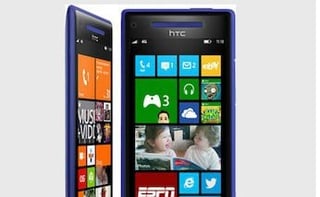

HTC reportedly is canceling plans to create a Windows Phone-running smartphone with a 5-plus-inch display because Microsoft’s mobile operating system can’t support a resolution high enough to enable the device to effectively compete in an incredibly competitive market.
Google’s Android operating system can support a resolution of 1080 horizontal pixels, while Microsoft’s newly released Windows Phone 8 supports only 720—a considerable difference in a market where display sizes and clarity are highly touted selling points.
Citing a person familiar with the project, Bloomberg reported Dec. 17 that HTC planned to introduce the phone next year. The phone’s cancellation delivers a blow to Microsoft, which is scrambling to win market share from Google and Apple. During the third quarter, Microsoft controlled a 2.4 percent share of global device sales, compared with iOS’s 14 percent and Android’s 72.4 percent share, according to Gartner.
An HTC spokesperson, when asked for comment, called the report a rumor and said that HTC had no comment. Microsoft likewise declined to comment on “rumors or speculation.”
Samsung, which sold 55 million smartphones during the quarter, does more than any brand to grow Android’s market share. Its Android-running, feature-packed Galaxy devices have been an enormous win for the company. It has sold more than 30 million Galaxy S III smartphones—a device that, with its 4.8-inch display, almost single-handedly pushed the trend toward larger displays into the mainstream.
The Galaxy S III also paved the way for Samsung to revisit the “phablet”—part phone, part tablet—form factor, which it did to great success with the 5.3-inch Galaxy Note and then to even greater success with the 5.5-inch Galaxy Note II. The latter feature displays with resolutions of 800 by 1280p and 720 by 1280p, respectively.
That HTC might back away from a 720p resolution device is understandable as it would be a considerable step backward from its most recently launched hero device, the HTC Droid DNA. The DNA features a 1080-by-1920p 5-inch display that’s the first with a true 1080p full HD super LCD 3.
The DNA is astonishingly crisp and attention-grabbing in a way that a 720p display has no hope of being. And in a market where brands—as HTC can attest—live and die by their ability to intrigue buyers, HTC can’t afford anything short of a head-turner.
In September, HTC and Microsoft introduced the Windows Phone 8X, a smartphone with a 4.3-inch display and a resolution of 720 by 1280p, and Nokia introduced the Lumia 920, which features a 4.5-inch display that seems to push the boundaries of what’s possible with the OS, advertising a 768-by-1280p display.
Samsung’s Ativ S also runs Windows Phone 8 and features a (720-by-1280p) 4.8-inch display. It’s the largest of the Microsoft smartphones, highlighting the software company’s inability to compete with devices like the Samsung Galaxy Note II and its need to increase what its new OS is capable of.