






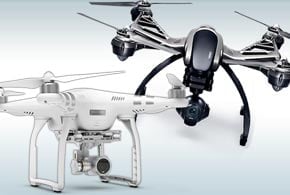

Microsoft announced on Feb. 15 the release of an open-source software toolkit called AirSim that can aid researchers in building autonomous drones and robots.
The technology originates from a Microsoft Research project that is also making its official debut on Feb. 15 called the Aerial Informatics and Robotics Platform. The project’s aim is to deliver a data-rich simulator toolkit that delivers a convincing environment with realistic physics that developers and designers can use to build robotics systems that adapt to their surroundings.
“Microsoft researchers say they can create simulators that offer a much more realistic view of the environment,” blogged Microsoft senior writer Allison Linn. “Aerial Informatics and Robotics Platform’s simulator is built on the latest photorealistic technologies, which can accurately render subtle things, like shadows and reflections, that make a significant difference in computer vision algorithms.”
It integrates with machine learning frameworks to help teach artificial intelligence (AI) systems to function in environments without the costly risks of physical harm or other real-world mishaps. It also includes software that enables developers to write code for two popular drone platforms, DJI and MavLink. The simulator is based on the Unreal Engine, which is typically used by game developers to create complex , high-fidelity 3D environments for their video games. A beta version is currently available at GitHub.
It’s not the first time Microsoft has enlisted virtual worlds to help train AI systems.
Last year, the company unveiled Project AIX, a platform for AI researchers based on Minecraft, the popular Lego-like sandbox game that Microsoft acquired in 2014 for $2.5 billion. Microsoft used the technology to create a Minecraft character that learns from its surroundings and can climb a hill unaided before inviting academics to take it for a spin.
Apart from autonomous drones and robots, Microsoft is also working on democratizing AI and bringing its productivity-boosting benefits to practically every organization and user.
The company is adding machine intelligence to many of its offerings, including Office 365, Dynamics 365 and Cortana. “We are not pursuing AI to beat humans at games. We are pursuing AI so that we can empower every person and every institution that people build with tools of AI, so that they can go on to solve the most pressing problems of our society and our economy,” Satya Nadella, CEO of Microsoft, said during a keynote address during last fall’s Microsoft Ignite 2016 conference.
In December, Microsoft’s venture capital arm announced a new fund specifically for AI companies focused on solving societal problems. The fund bankrolled Element AI, an AI research lab and incubator based in Montreal that builds commercial-grade AI systems.
Last month, Microsoft acquired Maluuba for an undisclosed amount. Also hailing from Canada, Maluuba specializes in AI and natural language processing, key technologies in Microsoft’s quest to build so-called “literate machines” that process information and deliver their findings in a humanlike manner.