









Apple just dropped a small army of new products in a matter of days, and while the hardware is genuinely impressive, the real story running through all of it is artificial intelligence.
From a $599 laptop for students to the most powerful MacBook Pro ever made, every single device Apple announced this week was built, in some meaningful way, around AI. That’s not a coincidence.
The chip is the message
If you want to understand what Apple is really doing with AI, start with the silicon.The crown jewel of this week’s announcements is the M5 Pro and M5 Max, new chips built using what Apple is calling “Fusion Architecture,” a design that joins two processor dies into a single chip. The result, Apple says, is over four times the peak GPU compute for AI compared to the previous generation, thanks in large part to a Neural Accelerator baked directly into each GPU core.
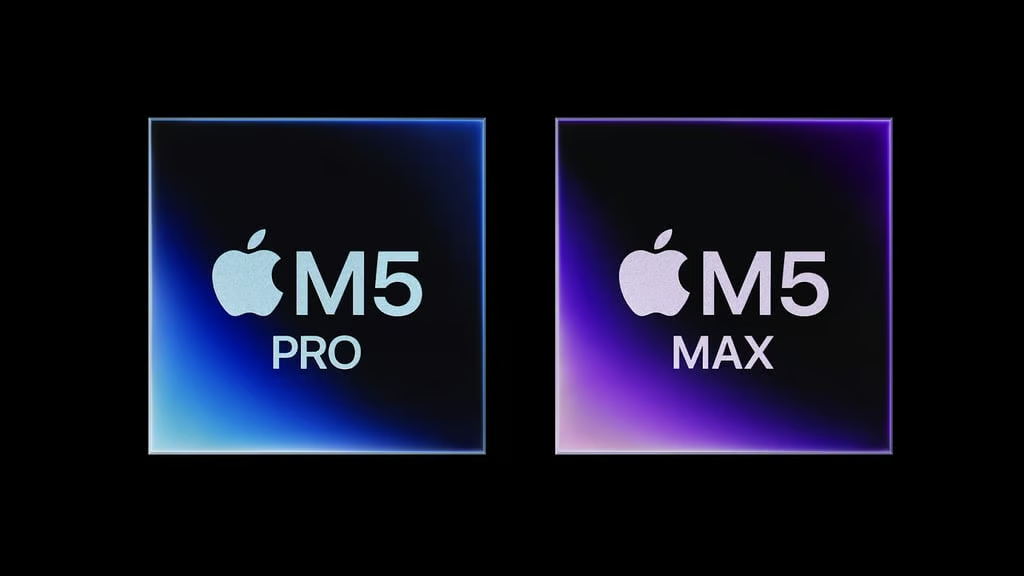
Image: Apple
That last detail matters more than it might sound. Apple has been putting Neural Engines in its chips for years, but embedding accelerators inside every single GPU core is a different approach, one designed to handle the kind of parallel workloads that AI models demand. On the new MacBook Pro, Apple says this enables professionals to run large language models locally, on the device itself, at speeds up to four times faster than M4 Pro for LLM prompt processing.
The numbers Apple is citing are striking. MacBook Pro with M5 Max delivers up to 8x faster AI image generation than M1 Max, and up to 6.7x faster LLM prompt processing. For anyone who has been running models locally, including researchers, developers, and anyone experimenting with tools like LM Studio, these are not just incremental improvements.
AI trickles down to every price point
What’s notable about this launch is that the AI push isn’t just at the premium tier.
The new MacBook Air with M5, starting at $1,099, carries the same next-generation GPU architecture with Neural Accelerators. Apple says it delivers up to 4x faster AI task performance than MacBook Air with M4, and up to 9.5x faster than the M1 version. For a laptop aimed at students and everyday users, that’s a meaningful upgrade, particularly as Apple Intelligence features become more capable.
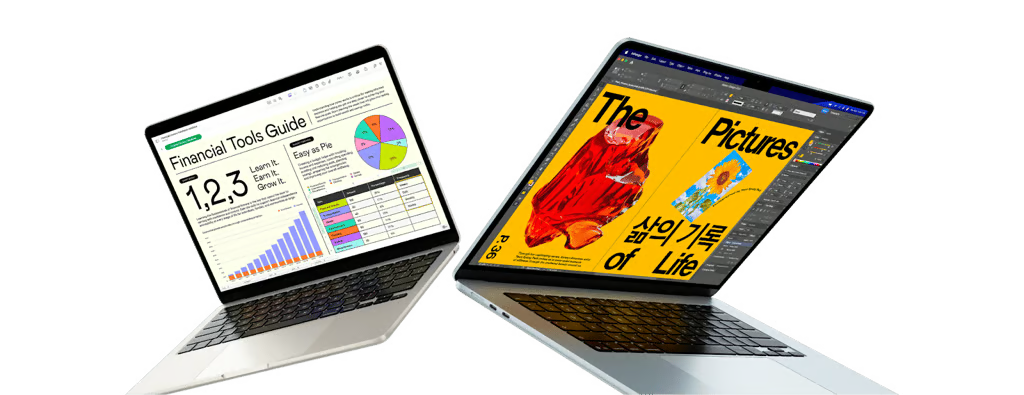
New MacBook Air with M5. Image: Apple
Even more noteworthy is the brand-new MacBook Neo, Apple’s cheapest laptop ever at $599. It runs on A18 Pro, the same chip that powers the iPhone 16 Pro, and Apple says it’s up to 3x faster for on-device AI workloads compared to a comparable PC. The 16-core Neural Engine is explicitly designed for fast, private, on-device Apple Intelligence. That Apple is stuffing this kind of AI performance into a $599 aluminum laptop represents a genuine shift in what “affordable computing” means.
The iPad Air with M4 follows a similar logic. Its 16-core Neural Engine is 3x faster than M1’s, and the new model comes with 12GB of unified memory, a 50% increase over the previous generation, which directly benefits how quickly AI models can run on the device.
The iPhone 17e, Apple’s most affordable iPhone 17, also arrives with the A19 chip and a 16-core Neural Engine that Apple says is “optimized for large generative models.” It also includes Neural Accelerators built into each GPU core, a feature previously reserved for pro-tier devices. The result is that even the entry-level iPhone now handles Apple Intelligence features natively, including Visual Intelligence, Live Translation, and Call Screening.
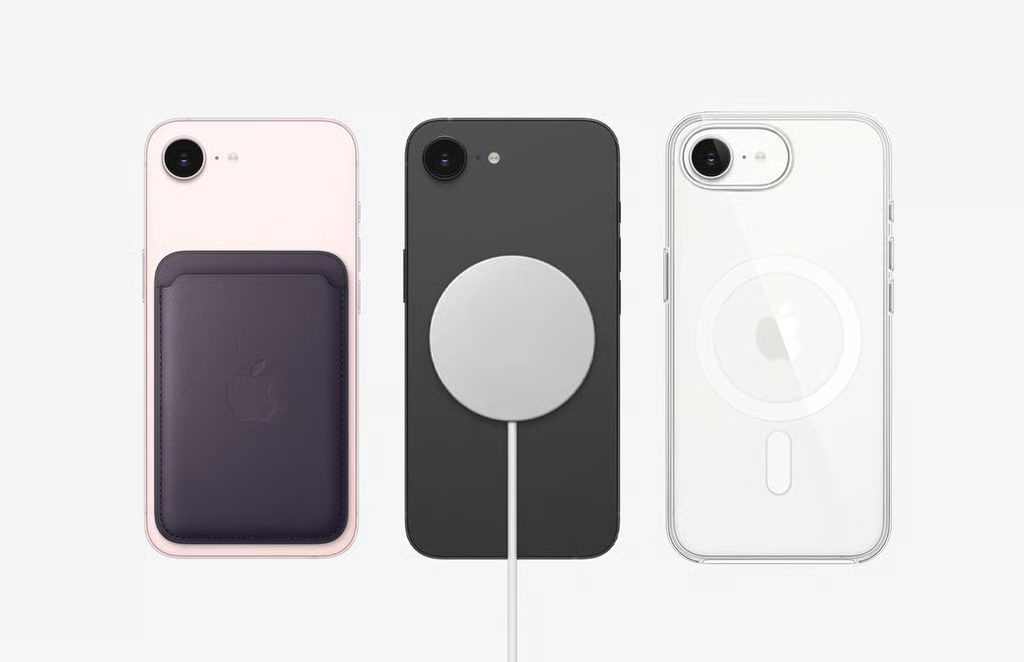
The iPhone 17e. Image: Apple
The software side: iPadOS 26, iOS 26, and macOS Tahoe
Hardware only tells half the story. All of Apple’s new devices ship with updated operating systems, iOS 26, iPadOS 26, and macOS Tahoe, and AI capabilities are woven through all of them.
On the Mac side, macOS Tahoe deepens the connection between Apple Intelligence and everyday apps.
Shortcuts can now tap directly into Apple Intelligence models, Reminders automatically categorizes tasks, and Live Translation works in Messages, FaceTime, and Phone calls. Spotlight, the system-wide search, has been significantly upgraded to let users take actions directly from the search bar, a feature that, a few years ago, would have required a third-party AI tool.
On iPadOS 26, the new windowing system and redesigned Files app aren’t just productivity upgrades; they’re built to handle the kind of complex, multi-app AI workflows that a device like the new iPad Air can now actually run. Apple Creator Studio apps, like Final Cut Pro, use the Neural Engine for features such as Scene Removal Mask that process entirely on-device.
Displays for an AI workload era
It would be easy to overlook the new Studio Display and Studio Display XDR as pure hardware updates. But even here, Apple is positioning around AI-adjacent workflows.
The Studio Display XDR, which replaces the Pro Display XDR, targets users doing HDR video editing, 3D rendering, and color grading, all workflows that are increasingly AI-assisted. At 2,000 nits of peak HDR brightness, a 120Hz refresh rate, and Thunderbolt 5 connectivity, it’s designed to pair with exactly the kind of high-AI-compute machines Apple launched this week.
Bottom line
Look across this launch as a whole, and a clear thesis emerges: Apple is betting that the future of AI isn’t in the cloud, it’s on your device. Every product announced this week, from the $599 MacBook Neo to the $3,899 MacBook Pro with M5 Max, is built around the premise that on-device AI is not just a feature but a selling point in itself.
The emphasis on privacy is part of that argument. On-device processing means data doesn’t leave your machine. As Apple Intelligence matures and as more third-party developers tap into Apple’s Foundation Models framework, the hardware released this week will be the foundation it runs on.
Also read: Apple’s Siri revamp delay is pushing some of its biggest AI upgrades into the iOS 27 cycle.