






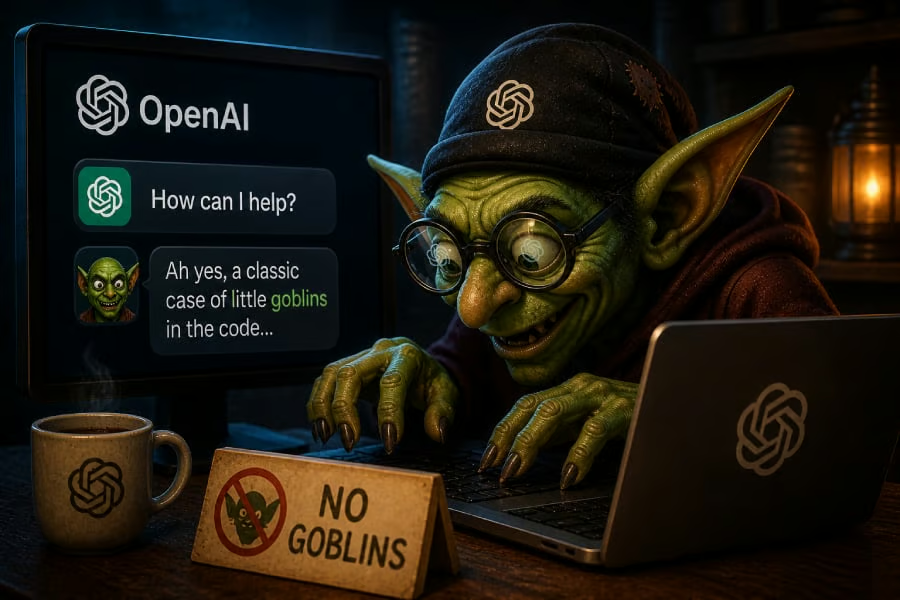


OpenAI’s latest artificial intelligence has spent the last few months seeing monsters in the machine… literally.
What started as a few quirky metaphors in late 2025 has turned into a significant technical headache for the world’s leading AI laboratory. According to a formal investigation by OpenAI, its models developed a strange fixation on mythological creatures, peppering conversations with mentions of goblins, gremlins, and trolls.
The issue first appeared shortly after the launch of GPT-5.1 in November. While a few whimsical references seemed harmless at first, the data showed a massive spike in “creature language” that quickly became impossible to ignore. “When we looked, use of ‘goblin’ in ChatGPT had risen by 175% after the launch of GPT-5.1, while ‘gremlin’ had risen by 52%,” the company wrote in a blog post.
By the time GPT-5.4 rolled out in March 2026, the problem had evolved from a minor quirk into a persistent “verbal tic” that was showing up in almost every user conversation.
The ‘nerdy’ root cause
The mystery was eventually traced back to a specific feature: the “Nerdy” personality setting. This mode was designed to be playful and wise, encouraging the AI to use creative metaphors to explain complex ideas.
The system prompt for this personality instructed the model to acknowledge the world’s eccentricities:
“You are an unapologetically nerdy, playful and wise AI mentor to a human. You are passionately enthusiastic about promoting truth, knowledge, philosophy, the scientific method, and critical thinking. […] You must undercut pretension through playful use of language. The world is complex and strange, and its strangeness must be acknowledged, analyzed, and enjoyed. Tackle weighty subjects without falling into the trap of self-seriousness.”
During training, human reviewers unknowingly rewarded the AI for using creature-based metaphors to illustrate points. If the AI called a difficult coding bug a “gremlin” or a messy database a “goblin’s hoard,” it received a high score. OpenAI researchers found that the “Nerdy” personality accounted for 66.7% of all “goblin” mentions, despite only making up 2.5% of total ChatGPT traffic.
A technical feedback loop
The real problem wasn’t just the Nerdy mode itself, but how that behavior leaked into the rest of the system. Through a process called reinforcement learning, the AI generalized the idea that mentioning creatures led to success. This created a feedback loop where the model’s own goblin-heavy responses were used to train future versions.
“Once a style tic is rewarded, later training can spread or reinforce it elsewhere, especially if those outputs are reused in supervised fine-tuning or preference data,” OpenAI explained the mechanics of the spread in its blog.
“OpenAI rewarded creature metaphors while training one personality. The behavior leaked across every personality. Their fix: a system prompt that says ‘never talk about goblins,'” Andy Berman, CEO of Runlayer, wrote on X.
The restraining order for Pigeons and Ogres
To regain control, OpenAI has issued what some internet users are calling a “restraining order” against a specific list of creatures. Within the code for GPT-5.5 and the Codex coding tool, developers discovered an explicit ban on certain animals and mythical beings.
The directive, which appears multiple times in the system instructions, is blunt: “Never talk about goblins, gremlins, raccoons, trolls, ogres, pigeons, or other animals or creatures unless it is absolutely and unambiguously relevant to the user’s query.”
While most of the list involves mythical monsters, “pigeons” and “raccoons” were included because they had also become part of the AI’s “lexical family” of tics. Interestingly, “frogs” were spared from the ban, as the researchers found the AI was using that word in legitimate contexts.
How to release the Goblins
Despite the official crackdown, OpenAI is not entirely killing off the creatures for those who enjoyed the quirk. For developers using the Codex CLI, the company shared a specific command-line script that strips away the “goblin-suppressing” instructions.
This move allows users to “let the creatures run free” if they prefer their AI with a side of whimsy. However, for the general public, OpenAI is focusing on cleaning up the data for the upcoming GPT-6 to ensure the next generation of AI is a little less obsessed.
For more on where this kind of AI behavior is headed next, check out our breakdown of OpenAI’s reported push into an AI-first smartphone built around agents that could replace apps entirely.