






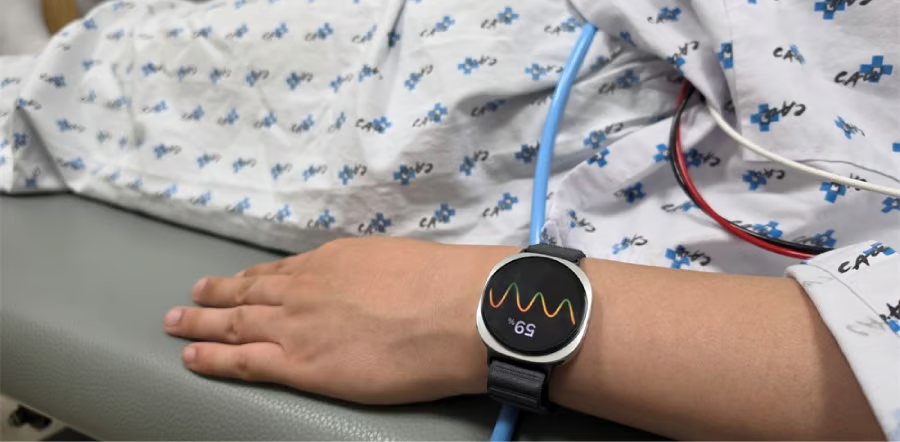


Five minutes can be enough time to sit down, call for help, or avoid a dangerous fall.
Samsung says the Galaxy Watch6 biosignals and AI predicted vasovagal syncope episodes up to five minutes early in a joint clinical study with Chung-Ang University Gwangmyeong Hospital in Korea. The finding could matter for people with recurring fainting spells, where the loss of consciousness is often brief, but sudden falls can lead to concussions, fractures, and other injuries.
For now, the finding remains research, not a feature Galaxy Watch owners can turn on. Samsung has not said when or whether fainting alerts will be available for consumers.
How the Galaxy Watch study worked
Samsung said the research team evaluated 132 patients with suspected vasovagal syncope symptoms during induced fainting tests.
Participants wore a Galaxy Watch6 equipped with a photoplethysmography sensor, which uses light to measure changes in blood flow beneath the skin. Researchers used the watch to collect heart rate variability data, then analyzed those biosignals with an AI algorithm.
Samsung said the model predicted fainting episodes up to five minutes in advance with 84.6% accuracy. The company also reported 90% sensitivity, a measure of how often the system correctly identified people who were about to faint.
“Up to 40% of people experience vasovagal syncope over their lifetime, with one-third experiencing recurrent episodes,” said Professor Junhwan Cho of the Department of Cardiology at Chung-Ang University Gwangmyeong Hospital.
“An early warning could give patients advance time to get into a safe position or call for help, which would dramatically reduce the incidence of secondary injuries,” Professor Cho emphasized.
Why wearable fainting alerts are complicated
Vasovagal syncope is the most common type of fainting. Endgagdet stated that it can occur when the body overreacts to triggers such as stress, pain, blood, heat, or prolonged standing, causing heart rate and blood pressure to drop suddenly.
A warning system could be useful because the danger often comes from the fall, not the fainting episode itself. For patients with recurring episodes, even a short alert window could make a difference. That could give Samsung a different angle from the Apple Watch, which Apple says can detect hard falls and help connect users to emergency services.
Apple also offers high- and low-heart-rate notifications and irregular-rhythm notifications, but its support materials do not position the Apple Watch as a consumer tool for predicting fainting before it happens.
Samsung did not say when, or whether, the capability would become available to Galaxy Watch users.
Before that happens, the research may need more real-world validation. CNET noted that larger external studies, especially outside a medical setting, would help corroborate the findings.
What comes next for Samsung’s health AI
Samsung said the findings were published in the European Heart Journal Digital Health and described the study as evidence that commercial smartwatches could help predict early syncope.
“This study is an example of how wearable technology can help shift healthcare from being designed for ‘post-care’ to a model of ‘preventive care,’” said Jongmin Choi, head of the Health R&D Group, Mobile eXperience Business, at Samsung Electronics.
Samsung said it plans to continue expanding health monitoring across its wearable portfolio and work with more medical institutions.
For now, the Galaxy Watch study is a promising clinical signal, not a feature announcement. If further testing supports the results, smartwatch health tools could move closer to warning users before a health event becomes an injury.
For more on Samsung’s expanding health features, read about how the company is bringing blood pressure monitoring to its Galaxy Watch lineup in the US after years of regulatory delay.