






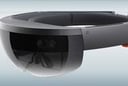

Outside the Redmond, Wash., tech titan’s own labs, the only way to experience Windows Holographic, Microsoft’s “mixed-reality” technology, is with HoloLens (pictured). With its $3,000 price tag, the augmented-reality headset is strictly for enterprise developers and deep-pocketed early adopters.
During this week’s Intel Developer Forum (IDF) in San Francisco, Microsoft announced that it is bringing the futuristic tech down to Earth in 2017.
“Next year, we will be releasing an update to Windows 10, which will enable mainstream PCs to run the Windows Holographic shell and associated mixed-reality and universal Windows applications,” wrote Terry Myerson, executive vice president of Microsoft’s Windows and Devices group in an Aug. 16 blog post. “The Windows Holographic shell enables an entirely new experience for multi-tasking in mixed reality, blending 2D and 3D apps at the same time, while supporting a broad range of 6 degrees of freedom devices.”
Intel’s chip technology will power many of those experiences, and not only by virtue of being the world’s leading chip maker.
Microsoft and Intel are working on a specification for business- and consumer-grade head-mounted displays and PCs capable of handling the demands of mixed-reality computing. The companies plan on releasing the specification in December during the Windows Hardware Engineering Community (WinHEC) conference in Shenzhen, China.
At IDF yesterday, Intel showed off Project Alloy, its own take on virtual reality (VR).
Like HoloLens, Project Alloy is a self-contained headset that doesn’t require external sensors or cameras to orient the device, nor does it need to be linked (wired or wirelessly) to a PC. Currently, VR headsets like the Oculus Rift and HTC Vive require that their users remain tethered to a PC that pumps out the processor- and graphically-intensive visuals required to deliver a convincing and responsive 3D experience.
For Microsoft, and Intel in particular, investing in next-generation virtual and augmented reality technologies could have a significant and potentially positive impact on their real-world fortunes.
Beset by a persistent PC sales slump, Intel announced in April year that it was shedding 12,000 jobs or 11 percent of its workforce. After largely missing out on the massive market for low-power processors used in smartphones and mobile devices, Intel has been turning its attention on fast-growing technologies, including internet of things devices and VR.
It’s a safe bet, at least according to a recent IDC forecast. The market research firm predicts that the market for augmented-reality and virtual-reality (AR/VR) products and services will reach a whopping $162 billion in 2020. By comparison, IDC expects the market to generate $5.2 billion this year.
Key to this explosive growth is the availability of more affordable VR solutions. “The rise of new, less expensive hardware will put virtual- and augmented-reality technology within the grasp of a growing numbers of companies and individuals,” IDC analyst Tom Mainelli said in a statement.