






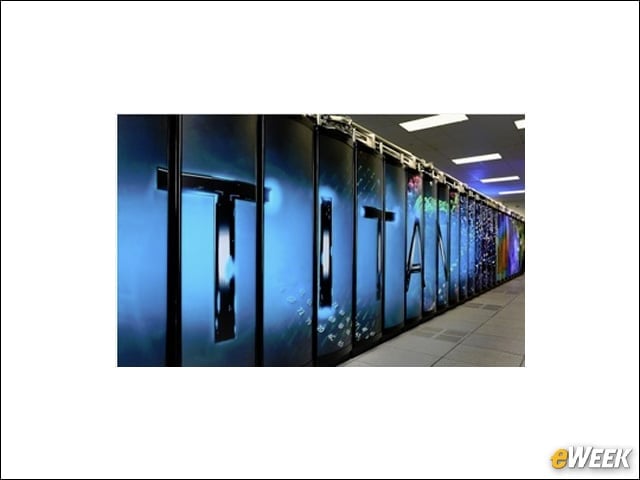

No. 1: Cray Titan
This supercomputer boasts 560,640 processors, including 261,632 of Nvidia’s Tesla K20x GPU accelerators, which also were announced at SC12. It also is powered by AMD’s Opteron 6274 chips. It leverages Cray’s Gemini interconnect.
No. 2: IBM Sequoia

When IBM’s Sequoia, a BlueGene/Q supercomputer, topped the Top500 list in June, it was the first time in about three years that a U.S.-based system had ascended to the top spot. Sequoia is powered by more than 1.5 million IBM Power processing cores.
No. 3: K Computer

Housed at the RIKEN Advanced Institute for Computational Science in Kobe, Japan, the K Computer was the world’s fastest until Sequoia displaced it. The Fujitsu-based system—powered by 705,024 SPARC64 processing cores and the first to break the 10-petaflops barrier—reached a performance of 10.51 petaflops.
No. 4: Mira

Mira is another IBM BlueGene/Q supercomputer that packs 786,432 Power processing cores. Housed at the Argonne National Laboratory in Illinois, the system hit a performance of 8.15 petaflops.
No. 5: JuQueen

The third BlueGene/Q supercomputer from IBM to be in the top five, JuQueen is installed at the Forschungszentrum Juelich supercomputing center in Germany. The system had been ranked eighth on the list in June, but has since upped the number of Power processing cores to 393,216 and the performance to 4.14 petaflops.
No. 6: SuperMUC

Six months ago, IBM’s SuperMUC—an iDataPlex system running 147,456 Intel Xeon E5-2600 cores—ranked No. 4 on the list. The supercomputer is housed at the Leibniz Rechenzentrum in Germany.
No. 7: Stampede

This supercomputer, which is being installed at TACC, is a Dell system running the company’s PowerEdge C800 servers that are powered by Intel’s Xeon eight-core Xeon E5-2680 chips. Currently, the supercomputer, which also leverages Intel’s new Xeon Phi coprocessors, has hit a performance of 2.6 flops. However, when it’s fully built out, TACC officials expect its performance to surpass 10 petaflops.
No. 8: Tianhe-1A

Developed by the Chinese National University of Defense Technology and installed at the National Supercomputing Center in Tianjin, China, Tianhe at one time was the fastest supercomputer in the world. It is powered by 186,368 Intel Xeon X5670 cores and more than 7,000 GPUs from Nvidia, and hit a performance of 2.56 petaflops.
No. 9: Fermi

Fermi is another IBM BlueGene/Q supercomputer, with a performance of more than 1.72 petaflops and powered by 163,840 Power processing cores. It is installed at Cineca, a consortium of Italian universities and the largest supercomputing center in that country.
No. 10: DARPA Trial Subset

New to the list, the Defense Advanced Research Projects Agency (DARPA) Trial Subset features IBM’s Power 775 servers and includes 63,360 Power processing cores. It hit a performance of 1.5 petaflops, and includes a custom interconnect from IBM.