








- 10 Red Flags Warning That Your Advanced Analytics Program Will Fail
- There’s Confusion About What Advanced Analytics Is
- Teams Select the Wrong Initial Use Cases
- No Real Strategy Exists
- Analytics Roles Are Poorly Defined
- Companies Isolates Analytics from Business Operations
- There Are No Analytics “Translators” On Board
- Costly Data-Cleansing Burdens Emerge
- IT Pursues Unnecessary Legacy Integrations
- No One Really Tracks Quantitative Impact
- The Ethical, Social and Regulatory Implications of Analytics are Overlooked
10 Red Flags Warning That Your Advanced Analytics Program Will Fail
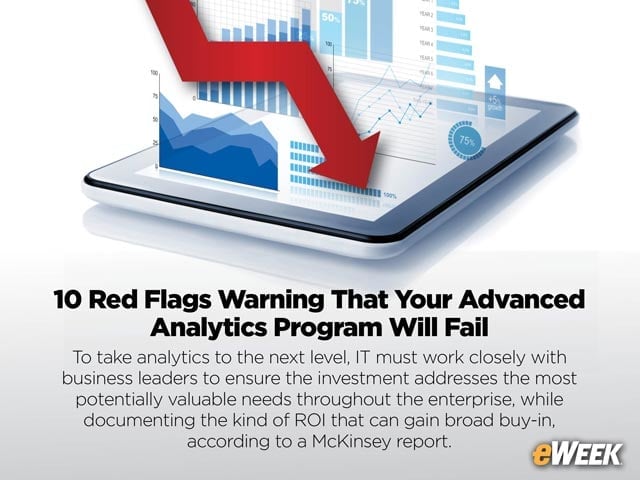
Too often, organizations fail to develop a comprehensive vision to maximize the value of analytics, according to a recent article from McKinsey & Co. The article, titled “Ten Red Flags Signaling Your Analytics Program Will Fail,” focuses on issues related to advanced analytics technology, (such as those applying machine learning). Unfortunately, too many of these initiatives are developed within silos, applying only to standalone use cases/business needs. To correct the problems and gain broader buy-in, IT/data teams must work closely with business leaders to identify the most potentially valuable of analytics efforts and document the resulting return on investment, among other steps. The following slideshow presents an adapted summary of the McKinsey article’s ten red flags.
There’s Confusion About What Advanced Analytics Is
Executives often do not understand the difference between traditional analytics (business intelligence and reporting) and advanced analytics (powerful predictive/prescriptive tools such as machine learning). The solution: Analytics initiative leaders should conduct workshops for executives to coach them on key components of advanced analytics, while addressing misconceptions.
Teams Select the Wrong Initial Use Cases
Companies often slap analytics on use cases like wallpaper—believing that if they apply these solutions to any needs good things will happen. Not necessarily. That’s why it’s best to pick three to five use cases that are most likely to generate the value quickly, then leverage these to generate buy-in for future analytics investments.
No Real Strategy Exists
It’s one thing to deploy analytics to solve a problem or two. But it’s far more valuable to combine “lessons learned” from these experiences with a broader, strategic view to create an analytics ecosystem that impacts multiple functions throughout the enterprise. Constantly ask yourself, “What existing opportunities would enable us to use analytics to improve existing business needs/functions/goals?” and “How can we use data and analytics to create new opportunities?”
Analytics Roles Are Poorly Defined
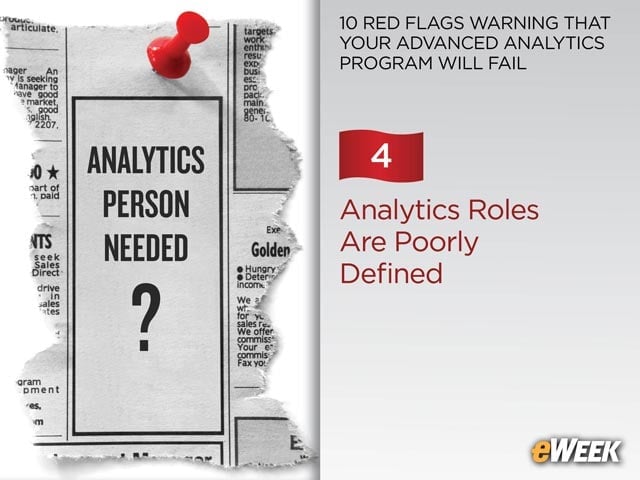
To show support for analytics, organizations will pour money into hiring dozens—or hundreds—of data scientists. Yet, they fail to sufficiently define their roles, so the “data scientists” end up doing tasks that have little to do with analytics. It’s essential to inventory required skill sets and apply them to clearly defined data-related roles and responsibilities, even if certain capabilities and duties overlap.
Companies Isolates Analytics from Business Operations
Struggles abound when analytics capabilities are developed and applied far removed from the business, within pockets of poorly coordinated silos. To make this work, a hybrid model will combine analytics and business talent to develop initial, centralized capabilities, along with guidance on data governance and other standards.
There Are No Analytics “Translators” On Board
As indicated in the last slide, IT can’t do analytics on its own. That’s why companies should designate teams on the business side that “get” both company operations/goals and analytics to determine high-impact use cases, and then “translate” business requirements to the data/analytics team to help build a winning solution. These translators can also generate buy-in with their colleagues.
Costly Data-Cleansing Burdens Emerge
Teams do not have to “scrub clean” all available data before launching analytics initiatives. In fact, as much as 70 percent of data-cleansing efforts are a waste. Instead, focus on the data that supports the most valuable, potential outcomes.
IT Pursues Unnecessary Legacy Integrations
It’s common to believe that you must integrate legacy systems to accommodate digital transformations. But data platforms can exist in parallel with legacies. The new platforms can conduct the transformational analytics while the legacy systems continue to serve more transactional data needs.
No One Really Tracks Quantitative Impact
Data is all about numbers, of course. But you’d be surprised at how many companies spend millions on analytics but never bother to track the investment to document bottom-line impact. Again, business must assess use cases for desired, metric-driven goals and constantly measure results—possibly using available automated systems—to gauge performance.
The Ethical, Social and Regulatory Implications of Analytics are Overlooked
Data frequently involves personal information, which means collecting and analyzing it could violate acceptable ethical, societal and regulatory standards. As part of a proactive risk-management program, analytics/data leaders should work with human resources, legal and business/ethics experts to anticipate these issues, and develop a game plan that enables effective analytics to proceed without lapsing into conflict.