






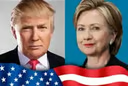


Bernie Sanders was right a year ago at the beginning of the first Democratic Party primary debates when he said, “The American people are sick and tired of hearing about your damned emails.”
He was referring to the first stories after investigators revealed that Democratic candidate Hillary Clinton had maintained a private email server, contrary to security rules. If only he had known how much more sick and tired we’d eventually become, perhaps he’d have phrased it differently.
If that had been the only significant cyber-event of this presidential election, perhaps Clinton’s email scandal would have ranked a place in history. Instead, it’s just one of many ways in which the common and easy access to a global network has forever changed American politics.
If it hadn’t been the Clinton email scandal, perhaps it would have been another related email scandal that hardly gets a second thought now, but which otherwise would have grabbed every headline in sight.
That second email scandal happened when someone—likely Russian state-sponsored hackers, according to the U.S. intelligence community—broke into the Democratic National Committee’s email system and leaked emails. The content and tenor of the emails made it clear the party leadership, which should have been neutral, was working hard to prevent Sanders from winning the nomination.
That led to the resignation of DNC chairman Debbie Wasserman Schultz of Florida during the height of the election campaign.
That second scandal is continuing, with news on election eve that cable news channel CNN had been working with the DNC to develop questions for the debates. Once again, that revelation came through stolen emails revealed on Wikileaks. Similar revelations a few days earlier had led to the firing of Democratic Strategist Donna Brazile from her job as a political analyst at CNN.
But lest you think that the whole election centered on weak cyber-security on the part of the DNC, there’s actually a lot more. The same folks who gave Wikileaks the DNC emails also broke into the email account of Leon Panetta and revealed some unsavory (but not unusual) details about the inner workings of political organizations, as well as the content of previous private speeches to Wall Street investors.
The continuous drip of email leaks over the months before the election had a significant negative impact on the sentiment in favor of Clinton. A look at the real-time sentiment analysis provided by LUX2016 reveals that the negative trend of sentiment continues, even after FBI Director James Comey revealed that the agency will not pursue charges against the former Secretary of State.
But, of course, there is scandal beyond email. While the Republicans didn’t have their email hacked, to some extent they didn’t need to. Instead, their candidate for president, Donald J. Trump, provided a real-time stream-of-consciousness dialogue on Twitter that routinely created its own set of scandals—not to mention apoplexy for other Republicans.
While this was by no means the first use of social media in politics, it was the first time that a candidate’s use of social media kept him in the news almost continuously, from the day he began his quest to seek the nomination until the day before the election.