






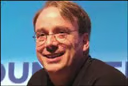

NEW ORLEANS—Linus Torvalds, who created the open-source Linux operating system 22 years ago, took the keynote stage at the LinuxCon conference along with fellow kernel developers to talk about the state of Linux kernel development.
Throughout the hour-long session Sept. 18, the panel was peppered with a barrage of questions on a wide variety of topics, with the outspoken Torvalds providing all manner of colorful comments.
One of the first questions that Torvalds was asked was about how easy or hard it is to actually get involved with Linux kernel development.
“We have an amazing amount of developers, and in some respects it is hard to get involved,” Torvalds said. “In other respects, of all the open-source projects that are out there, it is easier to get involved in Linux because there is so much to do.”
Torvalds pointed to the numbers of people currently involved in Linux. “It can’t be that hard to get involved,” he said.
For Torvalds, hardware innovation is part of the fun in doing kernel development He noted that when he started Linux 22 years ago, the hardware was very different than it is today. He expects that 20 years from now the hardware will change even more.
Hardware Innovation’s Future
Yet Torvalds considered that hardware innovation might at some point slow down. He said he’s interested in seeing how the industry will react when Moore’s Law no longer works. In his view, it’s just a matter of physics with how far silicon innovation can go.
“The reason why Linux runs well on cell phones is because cell phones grew up, and they are thousands of times more powerful than the original machine I used to build Linux,” Torvalds said. “People like to pay lip service to Moore’s Law, but in 10 years it will be really tough.”
Virtualization is a direction that many in the hardware community are taking, but it’s not an area of interest for Torvalds.
“I don’t’ want to have anything to do with virtualization stuff,” Torvalds said. “I want to run on hardware; I’m a real man.”
NSA Backdoor
Torvalds was also asked if he had ever been approached by the U.S. government to insert a backdoor into Linux.
Torvalds responded “no” while nodding his head “yes,” as the audience broke into spontaneous laughter.
On Being a Developer
During the session, Torvalds also explained why he became a developer in the first place. He said that when he started, he didn’t have money to run Unix on his own machine. He also noted that his friends were playing games on their computers that he couldn’t afford, so he had to learn to program.
“Necessity made me try to do something,” Torvalds said.
While Torvalds has a full life outside Linux, it is at the core of his existence, he said.
“I don’t see any project coming along being more interesting to me than Linux,” Torvalds said. “I couldn’t imagine filling the void in my life if I didn’t have Linux.”
Sean Michael Kerner is a senior editor at eWEEK and InternetNews.com. Follow him on Twitter @TechJournalist.