






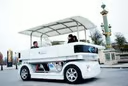

Induct Technology has begun selling the world’s first commercially available self-driving vehicle, Navia.
Imaged as an ideal transportation source for contained environments such as college and corporate campuses, Navia is a mix between a golf cart and a little, white minibus. It’s 100 percent electric, can travel at speeds of just over 12 mph and is able to transport up to eight people.
It also travels using laser-based sensors, so it doesn’t require rails or special infrastructure.
Navia can be instructed to travel a specific route or be activated when summoned by a mobile device—or possibly even from a desktop, says Induct. When a user climbs aboard, he or she can tap his or her destination on a tablet. Navia then closes its metal doors (they bring to mind something one might stand behind at an amusement park, before boarding a ride), and off Navia goes.
“Imagine a city without noisy, polluting buses, replaced by environmentally friendly, robotic shuttle buses that can be summoned by your mobile phone,” Pierre Lefevre, CEO of Induct, said in a Jan. 6 statement. “Navia is completely self-driving, 100 percent electric, emission free, safe and simple to use. It is the ideal solution for taking pedestrians that ‘last mile’ in city centers, industrial sites, theme parks, campuses, complexes and more.”
Navia charges by induction, “using magnetic fields,” and can run 24 hours a day. It requires no cables or human intervention. Induct calls it “completely self sufficient.”
In the kind of use cases Induct imagines, Navia is also a less-expensive alternative, according to Induct. The average cost of running a regular shuttle service with a driver in the United States is reportedly $200,000 a year.
“With Navia, we are able to offer a safe, environmentally friendly solution and reduce the operational costs by 40 to 60 percent,” said Lefevre.
During a trial at the Ecole Polytechnique Federale de Lausanne, a technical college in Switzerland, Navia offered the school a 40 percent cost savings over its regular shuttle service with a driver, a representative from the school said in a statement.
Beta versions of Navia are currently also deployed at Singapore’s Nanyang Technological University; at a high-security campus run by the United Kingdom’s Atomic Energy Authority; and at the campus of Otis Engineering, a British company working in lithium sulfur polymer technology.
A spokesperson for Induct says it’s not currently working on larger vehicles and remains focused solely on a solution that “navigates streets congested with pedestrians easily and safely without the use of a rail or designated path.” However, she added, “that could change in the future.”
Research firm IHS expects worldwide sales of self-driving cars—vehicles that can drive themselves but that a driver can take control of—to grow from nearly 230,000 in 2025 to 11.8 million in 2035. Of those, 4.8 million are expected to be only autonomous control—vehicles that, like Navia, aren’t intended to have a “driver” behind the wheel.
“There are several benefits from self-driving cars to society, drivers and pedestrians,” Egil Juliussen, a principal analyst with IHS Automotive, said in a Jan. 2 study.