







When Panasonic launched its then-new Toughbook line of ruggedized portable computers in 1996, the first model was the CF-25, which was essentially a laptop computer built into a thick, clunky briefcase, with a briefcase-like carrying handle.
Today, 20 years later, Panasonic is marking the anniversary of the Toughbook line, which has grown to include a wide range of rugged models, including Toughpad tablets, a detachable notebook and more.
The company’s Toughbooks became popular largely due to their ability to survive in the toughest of environmental conditions doled out by businesses. Toughbooks are built to stand up in wet or humid conditions in manufacturing plants or outdoor workplaces, while withstanding serious drops and bumps when used by workers in oil and gas exploration, mining, trucking and other industries.
The 20-year anniversary of the Toughbook line is being celebrated by Panasonic with a contest that is seeking entries from Toughbook owners who have been using their machines since the start. The contest’s prize is an all-expenses-paid four-night trip for two to Japan—the birthplace of the Toughbook—where guests will tour the Toughbook factory in Kobe and will also spend a day sightseeing in Kyoto and Tokyo. The trip will be held May 15-19 in 2017.
The winning vintage Toughbook owner will also be able to build and keep a new Toughbook while on the tour. Contestants must enter online starting Oct. 6, fill out a form and submit a photo or video of their vintage Toughbook device, which can include a humorous or creative spin. Entries will be accepted through Dec. 31, 2016.
The path to the Toughbook line actually began in about 1987, when Panasonic began gaining experience in building portable PCs and realizing that there was also a market for tough, ruggedized machines that could be used by workers in the field, according to the company. With that idea in mind, the company built a plant in Kobe, Japan, to build such devices.
“The recognition of Toughbook computers and its dramatic evolution over the past two decades is a testament to our committed ecosystem of sales partners as well as our internal sales and engineering teams who take pride in the job they do and the customers we collectively serve,” Magnus McDermid, senior vice president of Panasonic’s business mobility group for North America, said in a statement. “From our flagship Toughbook 25 computer to the industry’s first fully rugged detachable laptop, to our new handheld devices with voice capabilities, the team at Panasonic continues to lead the market with innovations in form factor, connectivity, reliability and performance, enabling us to deliver customized mobile computing technology based on direct feedback from our customers all over the world.”
The Toughbook product line over the last 20 years has seen a myriad of technology innovations incorporated into the devices to better serve customers. Before the Toughbook line was even officially unveiled in 1996, Panasonic added a CD-ROM drive to its CF-41 notebook in 1994, which it says was the first such drive in a notebook and led to the basis of the future Toughbook models. The CF-41 was also notable for its use of magnesium alloy in its construction, according to the company.
Two years later, the first rugged Toughbook, the CF-25, hit the market with the ability to withstand falls up to 27 inches without damage, while also resisting dust, dirt and humidity.
In 1999, the Toughbook CF-27 debuted with built-in GSM and WAN connectivity to allow mobile workers to communicate from remote locations. The devices also had touch-screens and hard drives that were surrounded by gel and foam blocks to isolate and protect them from serious shocks.
In 2001, the Toughbook CF-07 was born as the company’s first rugged tablet, though it was still called a Toughbook. The CF-07 included a mini PC with a stand-alone wireless display that could communicate together up to about 164 feet away.
The Toughbook CF-U1 arrived in 2008 as a rugged “ultra-mobile” PC, with a full Windows operating system and a host of integrated features such as barcode scanner, fingerprint reader, camera and hot-swap batteries, all aimed at helping mobile field workers do their jobs.
The first Windows-based Toughpad tablet models, starting with the Toughpad FZ-A1, were launched in 2012, adding a line of professional, ruggedized tablets that were built to be durable and resistant to high drops, dust, water spills and high temperatures.
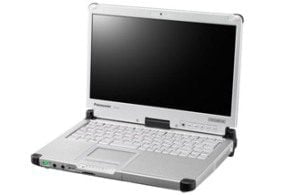
In 2016, the Toughbook CF-20 arrived as a rugged detachable notebook and tablet hybrid machine that can be used in six different modes for various tasks. Also in 2016, the Toughpad FZ-N1 launched as an Android 5.1 handheld with a 4.7-inch display that combines a smartphone with a tablet and barcode reader.
Brian Rowley, vice president of marketing and product management for Panasonic, told eWEEK that the Toughbook brand has continued to evolve over the years to meet the needs of customers in a wide range of businesses.
“We did think this Toughbook line would be around for 20 years,” said Rowley. “Our customers have grown to rely on that reliability” found in the devices. “Our devices are specific to field environments that are where we excel. We take the time to design a device specifically for a customer’s environment. We’re constantly making those modifications based on our customers and the feedback that we get.”