






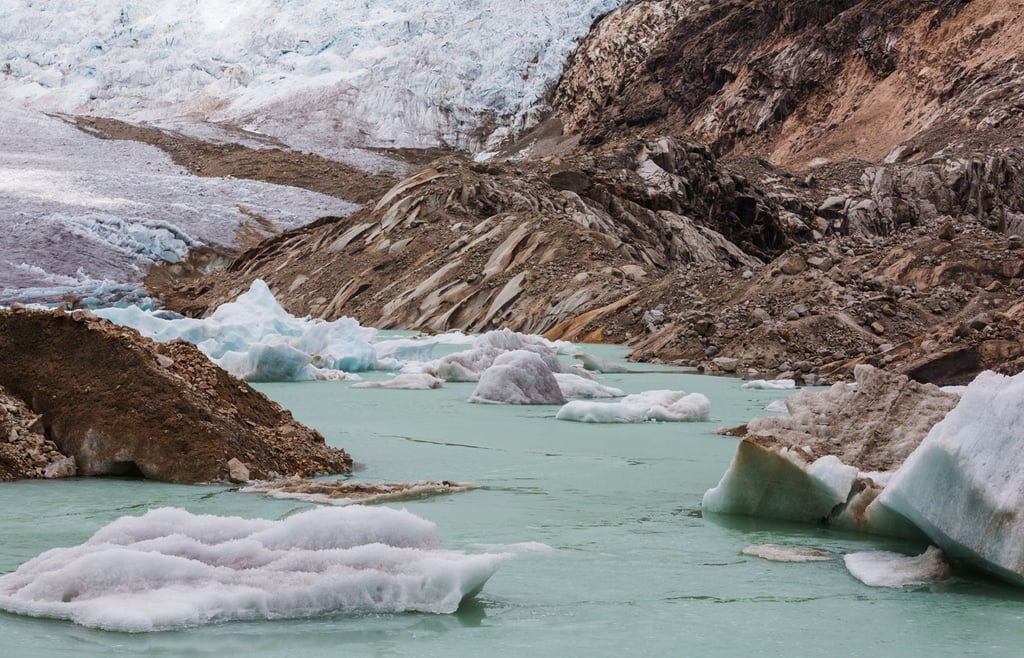


Scientists warn that the Arctic is warming far more quickly than the rest of the world and that this rapid change significantly impacts species, glaciers, and the planet’s climate. In the Norwegian archipelago of Svalbard, scientists have been monitoring the glaciers’ swift retreat, pointing to worrisome changes in the area. With warming up to seven times the global normal, Svalbard is at the forefront of this climate crisis. Since 1979, the Arctic has been warming at a rate that is almost four times faster than the global average. Glaciers encompass more than half of Svalbard.
A recent study reveals that 91 percent of Svalbard’s glaciers are shrinking, with a total area loss exceeding 500 square miles since 1985. The research also shows that over half of these glaciers exhibit noticeable seasonal patterns, fracturing and flowing into nearby seas. Dr. Tian Li, senior research associate in the Glaciology Centre at the University of Bristol, said “The scale of glacier retreats over the past few decades is astonishing.”
Root of the Problem
Experts say that a weather pattern called “blocking” caused these conditions. This pattern stops normal airflow and can lead to very high temperatures in some parts of the Arctic. Iceberg calving—large ice chunks breaking off and plunging into the ocean—is the main process by which these glaciers lose mass when they meet the sea. Researchers typically look at satellite pictures and manually collect the data to map the glacier calving front, which is the line where the ice enters the ocean.
However, this method requires maximum time and effort, isn’t very efficient, and can vary depending on who analyzes the images. Using technologies like artificial intelligence to rapidly identify glacier patterns across wide regions is a novel approach to resolving this issue. From 1985 to 2023, millions of satellite photos of 149 marine-terminating glaciers were analyzed using AI, enabling a hitherto unheard-of large-scale analysis of glacier retreats.
According to the research, 91 percent of Svalbard’s marine-terminating glaciers have been considerably receding. Since 1985, more than 800 km² of glacier mass has been lost, which is more than the area of New York City. This amounts to an annual loss of 24 km², which is over twice the size of London’s Heathrow Airport.
A Global Threat
In addition to melting glaciers, this warming alters patterns of precipitation and snowfall, causing significant changes in the Arctic environment. Rainfall and snowfall have significantly increased in recent years in locations such as Svalbard. Increased harsh weather will cause glaciers to melt more quickly, harming marine life and ecosystems. If cold-water habitats disappear, food chains may be disrupted and animals may have to relocate. Marine life, including fish, depends on stable ice to survive, but as glaciers continue to melt rapidly, their existence is in jeopardy.
As AI is deployed in an increasingly wide range of use cases, more people in the industry are beginning to investigate possible applications of AI for climate change. At the same time, more attention is being paid to finding ways to mitigate the environmental impact of AI and the data centers that power it. Due to its unusually high energy consumption for training and operation, AI also contributes to greenhouse gas emissions, waste, water shortages, and other environmental issues.
Learn more about the opportunities and challenges around AI and climate change.