








The holiday season may well not be a jolly one, if AI has its way.
AI continues to push deeper into the retail sector, raising questions about how many human workers — particularly temporary holiday hires — will still be needed in the years ahead. As retailers face mounting pressure to lower costs and speed up service, new AI-driven systems are beginning to take over tasks once dependent on large seasonal labor pools.
ReverseLogix CEO Gaurav Saran is at the forefront of this shift, and spoke with FOX Business about this matter. His company provides a cloud-based, end-to-end returns-management platform designed to automate one of the most time-consuming parts of retail operations: processing customer returns.
AI promises
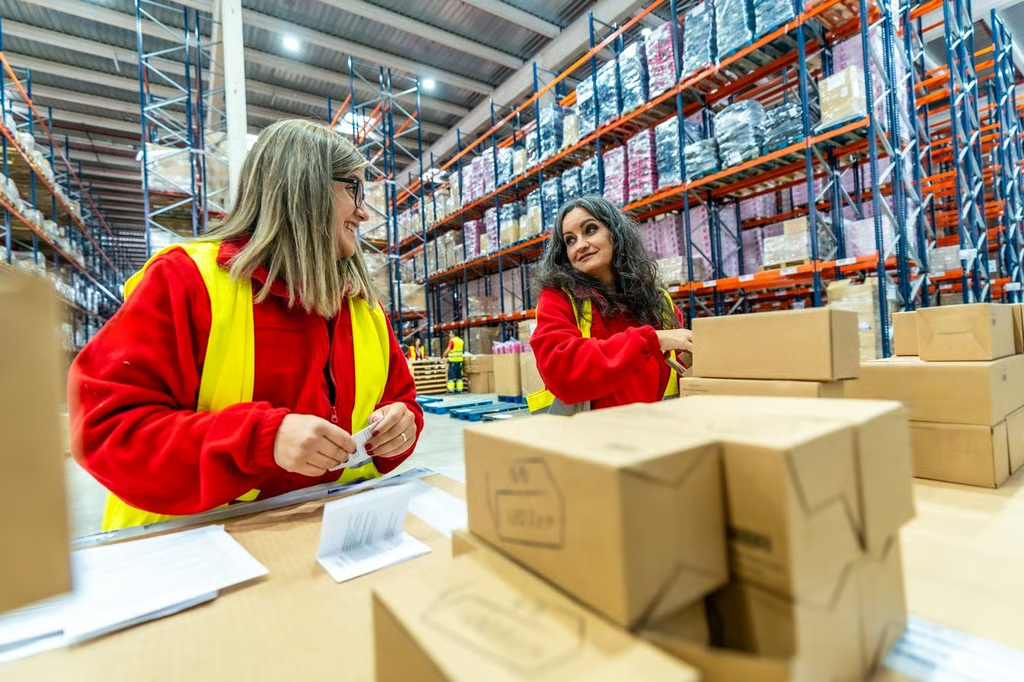
For decades, retailers relied heavily on temporary holiday workers to manage the flood of returns that follows major shopping periods. Workers typically inspected items by hand, filled out paperwork, made judgment calls on whether products were fit for resale, and routed them accordingly. Saran argues this approach is inherently slow, inconsistent, and expensive.
“Most of our customers have seen anywhere from two to three times the improvement in speed and accuracy of the returns process,” Saran said. Based on current adoption trends, he estimates that a “pretty sizable number” of workers — between 20% and 30% — could be replaced as early as next year.
The implications for the retail labor market are significant. Seasonal work has historically offered flexible employment opportunities for students, retirees, and others seeking short-term income. If retailers decide that machines can handle returns faster and more reliably, the number of available seasonal jobs could shrink considerably.
A new model for returns
ReverseLogix, launched in 2014, manages every step of a product’s journey after a customer initiates a return. The system oversees inspection, repair, restocking, or recycling. By centralizing these stages into one digital platform, Saran says companies gain real-time visibility into their reverse logistics while eliminating the inconsistencies of manual processing.
Traditionally, limited oversight across warehouses and channels resulted in high costs and a frustrating customer experience. Retailers also had to hire and train temporary employees to identify product damage, verify order information, and determine resale potential — tasks that required judgment and experience.
“With seasonal workers, there’s a level of training that comes in for them to gain the expertise on how to look at stuff,” Saran noted. “So all of those things add cost and time when compared to an AI-based visual inspection.”
AI models trained on product images and condition data can standardize the evaluation process, he said, reducing human error and improving decision-making. As the algorithms learn, he expects accuracy to surpass traditional manual review.
Advance to automation
Logistics and retail companies are seeking cost-cutting opportunities at a time when wage pressures, supply chain expenses, and shifting consumer expectations challenge profit margins.
Saran says automation gives companies greater predictability during peak retail seasons, eliminating the scramble to hire short-term staff. Faster processing times can also recover more product value by returning items to shelves before demand fades.
This pressure to operate more efficiently mirrors wider patterns in corporate America, where AI adoption has sparked workforce realignments and headline-making layoffs. Firms are increasingly evaluating which roles genuinely require human judgment and which can be offloaded to machines.
AI in customer-facing roles
The shift extends beyond warehouses. AI expert and business strategist Marva Bailer told FOX Business that AI has been altering the holiday workforce “in visible and invisible ways.”
Previously, retailers hired floor associates to answer basic questions, direct shoppers, or locate items. Today, AI tools can handle much of that work. According to Bailer, self-checkout guidance, interactive product search, real-time translation, and digital wayfinding reduce the need for extra staff in busy periods.
Checkout bottlenecks — once a major driver of seasonal hiring — have also eased in many stores through AI-enabled systems such as mobile scan-and-pay and automated item recognition. These technologies help maintain stable lines without requiring additional workers.
Still, Bailer emphasized that AI often supplements rather than eliminates employees. By absorbing routine transactions, she said, the tools let staff “focus on service, exceptions, and the human moments that define the season.”
Human roles are changing
Saran agrees that not all jobs tied to returns will disappear. While he expects a “dramatic” reduction in staffing needs over the next few years, he noted that humans remain essential for more complex or ambiguous cases, as well as for interpreting analytics and configuring systems.
As AI takes over repetitive tasks, remaining roles will likely demand higher-level decision-making skills. This shift could reduce entry-level opportunities but increase demand for more specialized workers who can manage, refine, and oversee automated systems.
The long-term outcome for the retail workforce may hinge on how quickly companies embrace these tools and how effectively workers can adapt. What is clear, however, is that the seasonal job landscape — a familiar fixture of the holiday economy — is already being reshaped by AI.
TikTok and other major social media platforms are hosting a wave of AI-generated deepfake videos in which the images and voices of real doctors are manipulated to promote supplements and spread health misinformation.