






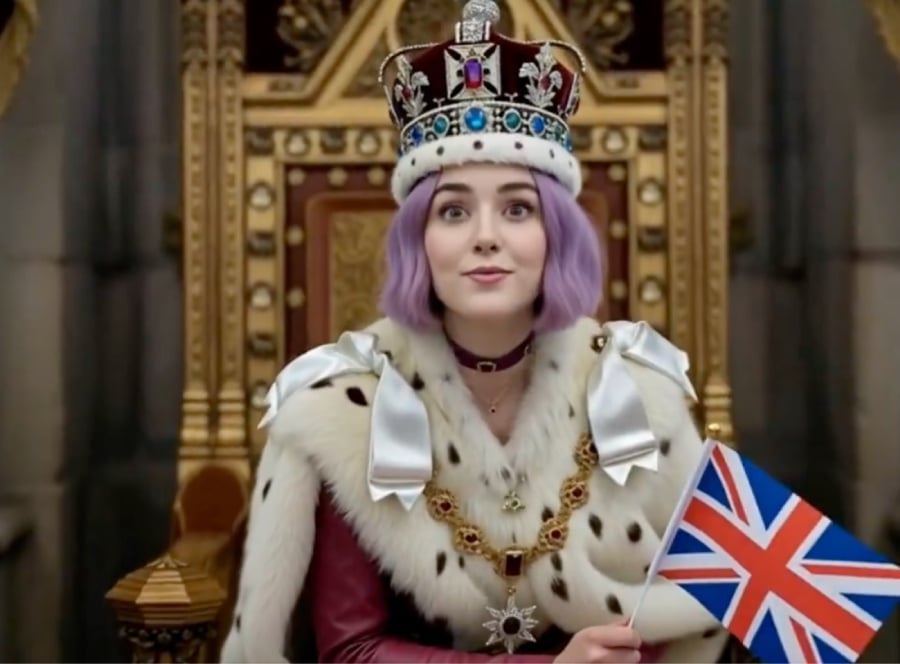


In the strange churn of social media, trends often appear from nowhere. This month, one of the most unlikely stars is Amelia, a purple-haired, AI-generated British schoolgirl who was never meant to exist outside a classroom but is now flooding timelines with extremist memes.
Originally created as part of an anti-extremism project, Amelia has been reshaped online into a nationalist symbol, shared thousands of times a day across platforms like X and Facebook, according to reporting by The Guardian.
Who is Amelia?
Amelia wasn’t born in a trendy marketing studio.
She began life as a fictional antagonist in an educational video game called Pathways: Navigating the Internet and Extremism. Funded by the UK Home Office and developed by the media company Shout Out UK, the game was designed to help teenagers in Yorkshire spot the signs of radicalisation.
In the game, Amelia plays a cautionary figure — a nationalist teen who tries to lure players into joining a group protesting the “erosion in British values.” But in a twist that has stunned experts, the very audience she was meant to warn against has embraced her.
Instead of being seen as a villain, Amelia has become a viral “waifu” (slang for an adored fictional character), popping up in AI-generated memes, manga-style art, and even bizarre crossovers with Father Ted and Harry Potter.
Online users, particularly on X, seized on her image. Using widely available AI tools, they began generating new videos and memes of Amelia. In these, she’s often seen walking around London or the House of Commons, spouting racist and anti-immigrant rhetoric.
“We have seen the meme having a remarkable spread and proliferating among the far right and beyond, but what’s also been of note is how it is now international,” Siddharth Venkataramakrishnan, an analyst at the Institute for Strategic Dialogue (ISD), told The Guardian.
The meme coin twist: ‘Monetisation of hate’
Then it got weirder — and more financial. As Amelia’s online fame exploded, an anonymous cryptocurrency token named after her appeared. Social media users began promoting it, attempting to cash in on her viral trend.
The surge was staggering. Analysis by the UK disinformation firm Peryton Intelligence, shared with The Guardian, showed posts about Amelia on X rocketed from about 500 a day in early January to over 10,000 by late January. Even Elon Musk retweeted a post promoting the Amelia cryptocurrency.
“What we’re seeing is the monetisation of hate,” said Matteo Bergamini, founder and CEO of Shout Out UK, the company that created the original Pathways game. “We’ve seen Telegram groups all messaging each other in Chinese about the meme coin and talking about how to artificially inflate its value, so a lot of money is being made.”
Creators in the crosshairs
For Bergamini and his team, the unintended success of their own character has brought a torrent of abuse. The company has received a flood of hate mail and threats, which have been reported to the police, according to The Guardian. He stresses that the Pathways game was never meant to stand alone.
“There has been a lot of misrepresentation unfortunately,” Bergamini told The Guardian. “The game does not state, for example, that questioning mass migration is inherently wrong.” He said it was designed as a classroom resource to be used alongside other teaching materials, and that feedback from schools remains positive.
Still, he’s alarmed by the sophisticated online machinery that hijacked Amelia. “This experience has shown us why this work is so immensely important, but also gives us pause for thought about our safety,” he said.
A Home Office programme stands firm
Despite the online chaos, the UK government is standing by the broader initiative. The Home Office told The Guardian that its Prevent counter-terrorism programme has diverted nearly 6,000 people from violent ideologies. It added that projects like the Pathways game “were designed to target local radicalisation risks and were created and delivered independently of government.”
Still, the Amelia episode has raised uncomfortable questions about how AI-generated characters can escape their original purpose and be repurposed quickly for influence, profit, and harm.
Also read: Grok AI investigations show how fast synthetic media can spiral when safeguards fail.