






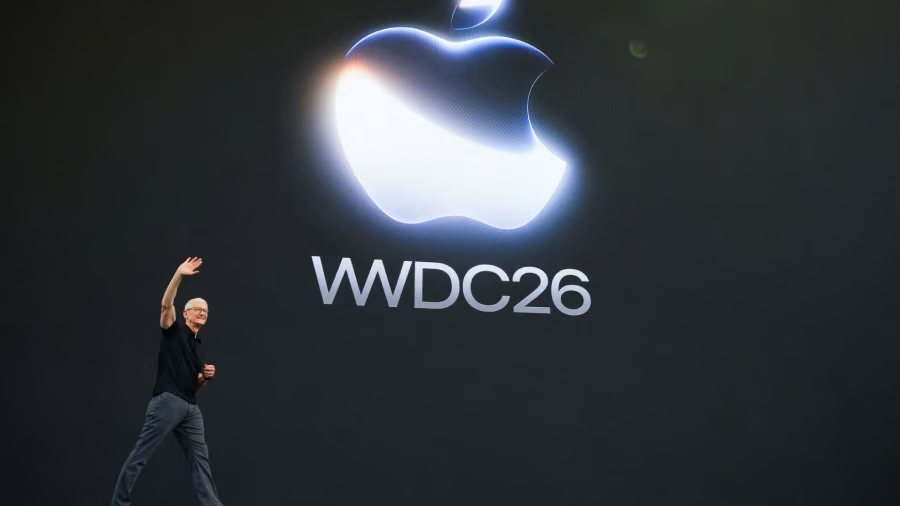


Apple’s long-delayed Siri overhaul has finally arrived.
At WWDC 2026, the company unveiled Siri AI, a completely rebuilt digital assistant powered by the next-generation Apple Intelligence. The announcement comes after repeated delays and growing pressure to catch up with rivals in the artificial intelligence race.
According to Apple, the new Siri AI is designed to move beyond traditional voice commands and become a more conversational assistant capable of understanding personal context, responding to questions with current information from the web, and taking actions across apps and devices.
“We’re excited to introduce Siri AI, a dramatically more capable and conversational assistant designed to help users find information and get things done throughout the day,” said Craig Federighi, Apple’s senior vice president of Software Engineering.
“With access to broad world knowledge for up-to-date answers on virtually any topic, along with onscreen awareness and personal context understanding, Siri AI can help users take action across apps more naturally than ever,” Federighi added.
Built around personal context
A key feature of Siri AI is its ability to understand information stored across a user's Apple ecosystem.
Apple says users can ask Siri to locate restaurant recommendations mentioned in messages, retrieve hotel confirmation numbers buried in old emails, or find photos from recent trips. The assistant can also understand what's displayed on a screen and help users act on that information.
The assistant also gains broader access to app actions, allowing users to draft emails, edit photos, share content, and complete tasks across multiple applications through natural language requests.
A dedicated Siri app arrives
For the first time, Siri will have its own standalone app.
The app stores conversation history and privately syncs chats across Apple devices via iCloud. Users can begin a conversation on one device and continue it on another, bringing Siri closer to chatbot-style experiences popularized by AI platforms such as ChatGPT, Claude, and Gemini.
Apple says Siri AI can answer factual questions using both web information and personal data, while supporting extended conversations and follow-up questions.
Apple is also expanding Siri’s visual capabilities. On iPhone, Siri AI can now analyze what users see through the Camera app using a new Siri mode. The assistant can identify objects, answer questions about visual content, provide nutritional information about meals, and perform actions based on what it sees.
Visual Intelligence is also coming to iPad, Mac, and Apple Vision Pro. Users will be able to ask questions about screenshots, files, images, app windows, and even physical objects in their surroundings. On Vision Pro, Siri can be activated simply by looking at a virtual interface and speaking naturally.
New writing and dictation features
Apple is also positioning Siri AI as a writing assistant. The company says users can generate drafts from scratch, edit existing text through natural language instructions, and receive writing suggestions across apps.
Siri can also adapt its writing style based on how users typically communicate with different people. For example, emails to managers can be drafted differently from messages sent to friends. Alongside writing improvements, Apple says Siri receives a major dictation upgrade, with improved accuracy for punctuation, formatting, capitalization, and speech recognition.
Apple tries to turn the page on AI delays
The Siri launch arrives after a turbulent period for Apple’s AI efforts.
The company first previewed a more advanced Siri in 2024 but later delayed the rollout after development challenges. The setback led to criticism from customers and investors, and Apple recently agreed to pay $250 million to settle a class-action lawsuit alleging it misled consumers about Apple Intelligence features.
During the WWDC keynote, Apple defended its slower approach to AI development.
“Some appear to be racing forward, seemingly pursuing AI for the sake of AI, without clear regard for the people, all of us, that it’s ultimately meant to serve,” Federighi said. “We believe that truly helpful AI must be centered around you and your needs.”
Availability
Apple says Siri AI is available for developer testing starting today across iOS 27, iPadOS 27, macOS 27, and visionOS 27.
A public beta is scheduled for later this year for users with supported devices set to English, with additional language support planned afterward. The feature will not launch in China initially, while iPhone and iPad users in the European Union will have to wait longer as Apple works through regulatory and privacy-related requirements.
Related reading: Apple is also exploring AI-powered health features, including Apple Watch tools designed to help users manage diabetes.