






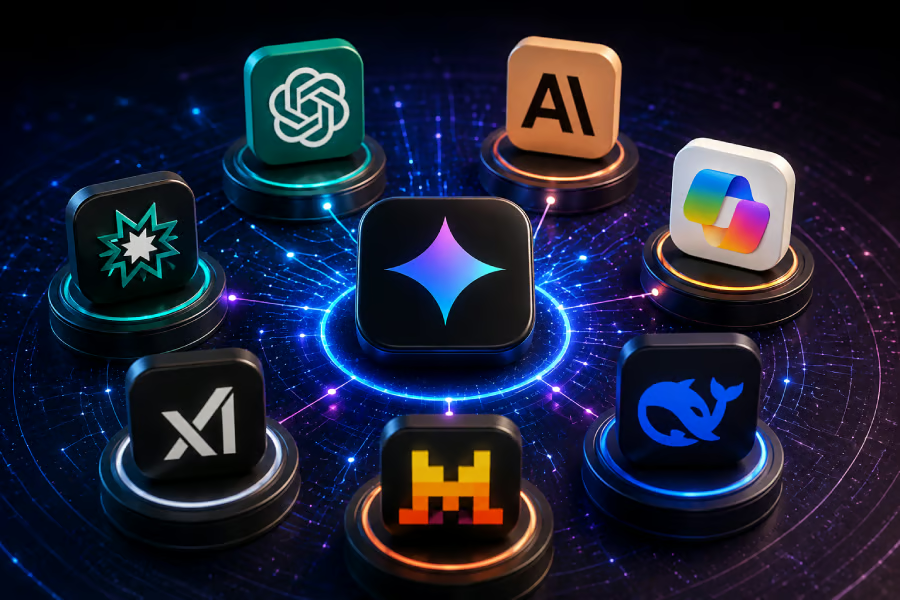


Google Gemini may be everywhere, but a growing crowd of AI rivals is proving there is more than one way to build a smart assistant.
For much of the past two years, Google’s Gemini and OpenAI’s ChatGPT dominated conversations around AI assistants. But in 2026, the market looks far more fragmented, with other platforms carving out niches in privacy, research, coding, and workflow management.
The shift reflects a bigger change happening across the industry. Users are no longer looking for a single chatbot that does everything. Instead, they want tools tailored for specific jobs, whether that is research, writing, automation, coding, or enterprise collaboration.
Here are seven of the biggest Gemini alternatives gaining attention in 2026, and where each one stands out.
- ChatGPT: Best overall Gemini alternative
- Claude: Best for writing, reasoning, and long documents
- Perplexity: Best for research
- Microsoft Copilot: Best for Microsoft 365 users
- DeepSeek: Best free alternative for developers
- Mistral AI: Best for European teams and open-source builders
- Grok: Best for real-time information and X power users
- Which Gemini alternative is best?
ChatGPT: Best overall Gemini alternative
OpenAI’s ChatGPT remains the easiest recommendation for most people because it does almost everything well.
Whether you are writing emails, brainstorming ideas, analyzing data, generating images, summarizing documents, or coding, ChatGPT feels like the most complete all-around AI assistant available today. The platform also continues to expand with voice conversations, memory features, deep research tools, and integrations with dozens of third-party apps.
What makes ChatGPT stand out is its flexibility. It works equally well for students, freelancers, developers, marketers, and business users without forcing you into a single workflow.
Where ChatGPT shines
- Writing and editing
- Coding and debugging
- Multimodal AI tasks
- Voice conversations
- General productivity
Downsides
- Can still hallucinate facts
- Some advanced tools sit behind expensive plans
- Heavy users may hit message caps
Claude: Best for writing, reasoning, and long documents
Anthropic’s Claude is easily one of the strongest alternatives for people who spend their day reading, writing, researching, or working with huge documents.
Claude feels calmer and more thoughtful than many AI tools. Its writing style is cleaner, less robotic, and generally requires less editing afterward. It also handles long context extremely well, making it ideal for reports, legal files, research papers, and massive codebases.
If Gemini sometimes feels too tied to quick web answers, Claude feels more like an AI collaborator that can stay focused through long conversations.
Where Claude shines
- Long-form writing
- Research and analysis
- Large document handling
- Coding assistance
- Natural conversation flow
Downsides
- Slower on complex prompts
- No built-in image generation
- Usage caps can frustrate heavy users
Perplexity: Best for research
Perplexity AI is what happens when AI chat meets modern search. Instead of giving answers without context, Perplexity shows sources directly alongside its responses. That alone makes it one of the most useful AI tools for journalists, researchers, students, and anyone who constantly fact-checks information.
Perplexity is also faster than many traditional search engines for finding concise answers without digging through endless links and ads.
Where Perplexity shines
- Web research
- Fact-checking
- Source-backed answers
- Current events
- Academic work
Downsides
- Weak long-form writing
- Limited workflow tools
- Better as a search assistant than a creative AI
Microsoft Copilot: Best for Microsoft 365 users
Microsoft Copilot makes the most sense for people already living inside Excel, Word, Outlook, Teams, and PowerPoint every day. Copilot’s biggest strength is integration. It can summarize meetings, draft documents from company files, organize inboxes, analyze spreadsheets, and automate routine office work without forcing users to leave Microsoft’s ecosystem.
For businesses deeply invested in Microsoft 365, Copilot often feels more practical than Gemini.
Where Copilot shines
- Microsoft Office workflows
- Meeting summaries
- Spreadsheet analysis
- Enterprise productivity
- Business collaboration
Downsides
- Less useful outside Microsoft apps
- Pricing becomes expensive for teams
- Output can feel generic at times
DeepSeek: Best free alternative for developers
DeepSeek exploded in popularity after developers realized how powerful its reasoning and coding abilities were compared to its price. The platform offers surprisingly strong performance in math, programming, and technical reasoning while remaining either free or dramatically cheaper than many Western AI competitors.
For developers who care more about raw reasoning than flashy interfaces, DeepSeek is becoming one of the most compelling Gemini alternatives around.
Where DeepSeek shines
- Coding
- Technical reasoning
- Mathematics
- Budget-friendly AI use
- Open-weight models
Downsides
- Privacy concerns remain a big discussion point
- Responses can become overly long
- Limited creative tools
Mistral AI: Best for European teams and open-source builders
Mistral AI has built a strong reputation among developers, startups, and European businesses looking for more control over AI systems. Unlike many closed AI platforms, Mistral offers open-weight models, self-hosting options, and strong GDPR-friendly positioning. Its Le Chat assistant is also fast, lightweight, and surprisingly capable for daily use.
If privacy, transparency, or local deployment matters to you, Mistral is one of the best Gemini alternatives available.
Where Mistral shines
- Open-source AI
- GDPR compliance
- Developer flexibility
- API pricing
- Multilingual performance
Downsides
- Smaller ecosystem
- Fewer consumer-friendly tools
- Not as polished as ChatGPT or Claude
Grok: Best for real-time information and X power users
xAI’s Grok leans heavily into real-time information and internet culture. Because of its deep connection to X, Grok often feels more aware of breaking discussions, trending topics, memes, and live conversations than traditional AI assistants.
It is not always the most polished AI tool, but for users who want fast-moving social context and less filtered responses, Grok offers something different from Gemini.
Where Grok shines
- Real-time social trends
- Current events
- Casual conversations
- Humor and personality
- Live internet context
Downsides
- Less reliable for deep analysis
- Tied heavily to X
- Can feel inconsistent on complex tasks
Which Gemini alternative is best?
The answer depends entirely on how you work.
If you want the most balanced all-around AI assistant, ChatGPT is still the safest pick. If writing and deep reasoning matter most, Claude is hard to beat. Perplexity and Grok dominate research. Copilot works best for Microsoft-heavy offices and productivity, while DeepSeek and Mistral AI offer incredible value for developers and technical users.
The bigger takeaway is that AI tools are no longer competing to be one-size-fits-all products. In 2026, the best AI assistant is usually the one designed specifically for the work you actually do.
For readers exploring more practical AI productivity tools, our AI meeting assistants cheat sheet breaks down the top platforms for note-taking, summaries, transcription, and workflow automation.