






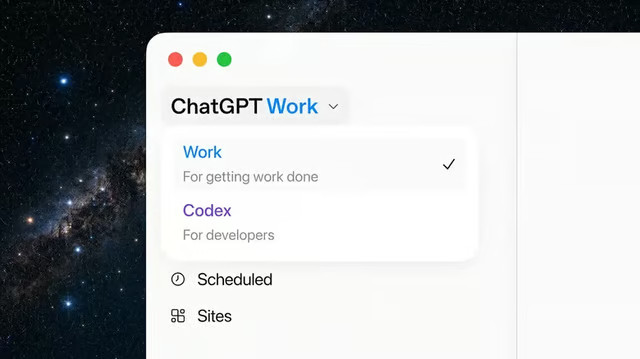


OpenAI introduced ChatGPT Work, an AI agent built on its Codex technology and powered by GPT-5.6. Connected to workplace tools such as Slack, Google Drive, email, calendars, and CRM systems, it can pull the information it needs and turn out finished documents, spreadsheets, presentations, and web apps rather than just answering questions about them.
Users can also assign recurring work to Scheduled Tasks, so it can monitor updates and prepare reports automatically over time.
For Australian enterprises, the timing is notable. The launch coincides with Prime Minister Anthony Albanese announcing the creation of an Office of AI within the Department of the Prime Minister and Cabinet, tasked with coordinating national Australian Standards for AI. The office will work across portfolios, including energy, copyright, employment, education, and national security, and will follow non-binding industry expectations issued in March.
That regulatory shift matters for any Australian business considering agentic tools like ChatGPT Work, which by design require broad access to corporate email, files, and scheduling systems to function.
What the Office of AI means for Australian enterprises using AI
The new office won't directly legislate agent behavior. But it signals that governance, data sovereignty, and accountability for autonomous systems are moving from voluntary guidance to enforceable national standards.
Industry reaction has been broadly supportive but cautious. UiPath Australia's Ian Dempsey noted that coordination on standards is "only half the story," arguing that real-world control of AI agents embedded in business processes needs equal attention as they scale, according to ITBrief.
For CISOs and IT leaders, an agent that can read email, edit shared drives, and execute scheduled tasks without constant supervision raises familiar questions about which data it can access, which actions require human sign-off, and how activity is logged for audit purposes.
OpenAI says enterprise and education administrators can manage permissions and connected tools through existing compliance controls. Still, those controls will increasingly need to align with Australian data residency and privacy obligations under the Privacy Act, as well as guidance from the Australian Cyber Security Center.
A productivity problem AI is being asked to solve
Australia's productivity growth has remained sluggish even as the labor market holds up, and the country's small and medium-sized businesses lag behind larger enterprises in output per hour worked.
Tools like ChatGPT Work are being pitched as a way to offset scarce specialist headcount by automating document production, reporting, and administrative coordination — the kind of work OpenAI says now touches nearly all of its own internal teams.
However, a problem remains unsolved. Deloitte Access Economics estimates wider Small and Medium Business (SMB) AI adoption could add $44 billion annually to the economy, but a third of non-adopters say they simply don't know where to start.
Competing for the enterprise desktop
ChatGPT Work also sharpens a contest already underway in Australian offices. Microsoft 365 Copilot and Google Workspace's Gemini are both embedded in productivity suites that Australian organizations already use day-to-day. Anthropic's Claude Cowork has emerged as a direct competitor, pursuing the same ‘complete the task, not just answer the question’ positioning.
Which of these gains ground in Australia may hinge less on model capability than on integration depth with existing Microsoft or Google environments, and on which vendor can most credibly promise data residency and auditability under the coming national standards.
What this means for Australian teams
Legal, accounting, and consulting firms are an obvious early testing ground for agents capable of drafting and refining materials from templates and reference files. So are remote and hybrid teams coordinating across time zones, where scheduled, recurring AI tasks could reduce handoff friction.
But the same features that promise efficiency gains — persistent access to files, calendars, and communications — are exactly what security and compliance teams will need to scope carefully as the Office of AI's standards take shape.
For now, Australian IT leaders evaluating ChatGPT Work face a familiar calculus, sharpened by new regulatory attention: measure the time saved against the access granted, and get governance settled before the agent, not after.