






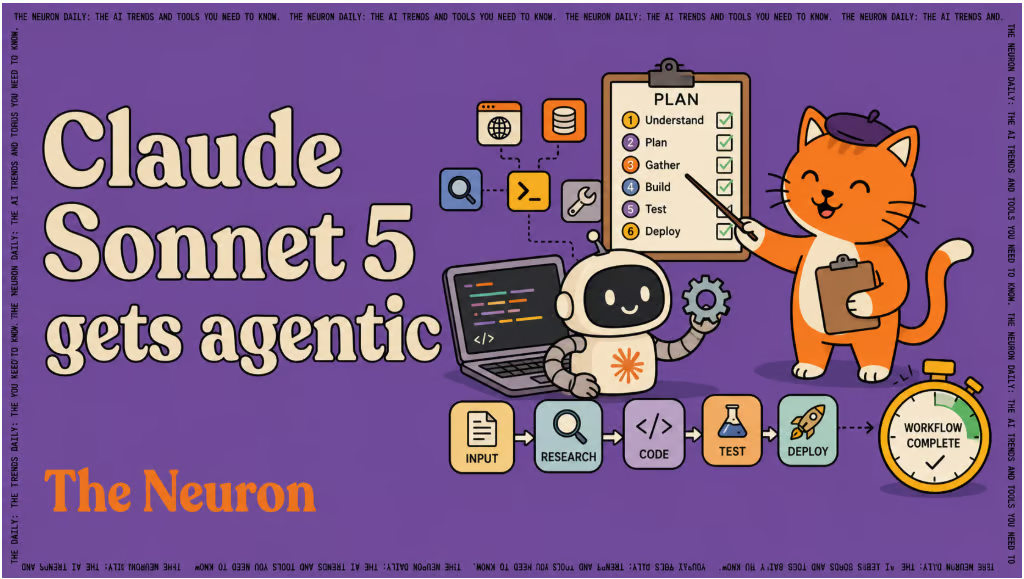


Every AI lab wants you to hand more work to agents. The catch: agents get expensive when they need the giant model, and riskier when that model starts touching browsers, terminals, codebases, and company data.
Anthropic’s answer is Claude Sonnet 5, its new default model for Free and Pro users, built to plan, use tools, code, browse, and run longer tasks without needing the pricier Opus tier.
Here’s what happened
- Sonnet 5 is now available across Claude plans, Claude Code, and the API.
- Anthropic says it performs close to Opus 4.8 on agentic work, at lower prices.
- Intro API pricing is $ 2/million input tokens and $10/million output tokens through Aug. 31, then $ 3/million input tokens and $15/million output tokens.
- Early testers praised its follow-through: bug fixes, pull requests, Salesforce updates, insurance workflows, legal research, and data exploration.
- Anthropic says it has lower rates of hallucination and sycophancy than Sonnet 4.6, with cyber safeguards on by default.
How to try it
- Open Claude; Free and Pro users should see Sonnet 5 as the default.
- In Claude Code, select Sonnet 5 for coding workflows.
- For developers, call claude-sonnet-5 through the Claude API.
Why this matters
Sonnet is the model most Claude normies actually touch. Opus is the fancy chef’s knife, while Sonnet is the one that lives in the drawer and actually gets used for Tuesday dinner.
The “this is huge” camp is posting real task wins. One non-coder said Sonnet 5 helped him build five web apps in 10 minutes. Another user praised its agentic follow-through after it investigated a bug, wrote a reproduction test, fixed the issue, and verified the result without extra hand-holding. GitHub’s early Copilot tests also showed positive results, especially for CLI-style coding tasks.
The skeptical camp is staring at the bill. Theo and others flagged that Sonnet 5 can cost more than Opus 4.8 on some benchmarks when you account for actual token usage, even if the sticker price is lower. Rohan Paul highlighted the same effective-cost problem. David Shapiro complained it goes off-task and lectures too much.
Our take
Sonnet 5 is Anthropic trying to make agents boring in a useful way: cheaper, safer, and default. But Fable 5’s return makes the timing awkward. Power users are already asking whether Sonnet 5 is the practical daily driver or just the model you use while waiting for the restricted frontier model to come back.
Editor’s note: This article originally appeared on our sister publication, The Neuron.