






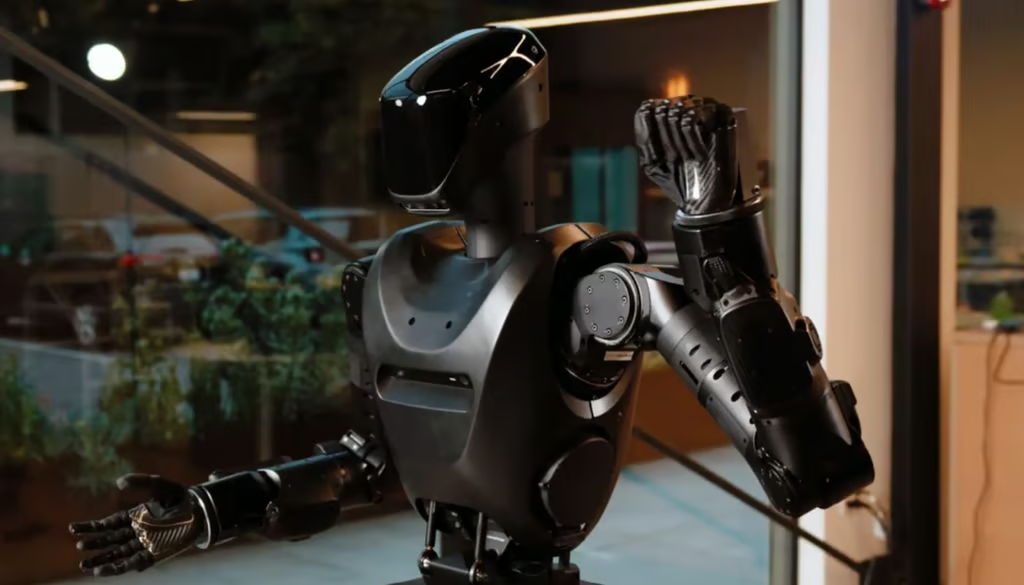


A San Francisco startup with ties to the Trump family is betting that the future of humanoid machines lies not in homes or restaurants, but in factories, military bases, and potentially even combat zones.
Foundation Future Industries, a robotics company founded in 2024, is developing autonomous humanoid robots designed for industrial work and defense applications. The company believes robots should take on some of the most dangerous tasks currently performed by humans.
“I’m convinced the technology is reaching a level where it can replace jobs that are dangerous for humans to perform, and if you can do that, it’s the highest net good you can create out of all applications of robotics,” Foundation CEO Sankaet Pathak told CNBC.
The company's vision stands apart from many rivals in the fast-growing humanoid robotics industry, where firms are focused on creating machines capable of household chores and customer service tasks. Instead, Foundation is targeting hazardous environments, including military operations.
Ukraine serves as an early testing ground
Earlier this year, Foundation sent two of its Phantom MK-1 humanoid robots to Ukraine for pilot demonstrations. According to the company, the deployment marked the first known use of humanoid robots in an active combat theater.
The tests, conducted with Ukrainian officials and supported by the US government, focused on logistics missions in dangerous areas. The robots were evaluated for tasks such as retrieving and transporting supplies, work that can expose soldiers to enemy fire.
Ukraine has become a major proving ground for emerging military technologies during its ongoing war with Russia. The conflict has already seen widespread use of drones, autonomous systems, and robotic platforms for reconnaissance, logistics, and battlefield operations.
Pathak told CNBC that the demonstrations in Ukraine showed that robots could successfully handle supply pickup missions in hazardous conditions.
Current limitations remain
Despite the ambitious goals, Foundation's current robots remain far from battlefield-ready. The Phantom MK-1 can carry only about 44 pounds, lacks waterproofing, and does not yet have the battery life needed for extended deployments.
To address those shortcomings, Foundation plans to introduce an upgraded Phantom 2 model later this year. Pathak said the next-generation robot will feature “superhuman abilities” and carry twice the payload of the existing system.
The company is also aiming to dramatically increase production, with plans to manufacture thousands of units this year.
Pentagon contracts and Washington connections
Foundation has already secured $24 million in government research contracts involving the US Army, Navy, and Air Force. The contracts are focused on evaluating potential uses for humanoid robots in areas such as logistics, inspection, and weapons handling.
According to Pathak, discussions with government officials have evolved beyond basic research and are increasingly focused on how the technology could be deployed at scale.
The company hopes to begin testing its robots with the US military within the next 12 to 18 months.
Foundation has also drawn attention because of its ties to Eric Trump, the son of President Donald Trump. Eric Trump recently joined the company as chief strategy adviser after previously investing in the startup.
That relationship has sparked criticism from Democratic Senator Elizabeth Warren, who described the company's government contracts as “corruption in plain sight,” according to CNBC.
A Foundation spokesperson told CNBC that Eric Trump had been an investor before becoming an adviser and shared the company's goal of strengthening US manufacturing.
Also read: Taiwan is testing armed robot dogs for remote island patrols as military robotics moves deeper into real-world security operations.