






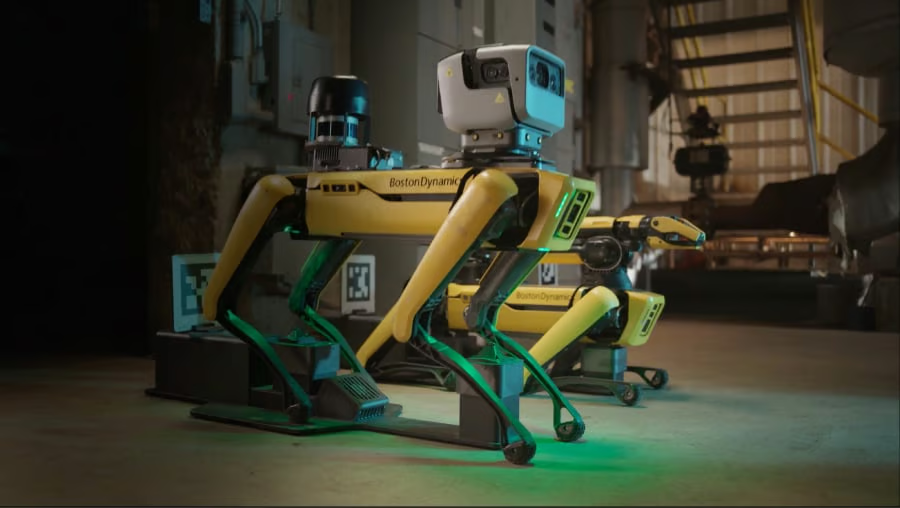


Google DeepMind and Boston Dynamics have teamed up to give Spot, the famous quadruped yellow robot dog, a new level of intelligence.
By integrating the new Gemini Robotics-ER 1.6 model into Spot, the companies are moving past pre-programmed scripts and toward “embodied reasoning,” essentially giving the robot the ability to look at a messy room or a complex factory floor and autonomously figure out what to do next.
According to Google DeepMind, this new model is a “reasoning-first” system. It allows robots to navigate facilities and interpret physical data, such as reading a needle on a pressure gauge, thereby bridging digital AI and physical action.
One of the most impressive additions is the agentic vision. Instead of just seeing a flat image, Spot can now zoom in on small details, use code to estimate measurements, and apply world knowledge to understand what it’s looking at. This is particularly useful for industrial inspections where Spot needs to monitor analog gauges or check if a chemical sight glass is full.
“Capabilities like instrument reading and more reliable task reasoning will enable Spot to see, understand, and react to real-world challenges completely autonomously,” said Marco da Silva, VP and GM of Spot at Boston Dynamics.
The system also introduces “Transparent Reasoning.” For the first time, users can look “under the hood” to see exactly why the robot made a specific decision, making the AI feel a little less like a black box.
While the primary focus remains on heavy industry, detecting gas leaks, counting pallets, and spotting puddles, a recent demonstration showed Spot performing much more “human” tasks. The robot was seen reading a handwritten to-do list, organizing shoes, and even taking a real dog for a walk using a leash.
Safety and the touch gap
Google has also integrated a safety benchmark called ASIMOV to ensure the robot doesn’t make dangerous mistakes, like placing a glass of water too close to the edge of a table.
One major hurdle remains: touch. Most AI models are trained on internet data, which is full of pictures and text but contains very little information on how things actually feel. Because of this, Spot currently relies almost entirely on its cameras to decide how to interact with objects.
Availability
Gemini Robotics-ER 1.6 is now available to developers via the Gemini API and Google AI Studio. Google DeepMind has also shared a developer Colab with examples of how to configure the model and prompt it for embodied reasoning tasks.
For Boston Dynamics customers, the transition to the Gemini-powered AIVI-Learning model is officially live for all enrolled customers as of April 8, 2026.
Also read: More than 100 machines will test their balance, endurance, and autonomy at Beijing’s upcoming humanoid robot half-marathon.