






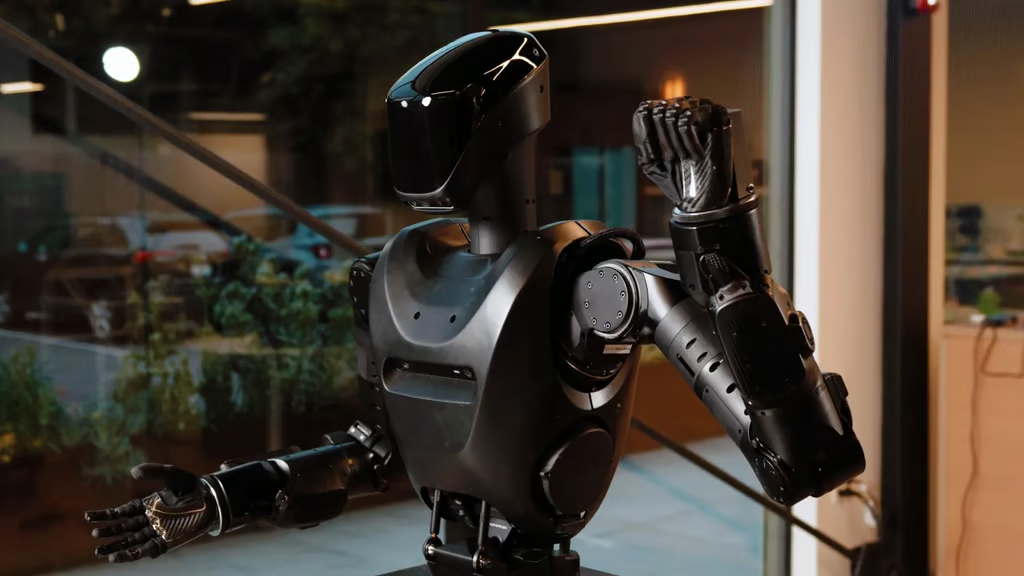


A young robotics company says it is in active discussions with officials tied to President Donald Trump about expanding the role of its humanoid machines within the US military, potentially including arming them in the future.
Foundation, a two-year-old robotics startup headquartered in San Francisco, has already secured at least $18 million in military contracts with the Army, Air Force, and Navy, according to federal contracting data reviewed by NBC Bay Area.
While existing deals focus on research, logistics, and equipment manufacturing, the company’s leadership says it’s now in active discussions with Trump administration officials about taking things a significant step further: putting weapons in the hands of its humanoid robots.
“There are a lot of people that are excited about being able to get these [robots] on the battlefield because they understand there is a big threat out there that we need to confront,” Mike LeBlanc, Foundation’s co-founder and a Marine Corps veteran, told NBC Bay Area.
LeBlanc didn’t mince words when describing his company’s creation. He called the robots “great weapons” and compared the technology to a modern-day shotgun. “In the hands of a criminal, it’s terrifying,” he said. “In the hands of a sheriff, it could be a godsend.”
Their flagship humanoid robot, named “Phantom,” is already being tested for non-combat roles. The company plans to deploy two robots to Ukraine by the end of the month to support “military reconnaissance” efforts in the ongoing war with Russia. The robots deployed there will not carry weapons, according to the report.
The China factor
Foundation’s push comes as Chinese robotics firms are making dramatic public displays of their own machines. At this year’s CCTV Spring Festival Gala, humanoid robots from four Chinese startups performed martial arts routines, executed flips, and even demonstrated weapon skills during the Lunar New Year broadcast, which was watched by hundreds of millions.
Unitree Robotics, one of the companies featured, aims to ship up to 20,000 humanoid robots this year, according to its CEO. Data from research firm Omdia shows China accounted for roughly 90% of the 13,000 humanoid robots shipped globally last year.
LeBlanc, who served eight years on active duty, argued that refusing to embrace the technology would leave America vulnerable.
“With so many of our competitors signing off of this and not being interested in doing it, it’s really given us a clear path to deliver,” LeBlanc said. “I promise you there’s no moral debate going on in China about whether they’re going to use robots in combat.”
The ethics question
Not everyone is convinced that arming robots is the right path forward.
David DeCosse, a professor at Santa Clara University who has studied the ethics of war, warned that delegating life-and-death decisions to machines creates dangerous ambiguity about accountability.
“If it’s a robot, even a programmed robot, I think that responsibility gets diminished in a problematic way,” DeCosse told NBC Bay Area. He pushed back against the argument that America must pursue the technology because other countries are.
“We have gotten as far as we have in this country by being smart about our defense and also being moral about it,” DeCosse said. “A race to the bottom with these things is not a race that I think as Americans we want to pursue.”
According to NBC Bay Area, in 2022, six major robotics firms led by Boston Dynamics signed an open letter pledging not to weaponize their machines, warning it would create “new risks of harm and serious ethical issues.”
Also read: Japan’s robot monk debut shows how quickly AI is moving from screens into real-world roles.