






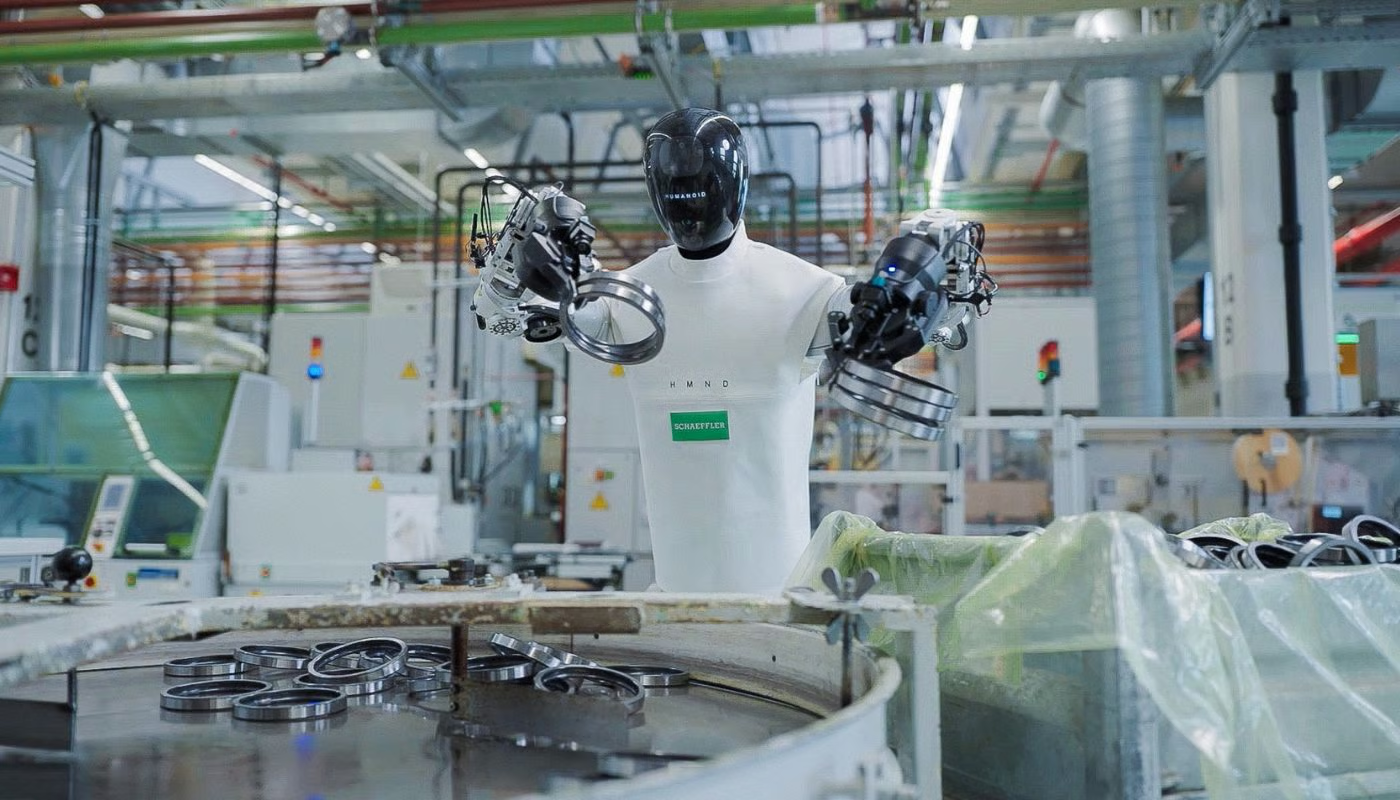


Humanoid robots are moving from polished demos to the factory floor.
London-based robotics startup Humanoid has signed a binding phased deployment agreement with German industrial giant Schaeffler to roll out more than 1,000 humanoid robots across its global manufacturing operations.
The first units are expected to begin work in live production environments in Germany before the end of 2026, marking a major step from pilot testing to real industrial deployment. The deal covers a staged rollout across Schaeffler sites, starting with two factories in Germany and expanding gradually toward global integration by 2032.
The partnership builds on earlier proof-of-concept work between both companies, which now moves into full industrial validation. According to the agreement, the first deployment phase will run from December 2026 to June 2027. At Schaeffler’s Herzogenaurach site, the robots will be tested on box-handling tasks inside active production lines.
Meanwhile, the Schweinfurt facility will begin with a structured testing phase, followed by on-site validation to achieve stable, near-full-scale operations.
The rollout is designed to demonstrate whether humanoid systems can reliably operate in real-world manufacturing settings rather than in controlled lab environments. Reuters reports that the initial deployment will involve “an estimated 1,000 to 2,000 robots across Schaeffler’s global manufacturing sites by 2032.”
Robot-as-a-Service and factory integration
The agreement is structured under a Robot-as-a-Service (RaaS) model, meaning Schaeffler will receive not only hardware but also software, maintenance, fleet management tools, updates, and 24/7 technical support from Humanoid.
The company will also help integrate the robots directly into existing factory systems, aligning with safety standards, IT infrastructure, and production workflows. This approach is designed to reduce friction for large-scale industrial adoption, where robotics must plug into complex, already-running production lines.
“Together with Schaeffler, one of our key industrial partners, we are taking an important step toward making humanoid robotics part of global manufacturing operations,” said Artem Sokolov, Founder and CEO of Humanoid. “We have already seen strong results from our proof of concept together, and now we are taking the next step to staged deployment. Moving into real-world operations is where the true value of humanoid robots is proven.”
A supply deal that changes the scale conversation
Alongside deployment, the companies signed a five-year actuator supply agreement that may be even more significant than the robot rollout itself.
Schaeffler will become Humanoid’s preferred supplier for more than half of its joint actuator needs for wheeled humanoid platforms through 2031. The agreement is expected to result in the supply of a seven-figure number of actuators.
Forbes highlights that this figure, at least one million actuators, could imply something much larger when translated into robot production volumes. Based on actuator requirements per robot, analysts cited in the report suggest the supply agreement could support up to 100,000 humanoid robots over the coming years. That projection places the deal among the most aggressive scaling signals yet seen in the humanoid robotics sector.
What happens next?
After the initial 2026–2027 phase, both companies plan to expand deployment across additional factory processes, including more complex tasks such as assembly and packaging. The full agreement runs through 2032, giving Humanoid several years to improve reliability, autonomy, and cost efficiency before reaching the full contracted deployment scale.
Also read: Rivian founder RJ Scaringe has launched Mind Robotics, a new AI robotics startup backed by a $115 million seed round.