








French AI company Mistral’s new Optical Character Recognition (OCR) API is blazing fast, hyperaccurate, and multimodal, meaning it can accurately recognize and process text, images, tables, equations, handwritten notes, and other document elements. This could have a huge impact on how companies convert printed documents into a format that’s AI-friendly, as most AI models work best with clean, structured text.
If its claimed rate of 2,000 pages per minute on a single node is accurate, it also outperforms major competitors including Google, Microsoft, and OpenAI, creating huge efficiencies for businesses dealing with large volumes of documents. Here’s what you need to know about Mistral OCR.
What makes Mistral OCR different?
While traditional OCR tools focus primarily on text extraction, Mistral OCR is multimodal. It can accurately recognize and process a wide range of elements in addition to text and format them neatly rather than a disorganized text block, making it easier for AI-powered applications. In addition to a claimed speed of up to 2,000 pages per minute on a single node, it also supports multiple languages, allowing businesses to digitize documents in different scripts and fonts.
By comparison, Google Document AI handles up to 1,800 pages per minute, Microsoft Azure OCR processes around 600 pages per minute, and OpenAI lacks a dedicated OCR benchmark. These differences highlight Mistral’s advantage in high-volume document digitization.
Mistral claims its OCR model outperforms major competitors such as Google Document AI, Azure OCR, and OpenAI’s GPT-4o in other benchmark tests. It achieves top scores in mathematical recognition, scanned documents, and multilingual text processing, boasting a 94.89% accuracy rate, thus setting a new gold standard for OCR technology. Its capability to handle complex elements like LaTeX formatting and interleaved images gives it a distinct advantage over competitors.
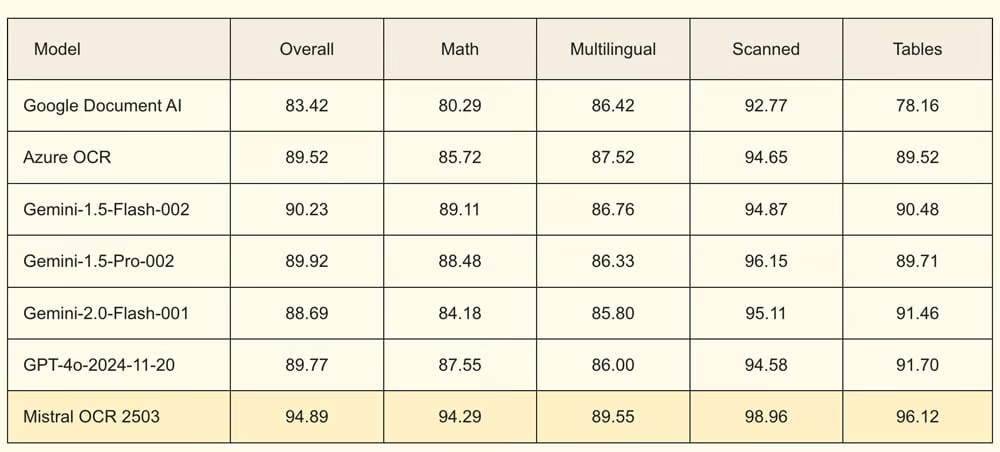
Mistral top-tier benchmarks test. Image: Mistral
Mistral OCR and AI: Why it matters
Many companies struggle to make their vast document libraries AI-friendly. Mistral OCR solves this problem by converting unstructured PDFs and images into AI-ready formats like Markdown or JSON, which are commonly used in AI training and automation.
This makes it particularly useful for Retrieval-Augmented Generation (RAG) systems, which combine AI-generated content with existing documents for better responses. Law firms, research institutions, and customer service departments could benefit from this by quickly searching and analyzing complex records.
Designed for businesses, researchers, and more
Mistral OCR is currently used in its AI assistant, Le Chat, assisting users in processing PDFs with improved accuracy. Its applications also extend across various industries, including:
- Scientific research: Converts complex research papers into AI-friendly formats.
- Legal and compliance: Efficiently processes and organizes legal documents, contracts, and compliance reports.
- Historical preservation: Digitizes and indexes historical texts and artifacts for better accessibility.
- Customer service: Automates knowledge extraction from manuals and FAQs, improving customer support response times.
Availability and pricing
Mistral OCR is now available on La Plateforme, Mistral’s developer suite, and will soon be accessible through cloud providers like AWS, Azure, and Google Cloud. It is priced at 1,000 pages per dollar, with an option for batch processing that doubles efficiency. Organizations with strict security needs can also choose an on-premises deployment to keep sensitive documents within their infrastructure.