






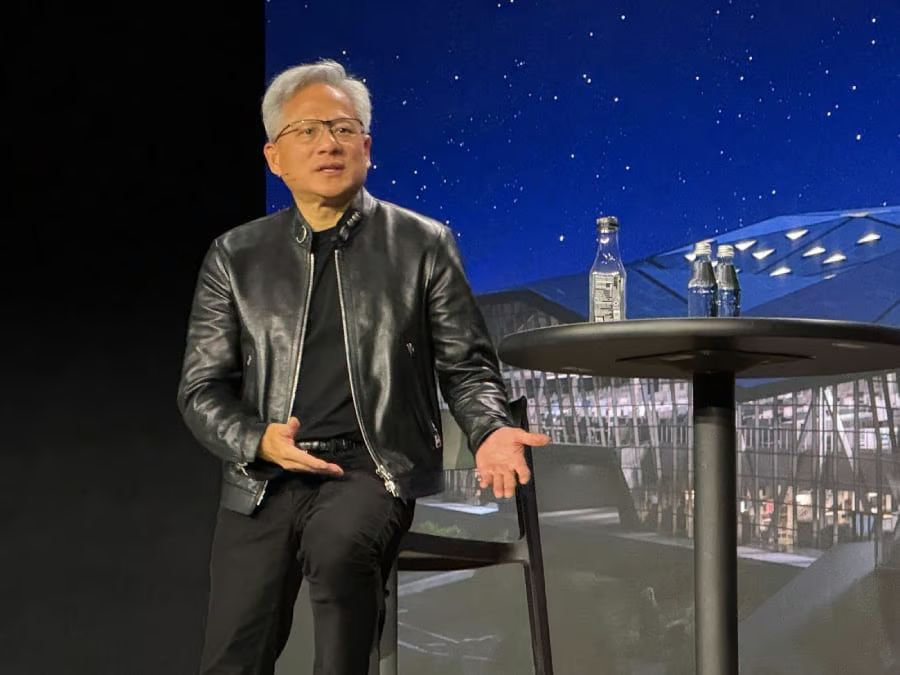


Jensen Huang picked an odd way to make his X debut.
On Friday, more than 25 companies, investors and open-source institutions signed "Open Weights and American AI Leadership," a letter urging US policymakers not to clamp down on open-weight AI models, the kind anyone can download, inspect, modify and run on their own hardware.
Signatories include Nvidia, Microsoft, Meta, Dell Technologies, IBM, Palantir, Cisco, Palo Alto Networks, Andreessen Horowitz, Y Combinator, Hugging Face, Mozilla and the Linux Foundation, among others.
The letter compares the moment to the rise of open-source software in the 1980s, arguing that America's AI edge will be defined by how widely the technology spreads rather than by any single top-performing model. Restricting open models, the group warns, would concentrate power in a handful of providers and could push businesses toward cheaper Chinese alternatives instead.
Huang used his very first post on X to promote it. "AI will transform every industry, power every company, and be built by every country," he wrote. "Open models strengthen safety and cybersecurity, accelerate innovation and diffusion, and enable sovereignty."
Microsoft CEO Satya Nadella and Dell CEO Michael Dell both echoed the message on social media the same day.
OpenAI CEO Sam Altman, whose company did not initially sign, posted that he was "glad to see" the support, adding, "I want the US to win in AI both in open source and proprietary models." OpenAI added its name to the list Friday evening, Business Insider reported. Elon Musk, whose SpaceX did not sign, quote-posted Huang's message: "This has my full support. Jensen is right."
Industry pushes back on possible restrictions
The letter comes as the Trump administration considers whether to limit or ban some Chinese open-weight AI models following concerns over Moonshot AI's Kimi K3 model and allegations that it was trained using outputs from Anthropic's Fable 5 through model distillation.
Rather than restricting open-weight models, the signatories argue the United States should build a broader AI ecosystem.
"Our AI leadership will be judged not by one frontier AI model, but by whether the United States builds a strong, open ecosystem that diffuses into every sector," the letter states.
The group says downloadable models allow startups, universities, businesses, and public institutions to build AI applications without paying the cost of training frontier models from scratch, while also encouraging competition across chips, cloud platforms, software, and services.
Safety debate shifts to openness
The companies also challenge the idea that closed AI models are automatically safer.
The letter argues that concentrating advanced AI capabilities in a handful of proprietary systems creates "single points of failure" and says open-weight models give researchers and developers greater ability to identify vulnerabilities, strengthen defenses, and improve transparency. At the same time, the coalition acknowledges risks tied to model distillation and intellectual property theft.
"Unlawful efforts to extract value from closed models raise legitimate concerns," the letter says. "Those concerns should be addressed through targeted legal and commercial frameworks rather than sweeping restrictions on techniques that play an important role in AI innovation."
That position comes after White House Office of Science and Technology Policy Director Michael Kratsios accused Moonshot AI of using Anthropic's model to build Kimi K3, while Treasury Secretary Scott Bessent said companies engaging in improper distillation could face sanctions.
What it means for the AI race
The letter highlights a growing divide within the AI industry over how governments should regulate advanced models.
Companies with significant investments in open-weight AI, including Meta, Mistral, Hugging Face, Nvidia, and Microsoft, argue that limiting access could slow innovation, reduce competition, and push developers toward overseas alternatives. Meanwhile, policymakers remain focused on national security and protecting intellectual property as Chinese AI capabilities continue to advance.
The fact that OpenAI and Google ultimately added their names to the letter broadens industry support for open-weight AI, although Anthropic remains absent.
The coalition's message reflects a broader struggle over who shapes the future of AI. Open-weight models can expand access, lower costs, and speed innovation, but they also make it harder to control how advanced systems are modified and distributed. Policymakers now face the challenge of balancing openness with security, especially as competition between the US and China intensifies.
Also read: Intel and AMD are pursuing long-term China CPU deals as some server processor prices have risen more than 40% this year amid AI-driven demand.