






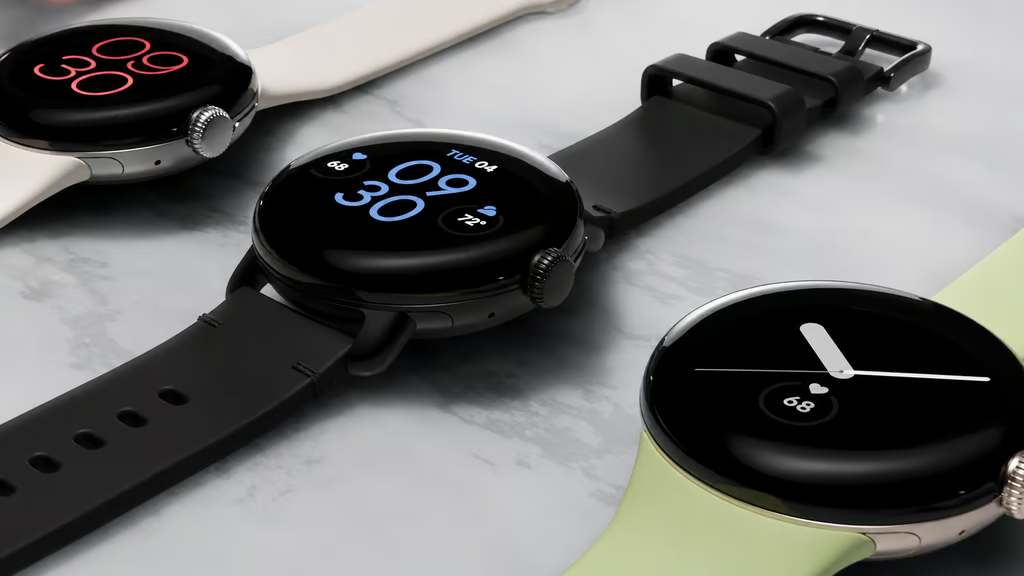


Google's Wear OS 7 is moving Google’s smartwatch platform forward without the device that started it. The company’s update notice identifies the Pixel Watch 2, Pixel Watch 3, and Pixel Watch 4 as eligible devices, leaving the 2022 model on an older operating system.
The omission follows Google’s published support schedule. Updates for the original Pixel Watch were guaranteed through at least October 2025, and the watch also missed the Wear OS 6 release that month. Organizations that allow personally owned wearables to display work messages, account alerts, or authentication prompts should account for those support limits in device policies.
Google’s support cutoff leaves the first watch behind
Google’s June 2026 Pixel Watch update lists only the second-, third-, and fourth-generation models under device applicability. Google does not explicitly say the original watch will never receive Wear OS 7, but it provides no announced upgrade path for the device.
The same cutoff appeared in Google’s Wear OS 6 rollout, which covered only the Pixel Watch 2 and Pixel Watch 3.
Google guarantees Pixel Watch updates for at least three years after each model first becomes available through its US store. Its support schedule lists October 2025 for the original model, October 2026 for the Pixel Watch 2, October 2027 for the Pixel Watch 3, and October 2028 for the Pixel Watch 4.
The cutoff resembles other lifecycle boundaries across Google’s hardware, including the Pixel 6’s approaching platform limit while newer phones remain eligible for later platform upgrades.
Those dates end guaranteed coverage but do not prevent Google from issuing isolated fixes. A March 2026 modem update improved E911 emergency-dialing behavior without adding a new Wear OS version or extending the published support schedule.
Wear OS features move to newer hardware
Because the original Pixel Watch is not included in the Wear OS 7 rollout, it has no announced path to the OS-level features delivered through the release. These include Live Updates for sports scores, deliveries, and workouts, along with expanded connected-device controls and system-level power optimizations.
Google says average users moving from Wear OS 6 to Wear OS 7 may see up to a 10% battery-life improvement. That comparison does not directly apply to the original Pixel Watch because it never received Wear OS 6.
Later in 2026, select Wear OS 7 devices are scheduled to receive Gemini Intelligence as part of Google’s expansion of proactive AI across Android. Planned watch features include natural-language widget creation, multistep app automation, Personal Intelligence, and a redesigned interface. Google has not named every eligible device, so Wear OS 7 alone will not necessarily guarantee access to every AI capability.
The first Pixel Watch can continue running existing functions and compatible apps, but future app support will depend on individual developers. App updates cannot add operating-system capabilities or renew Google’s guarantee of routine system and security updates.
Google is also broadening its wearable lineup with products such as the screenless Fitbit Air. Buyers and IT teams should compare each device’s published support deadline—not just its current functionality — when assessing long-term value and setting refresh cycles.
Read more: Apple is drawing similar hardware and regional eligibility lines as Siri AI reaches supported Apple Watch models with significant deployment limitations.