






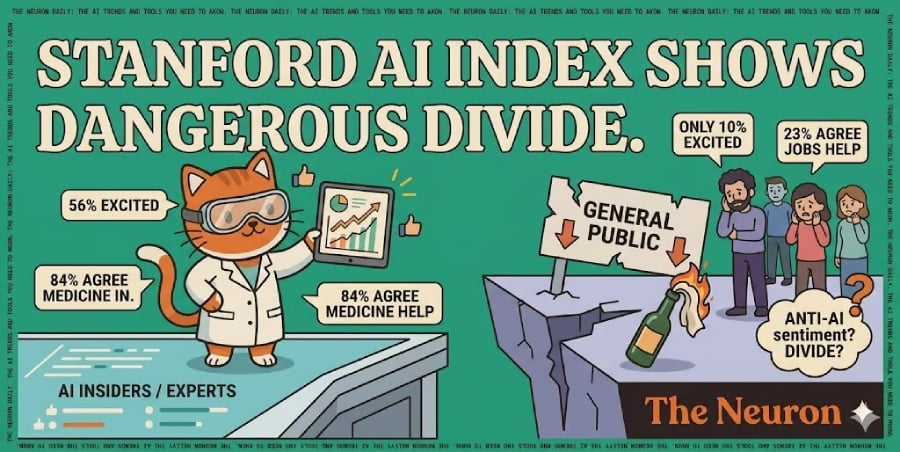


Stanford HAI dropped its 2026 AI Index yesterday, and for the first time, the report’s most important section isn’t about benchmarks. It’s about how completely the people building AI and the people living with it have stopped agreeing on basic facts.
Here’s what the data shows:
- Only 10% of Americans say they’re more excited than concerned about AI. Among AI experts: 56%.
- On medical care: 84% of experts think AI will help. Only 44% of the public agrees.
- On jobs: 73% of experts say AI will help. Only 23% of the public agrees.
- China’s top model now trails Anthropic’s by just 2.7%. The US lead has effectively evaporated.
- Grok 4’s training run alone produced an estimated 72,816 tons of CO2 (per the Index); cumulative AI power demand is now comparable to Switzerland’s national electricity consumption.
Why this matters
The report dropped within the same week that someone threw a Molotov cocktail at Sam Altman’s San Francisco home. Federal agents have since arrested a Texas man with an anti-AI manifesto. In his 3 a.m. response post, Altman admitted he had “underestimated the power of words and narratives.”
Investor Sam Lessin just published a piece arguing AI isn’t a labor crisis but a meaning crisis: it breaks the industrial story (work hard, life gets better) and replaces it with two equally bad options (“stay alive and receive abundance” but no meaning from work” or “the work ladder is gone” and you’re now in the permanent underclass).
Alberto Romero followed by warning that the Luddite playbook is back: when technology gets locked behind fences and abstraction, “the mob will turn their unassailable emotions toward human targets.” Or in wartime scenarios (like US vs Iran), turn the data centers into targets.
Our take
Every previous AI Index was a scoreboard. This one is a thermometer, and the patient is running hot. The labs spent two years racing each other on capability while assuming public trust would catch up automatically. Stanford’s data is the receipt: it didn’t.
Andrew Curran’s argument from this weekend hits even harder in this light; he points out that frontier models like Mythos are now so expensive to serve that they have to be rationed to a few dozen mega-customers, which means the people most worried about AI will be the people most cut off from it.
This gap doesn’t close on its own. Somebody has to actively close it; we here at The Neuron believe that means open source, freely available local AI built into every new computer.
Editor’s note: This content originally ran in the newsletter of our sister publication, The Neuron. To read more from The Neuron, sign up for its newsletter here.