






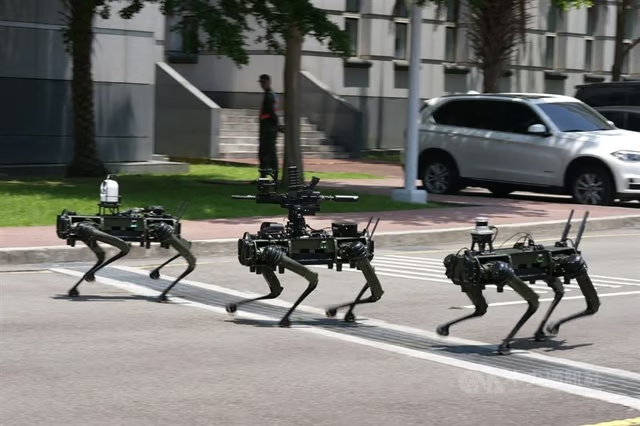


Taiwan’s next island sentry may have four legs, sensors, and a weapon mounted on its back.
The National Chung-Shan Institute of Science and Technology has showcased three robotic quadrupeds designed for reconnaissance, surveillance, and potential firepower support. The robot dogs, built on platforms from US-based Ghost Robotics and modified with Taiwan-developed systems, could eventually help patrol remote Taiwan-controlled outposts in the South China Sea.
The demonstration points to a larger defense question for Taipei: how to maintain visibility and deterrence across far-flung islands without putting more personnel in exposed locations.
A new role in Taiwan's defense strategy
The unveiling comes as Taiwan continues investing in new military technologies amid growing security concerns and increasing activity by Chinese vessels and aircraft around territories controlled by Taipei. The robots are being considered for use on Taiwan-controlled islands that sit far from the main island, including Itu Aba in the Spratly Islands and the Pratas Islands further north.
These outposts are sparsely populated and are primarily guarded by coast guard personnel. Maintaining a permanent human presence in such locations can be challenging, making unmanned systems an attractive option for surveillance and patrol duties.
Speaking about the robots, Jen Kuo-kuang, deputy head of NCSIST's missile and rocket systems research division, said there was demand for the technology even though no formal procurement order has been placed.
"In fact, the marines believe that on beaches and the coastline, including for the coast guard in Nansha and Dongsha for patrols and inspection, there is a pressing need," Jen said, according to Reuters.
Nansha and Dongsha are Taiwan's names for the Spratly and Pratas island groups.
The robot dog project is part of Taiwan's wider effort to modernize its armed forces and strengthen deterrence capabilities. Unmanned systems have become a major focus for Taiwan's defense planners in recent years, particularly as military officials study lessons from modern conflicts where drones and autonomous technologies have played increasingly important roles.
The three robots demonstrated this week represent different operational roles. One is designed for reconnaissance missions, another for surveillance, while the third carries a weapon system intended to provide firepower support. Although the military has signaled interest, officials emphasized that the program remains in the demonstration stage.
Rising tensions in the South China Sea
Taiwan's interest in robotic patrol systems comes against a backdrop of growing maritime pressure around its offshore territories. Taipei has reported a rise in Chinese coast guard activity near the Pratas Islands and has also complained about Chinese drones operating in the area.
Both Beijing and Taipei claim large portions of the South China Sea, although Taiwan's control is limited to a handful of islands and features, including Itu Aba and the Pratas. China views Taiwan as part of its territory, a position rejected by Taiwan's government.
For now, the robot dogs remain prototypes rather than deployed assets. But the demonstration offered a glimpse of how Taiwan could use autonomous technology to extend its presence on remote islands without significantly increasing personnel requirements.
Taiwan is not alone in exploring robotic systems for specialized roles, as companies across the Asia-Pacific region are also testing autonomous machines for real-world operations, including LG CNS's recent demonstration of AI-powered warehouse robots in South Korea.