






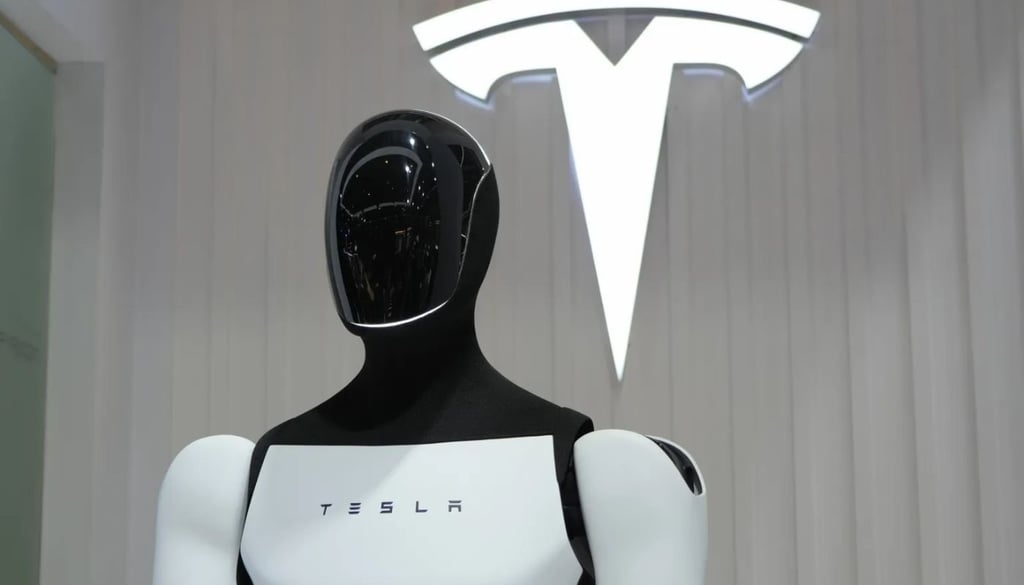


Shanghai’s most productive EV plant could soon have a very different kind of assembly line.
Tesla’s China president has publicly floated the idea of using the company’s Shanghai Gigafactory, its single largest production base globally, to manufacture humanoid robots, marking the first time a Tesla executive has made such a statement on record.
Speaking to reporters on Tuesday during a government-organized tour of the Shanghai facility, Wang Hao, Tesla’s vice president and president of Tesla China, said the plant’s manufacturing muscle could be the answer to one of the biggest unsolved problems in robotics: scaling up production.
New factory ‘a golden key’
Wang pointed to CEO Elon Musk’s own acknowledgment that mass production remains a critical bottleneck for humanoid robots, then offered his take on how to crack it.
“Like other Tesla factories, Giga Shanghai can shoulder important responsibilities in manufacturing all new products, including robots, to make our contributions to the company,” Wang told reporters, according to South China Morning Post. “We are highly confident in welcoming the arrival of a new era of robots.”
He described the Shanghai operation as “a golden key to solving this challenge,” though he stopped short of outlining exactly how the factory would support robot production, or whether Tesla would repurpose existing Shanghai facilities or build an entirely new plant.
Tesla China later issued a clarifying statement, saying “currently, there are no specific plans to mass-produce humanoid robots at Gigafactory Shanghai,” and that Wang’s remarks referred to the facility’s “strong scalable mass production capabilities and significant future potential,” according to Nikkei Asia.
The comments come at a pivotal moment for Tesla. In January, the company announced a strategic pivot, repositioning itself as a physical AI firm after reporting disappointing earnings and delivery numbers the previous year.
As part of that shift, Musk said Tesla would wind down production of its Model S and Model X vehicles and convert the Fremont, California, factory into a dedicated production site for its Optimus humanoid robot.
Shanghai’s track record makes it a contender
Any conversation about scaling Tesla’s next big bet naturally circles back to Shanghai. The Gigafactory is, by any measure, Tesla’s most productive plant. In 2025, it produced roughly 851,000 vehicles, 52% of Tesla’s entire global output, even as the company’s worldwide deliveries dipped 8.6% to 1.63 million units, per SCMP.
The numbers have held strong into 2026. In the first quarter alone, the Shanghai plant delivered 213,398 vehicles, a 23.5% year-on-year increase, accounting for nearly 60% of Tesla’s global deliveries for the period.
The factory’s Shanghai R&D hub is also Tesla’s first vehicle development center located outside the US, and Wang said he hopes it eventually grows to rival its American counterpart in scale.
Humanoid robots are expected to be used across industries, from logistics and manufacturing to elderly care and hospitality. The sector is becoming a focal point in the broader technology competition between the US and China.
Musk himself has previously acknowledged the strength of Chinese robotics companies, predicting they could play a dominant role globally alongside Tesla.