






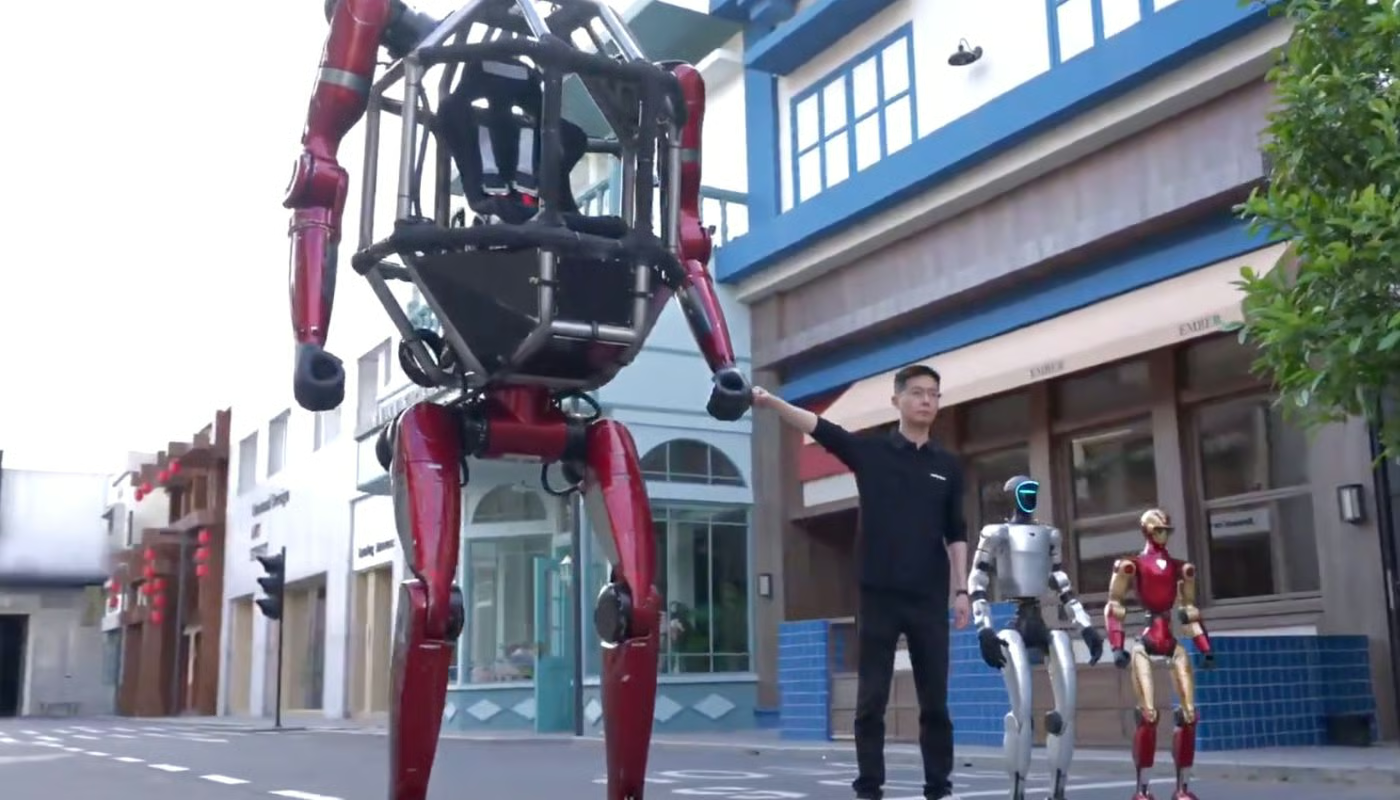


Chinese robotics company Unitree Robotics has unveiled what it calls the world’s first production-ready manned mecha.
The robot, named GD01, was introduced Tuesday in videos showing Unitree founder and CEO Wang Xingxing climbing into the cockpit and piloting the machine. The roughly 2.7-meter-tall robot can switch between two-legged and four-legged movement modes and carries a starting price of 3.9 million yuan, or about $650,000.
Demonstration footage released by the company showed the 500-kilogram machine walking upright before using its mechanical arms to knock down a brick wall. Moments later, the robot folded into a quadruped configuration designed for rougher terrain.
China’s robotics push accelerates
The launch comes as Chinese robotics firms continue to expand aggressively in humanoid and embodied AI systems.
Research firm Omdia estimates Chinese companies accounted for nearly 90% of global humanoid robot sales in 2025. Unitree reportedly shipped more than 5,500 humanoid robots last year as it expanded beyond its robot dog business into humanoid systems and now piloted mobility platforms.
The mecha’s debut also comes as China ramps up support for embodied intelligence. Earlier this year, China’s Ministry of Industry and Information Technology introduced a standard system for humanoid robots and embodied AI, while cities including Beijing, Shanghai, and Shenzhen rolled out policies to accelerate robotics development.
Experts see potential and plenty of challenges
Huang Jiawei, a marketing staff member at Unitree, told Global Times that the listed price of 3.9 million yuan is still preliminary. “The final production version may still be adjusted depending on performance optimization,” Huang said.
Huang also said the company sees robots playing larger roles in dangerous work environments and inspection tasks, adding: “The product is still in its first generation at this stage, and there is indeed a lot of room for imagination.”
Chen Jing, vice president of the Technology and Strategy Research Institute, told Global Times the machine represents a major engineering step forward for embodied AI because it is no longer limited to laboratory demonstrations.
Still, Chen noted several practical hurdles remain, including battery life, comfort, maintenance complexity, and real-world usability. Veteran telecom analyst Ma Jihua told the publication the robots could eventually find uses in theme parks, filmmaking, rescue operations, and hazardous environments, even if mainstream adoption remains distant.
Meanwhile, the company is also moving toward a public listing. In March, Unitree filed for an IPO on Shanghai’s STAR Market, seeking to raise about 4.2 billion yuan, or roughly $608 million, for robotics R&D and smart manufacturing.