






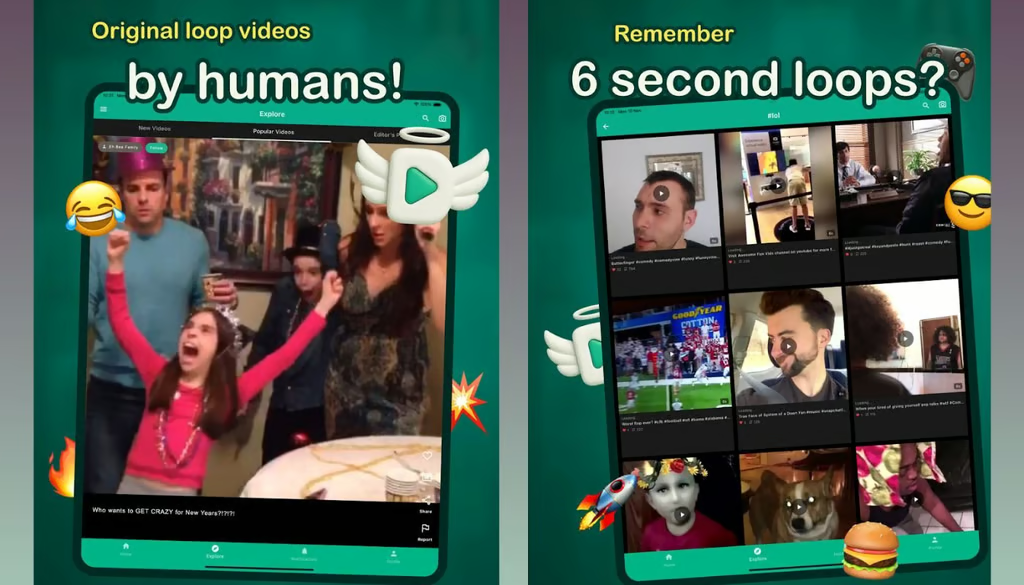


Vine didn’t get a sequel. It got a resurrection. And its name is diVine.
Led by early Twitter employee Evan “Rabble” Henshaw-Plath and funded by Jack Dorsey’s nonprofit, diVine isn’t just for nostalgia lovers. It’s also a functioning platform where users can record and upload new looping videos.
The reboot was made possible by a massive preservation effort by the volunteer group Archive Team, which saved Vine’s content as giant data dumps years ago. Henshaw-Plath spent months building tools to extract and rebuild the clips and user profiles into something usable again.
“So basically, I’m like, can we do something that’s kind of nostalgic?” he told TechCrunch. “Can we do something that takes us back, that lets us see those old things, but also lets us see an era of social media where you could either have control of your algorithms, or you could choose who you follow, and it’s just your feed, and where you know that it’s a real person that recorded the video?”
According to him, diVine currently includes about 150,000 to 200,000 videos from around 60,000 creators, although the full long tail of Vine’s original millions of clips cannot be recovered.
A platform built to keep AI out
Unlike today’s AI-soaked apps, diVine is taking a hard stance: AI-generated video isn’t allowed.
“We’re in the middle of an AI takeover of social media,” the site says. “TikTok, YouTube, and Instagram are increasingly flooded with AI slop — videos that look real but were never captured by a camera, people who don’t exist, scenarios that never happened.”
To prevent that, diVine uses verification tools from the Guardian Project to check that every upload was recorded by a real camera, not generated or edited by AI.
“We’re not anti-technology. We love what technology can do. But we believe that social media should be a place where real people connect with real people,” the platform noted. “AI has its place—but that place isn’t pretending to be human. Not on diVine.”
Built on decentralization, not corporate control
Like many of Dorsey’s recent projects, diVine is built on Nostr, a decentralized, open-source protocol. That structure lets people run their own servers, algorithms, and moderation tools, an attempt to avoid the corporate chokeholds that killed the original Vine.
In a statement to TechCrunch, Dorsey emphasized why that matters: “Nostr — the underlying open source protocol being used by diVine — is empowering developers to create a new generation of apps without the need for VC-backing, toxic business models or huge teams of engineers.”
He also explained his funding decision through his nonprofit, “and Other Stuff,” stating, “The reason I funded the non-profit… is to allow creative engineers like Rabble to show what’s possible in this new world, by using permissionless protocols which can’t be shut down based on the whim of a corporate owner.”
The team behind the reboot is prioritizing people whose original Vines were recovered. Those creators can reclaim their accounts by proving ownership of the social profiles they previously linked. They can also request takedowns through DMCA notices or upload missing videos if the archive didn’t capture them.
A revival ahead of Musk
Elon Musk, owner of X, has repeatedly teased bringing Vine back, even claiming his team found the video archive in August. But so far, he hasn’t launched anything publicly. That leaves diVine as the first working reboot, stocked with restored clips and a philosophy that runs counter to today’s AI-driven feeds.
Meanwhile, early interest has been intense. Rabble posted that they saw “10k people join the diVine.video testflight in four hours.”
Healthcare organizations are adopting AI 2.2 times faster than other industries, with spending reaching about $1.4 billion in 2025, underscoring how deeply AI is reshaping workflows even as some platforms intentionally keep it out of the core experience.