






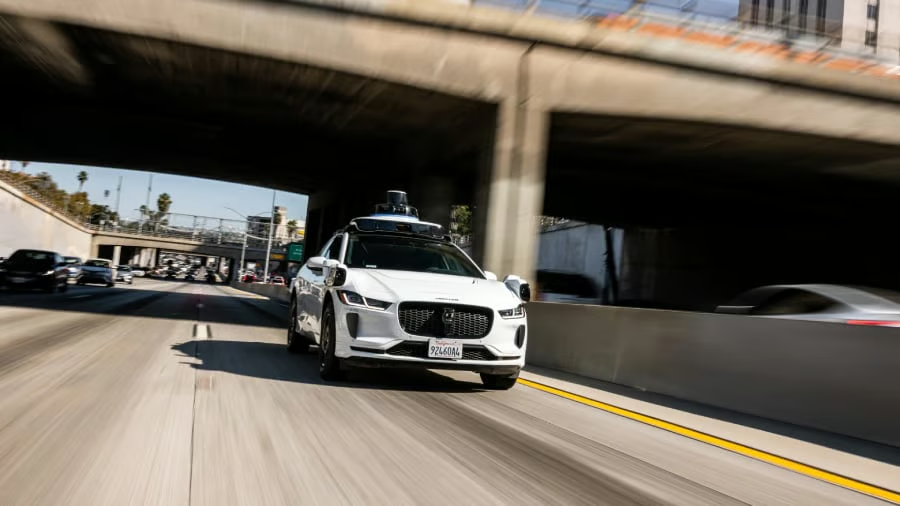


Freeways are where most people test the limits of speed, patience, and trust in other drivers. Waymo’s vehicles are now joining that mix.
The company announced on Wednesday that riders in San Francisco, Los Angeles, and Phoenix can now hop in and let the cars take the high-speed routes. The expansion allows select riders to take autonomous trips that use freeways when that route is “meaningfully faster.”
For years, Waymo’s self-driving cars have mostly stayed on city streets. Now, they’re venturing onto freeways, handling high-speed merges, exits, and lane changes without a human driver. The move brings a faster, more flexible experience for users traveling between cities or to major destinations such as airports.
“We’re offering freeway access to a growing number of public riders and will introduce the service to more over time, including as we expand freeway capabilities to Austin, Atlanta, and beyond,” Waymo said in its official blog.
The update expands the company’s Bay Area coverage from San Francisco to San Jose, complete with curbside service at Mineta San Jose International Airport, its second airport connection after Phoenix Sky Harbor.
Waymo co-CEO Dmitri Dolgov called the milestone a “profound engineering feat,” noting that freeway driving is “very easy to learn, but very hard to master when we’re talking about full autonomy without a human driver as a backup, and at scale.”
Safety, sensors, and speed
While the service is new to the public, the technology is built upon a decade-plus of testing. Waymo has “millions of miles logged on freeways” through testing with employees and guests in its active markets.
The testing includes not just public roads but also closed courses and extensive simulation to prepare the vehicles for rare, high-stakes events such as complex merging, lane-splitting motorcyclists, and high-speed vehicle malfunctions.
The robotaxis are designed to generally travel up to the maximum posted speed limit, often 65 MPH. Still, a spokesperson confirmed that vehicles “may sometimes go a few miles over the limit for safety purposes in extraordinary circumstances,” CNBC reported.
The rollout required close coordination with the California Highway Patrol and the Arizona Department of Public Safety, as well as the installation of new charging infrastructure for its electric fleet.
Musk’s longstanding critique of sensor strategy
Waymo’s fifth-generation self-driving system combines lidar, radar, and 29 cameras — a mix Tesla CEO Elon Musk once criticized as “sensor contention” and claimed the system’s sensors “cause increased, not decreased, risk,” hence “Waymos can’t drive on highways.”
But after the freeway announcement, Musk responded to Google’s chief scientist, Jeff Dean, on X with simply “Congrats.”
With this milestone, Waymo becomes the first company in the US to offer fully driverless freeway rides to the public, beating competitors like Tesla, Cruise, and Zoox.
Tesla’s “Robotaxi” service still uses human drivers, and Cruise remains grounded after recent safety issues. That leaves Waymo as the clear frontrunner in a race that’s as much about trust and regulation as it is about technology.
Waymo plans to extend freeway service to Austin, Atlanta, and other US cities in the near future, while also preparing to launch its first international robotaxi operations in London by 2026.
Waymo’s freeway expansion in the US mirrors its international push, with a 2026 London pilot plan mapping out how the company and UK regulators will test fully driverless rides in one of the world’s most complex cities.