







Pulse Secure announced its new Pulse Services Director 18.1 release on March 21, providing new virtual Application Delivery Controller (vADC) capabilities to help improve application visibility and security.
Application Delivery Controllers (ADCs) can play a central role in load balancing workloads and enabling access to applications. Given its position in a network deployment, ADC technology also can be an ideal location for monitoring application activities, which is a core capability of the new Pulse Secure vADC.
“The new centralized analytics capabilities allow for greater insight into how applications are behaving,” Aidan Clarke, Senior Product Manager atPulse Secure, told eWEEK.
The vADC technology in Pulse Secure’s new release has been developed by multiple vendors over the years, with Pulse Secure acquiring the technology from Brocade in June 2017. Brocade in turn originally acquired the vADC technology from Riverbed Technology in February 2015, where it was known as SteelApp after being rebranded in 2014 from the original name Stingray. Riverbed had actually acquired the Stingray technology from technology vendor Zeus in July 2011, where it was originally known as Zeus Extensible Traffic Manager.
Clarke said that since landing at Pulse Secure, the vADC technology has also been integrated with Pulse Secure’s other products. Pulse Secure was founded in 2014 based on technologies spun out from Juniper Networks’ Junos Pulse secure access platform.
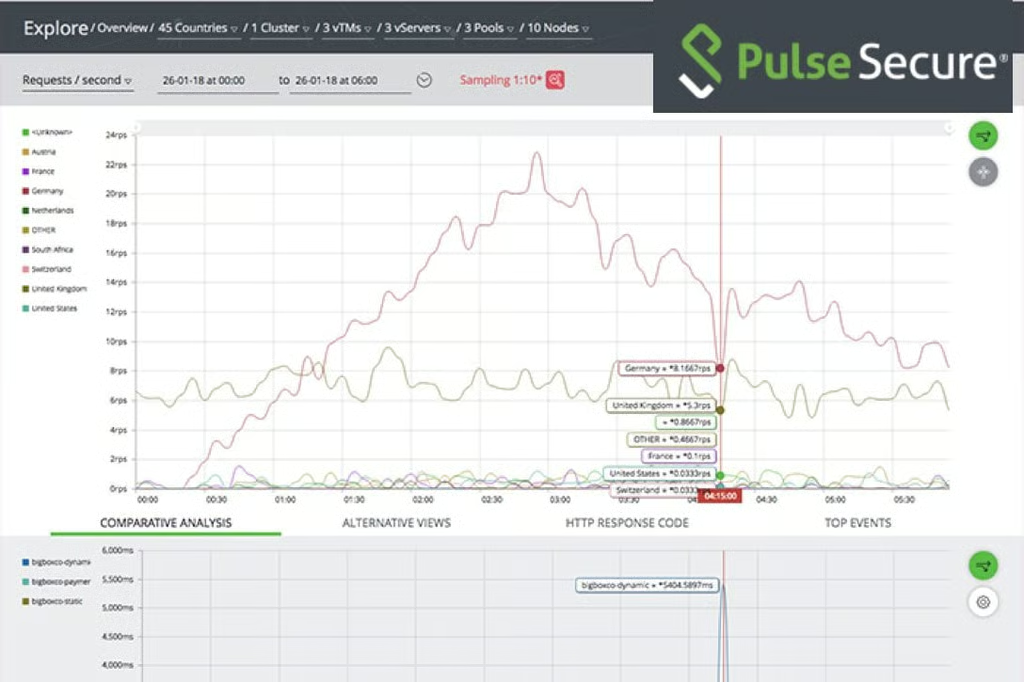
At Pulse Secure, Clarke said that the vADC suite is made up of three distinct products: the Virtual Traffic Manager (vTM), the Virtual Web Application Firewall (vWAF) and the Services Director, which is used to centrally license, monitor and manage the vTM and vWAF. Clarke noted all three of the products came over from Brocade in the acquisition. The new Services Director 18.1 release adds enterprise management and analytics. Clarke explained that with Services Director 18.1 an organization can centrally deploy an analytics profile to their Pulse vADC deployments, that allows for application telemetry to be pushed to an analytics platform.
“This is useful for customers with advanced analytics programs already deployed,” Clarke said.
He added that 80 percent of the customers that Pulse Secure has spoken to that have an analytics solution are using Splunk. But the vast majority of those didn’t feel they were getting value or insight from the system for their ADC environments.
“With this Services Director 18.1 release, customers that are using a Splunk system to collect application telemetry can leverage the Services Director’s built-in analytics application to get an intuitive interface to that exported data,” Clarke said.
Clark said that the analytics application provides a set of easy-to-use data interaction tools. He added that Pulse Secure decided to deploy its own analytics application in Services Director, over simply providing a Splunk application to its customers to be able provide value to both Splunk and non-Splunk customers.
Security
From a security standpoint, Clarke said that the analytics capabilities can be used to help identify information about traffic spikes to help spot potential Denial of Service (DoS) attacks.
Additionally, Clarke said that analytics can be used to identify application queries that are taking too long to execute on the web server, which is commonly seen in application layer attacks. The centralized log collection that is part of the analytics capability also includes Web Application Firewall logs, providing additional cyber-security visibility.
With the cyber-security insights provided by the analytics tool, Clarke said that administrators can respond to threats, with traffic filtering, blocking, or application layer remediation, such as application level filtering or application traffic prioritization for critical customers.
Sean Michael Kerner is a senior editor at eWEEK and InternetNews.com. Follow him on Twitter @TechJournalist.