







In an attempt to rekindle flagging enterprise sales, Hewlett-Packard introduced a wide range of products and services at its Discover2014 conference in Las Vegas.
The introductions ranged from minor software tweaks to a high performance liquid-cooled supercomputer. The common thread was a renewed push into the enterprise space at a time when competitors, including IBM, are bailing out of commodity servers and Dell has retreated to being a private company to adjust its strategy out of the public glare.
Overall it was encouraging to see Hewlett-Packard come out swinging at its main yearly conference. The wide range of introductions was in contrast to SAP, which during last week’s Sapphire conference was hard pressed to find much new to talk about.
“Enterprise IT as we know is being re-architected,” said HP’s Bill Veghte, the executive vice-president of HP’s enterprise group. While enterprise IT may be getting re-architected to accommodate cloud, mobile and social-based computing, the enterprise group itself has been undergoing a transition.
HP as a company has been going through rounds of layoffs as revenues have continued to slide year after year. The enterprise group represents about one quarter of the company’s revenues and produces about 40 percent of the operating earnings. Veghte, formerly from Microsoft, was named to replace Dave Donatelli last year as enterprise revenues dipped.
HP once had cozy relationships with now competitors including Cisco, but needed to readjust its business strategy along with the rest of the enterprise vendors to make the transition to open source and cloud computing. They have had to serve the needs of IT and business managers that want new services to be available in real-time rather than waiting months for needed capabilities.
The product introductions from HP spanned server, storage and networking segments to show the company can perform as a full line enterprise vendor at a time when competitors are unsure where to focus their resources.
In storage, the big announcement was an aggressive move in flash-based storage boasting a $2 per gigabyte benchmark and calling out traditional storage vendor EMC as too expensive and start-up flash storage companies such as Pure Storage and Violin as too niche oriented for enterprise deployment.
David Scott, the senior vice-president of HP Storage, said the $2 per gigabyte price point marked the end of traditional tiered-storage approaches. The company also boasted of joint efforts with vendors such as Symantec to create a ‘federated storage’ model designed to vastly simplify storage backup and recovery procedures.
Networking was singled out as the main laggard in creating a software-defined infrastructure where networking resources could be harmonized with server and storage capabilities to create capacity on the fly. “No SDN (software defined network), no cloud,” said Antonio Neri, HP’s senior vice president of servers and networking business units.
Neri said legacy data systems were holding back the deployment of software-defined infrastructures. The company introduced Virtual Cloud Networking software to work with the OpenStack Neutron network plug-in and also introduced an open flow controller to make it easier to bridge legacy and open flow-oriented networks.
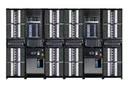
The company’s high end Apollo 8000 system is a liquid cooled, Intel-based system that puts HP into competition with the IBM and Cray based supercomputers. The choice of liquid cooling over air cooled systems was touted as much more energy efficient.
The Apollo 8000 sports a closed loop cooling system that keeps the liquid separate from the other system components. The high end of the server market, which systems such as the 8000 address, has remained one of the more vibrant sectors of the server business.
Overall, HP’s decision to double down on enterprise segments where traditional competitors are wobbling makes sense. As Veghte said, the enterprise segment is indeed being re-architected and HP intends to provide the full spectrum of hardware and services to achieve that business goal.
Eric Lundquist is a technology analyst at Ziff Brothers Investments, a private investment firm. Lundquist, who was editor-in-chief at eWEEK (previously PC WEEK) from 1996-2008 authored this article for eWEEK to share his thoughts on technology, products and services. No investment advice is offered in this article. All duties are disclaimed. Lundquist works separately for a private investment firm which may at any time invest in companies whose products are discussed in this article and no disclosure of securities transactions will be made.