






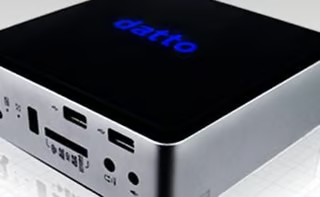

Backup, disaster recovery (BDR) and intelligent business continuity (IBC) solutions specialist Datto announced the release of Alto, an on- and off-site backup and disaster recovery solution for small and midsize businesses (SMBs).
Alto is sold at a range of price points and is designed to provide companies with as few as one employee with a hybrid cloud platform for hybrid virtualization of servers and workstations. Image-based backup is not just the backbone of the Alto platform but also adds usability in disaster scenarios, as users no longer have to pick and choose what files are backed up or worry about saving the most recent draft to a shared backup folder.
In addition to protecting files, entire systems are backed up and virtualized so the applications and critical systems which keep a business running remain active, and a user can spin up virtualizations that are connected through a virtual private network (VPN) to their network automatically.
“We believe that every business, of any size, is entitled to a robust solution to back up their critical business data and insure themselves against costly downtime and extended interruptions in business continuity,” Austin McChord, CEO and founder of Datto, said in a statement. “We have built a product that eliminates complex overhead for end users and adds an unmatched level of service through our channel partners and our award-winning support team.”
Other features include backups that are automatically verified daily through screenshot backup verification, Datto’s Inverse Chain Technology, which creates an optimal backup chain from scratch and restores and virtualizes every point, and bare metal restore technology allows users to perform restores to dissimilar hardware. Starting from an imaged CD or USB thumb drive, the user will follow a graphic user interface (GUI) from selecting machines to automatic partitioning to conduct a bare metal restore.
Data protection and disaster recovery planning is a priority but remains a challenge for small businesses, according to the results of a March survey of more than 1,000 SMB IT professionals by software developer Spiceworks and sponsored by online backup specialist Carbonite.
The survey revealed slightly less than half (45 percent) of respondents said their organization had experienced a data loss, costing an average of nearly $9,000 in recovery fees. Of those, 54 percent said the data loss was due to a hardware failure.
Small businesses spend an average of $5,700 each year to manage data backup and recovery environments, and while the majority of respondents (70 percent) said they are satisfied with current backup methods, nearly one-third (30 percent) believe their approaches and technologies are insufficient, survey results indicated.