






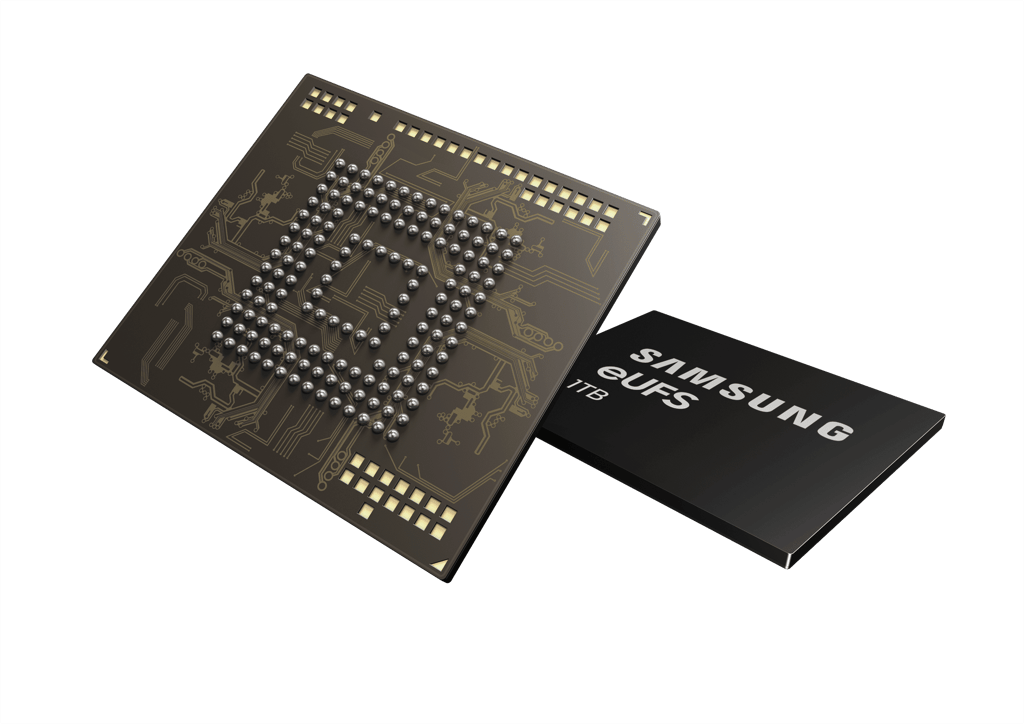

A year and a half before world records will be shattered at the Olympic Games in Tokyo, Samsung has smashed a record of its own in the world of data storage.
The huge South Korean IT conglomerate announced Jan. 29 that it has begun mass producing the industry’s first 1TB embedded Universal Flash Storage (eUFS) 2.1, for use in next-generation mobile applications in smartphones.
Four years after introducing the first UFS solution, the 128-gigabyte (GB) eUFS, Samsung has cracked the much-anticipated terabyte threshold in smartphone storage. Smartphone users will soon be able to leverage storage capacity comparable to a premium notebook PC, without having to pair their phones with additional memory cards, the company said.
Within the same package size (11.5mm x 13.0mm), the 1TB eUFS solution doubles the capacity of the previous 512GB version by combining 16 stacked layers of Samsung’s most advanced 512-gigabit (Gb) V-NAND flash memory and a newly developed proprietary controller.
Can Store 260 10-Minute 4K Videos
As an example of the capability of the 1TB capacity, smartphone users will now be able to store as many as 260 10-minute videos in 4K UHD (3840×2160) format, whereas the 64GB eUFS widely used in many current high-end smartphones is capable of storing 13 videos of the same size, Samsung said.
The company claims the 1TB eUFS also is speedy, allowing users to transfer large amounts of multimedia content in reduced time. At up to 1,000 megabytes per second (MB/s), the new eUFS features approximately twice the sequential read speed of a typical 2.5-inch SATA solid state drive (SSD), Samsung said. This means that 5GB-sized full HD videos can be offloaded to an NVMe SSD in as fast as five seconds, which is 10 times the speed of a typical microSD card.
In addition, the random read speed has increased by up to 38 percent over the 512GB version, clocking in at up to 58,000 IOPS, Samsung claimed. Random writes are 500 times faster than a high-performance microSD card (100 IOPS), coming in at up to 50,000 IOPS. The random speeds allow for high-speed continuous shooting at 960 frames per second and will enable smartphone users to take full advantage of the multi-camera capabilities in today and tomorrow’s flagship models.
Samsung said it plans to expand the production of its fifth-generation 512Gb V-NAND at its Pyeongtaek plant in Korea throughout the first half of 2019 to fully address the anticipated strong demand for the 1TB eUFS from mobile device manufacturers around the world.