




- 10 Things You Probably Dont Know About Cloud Storage and Computing
- Using Public and Private Clouds
- Where to Put It to Work
- One Size Doesnt Fit All
- Where It Fits in an IT Strategy
- It Takes Planning
- A Delivery Model, Not a Black Box
- Its Not Just for Small Players
- Self-Service Computing Capacity
- Standardizing Business Processes
- Choose the Right Workload
10 Things You Probably Dont Know About Cloud Storage and Computing
by Chris Preimesberger
Using Public and Private Clouds
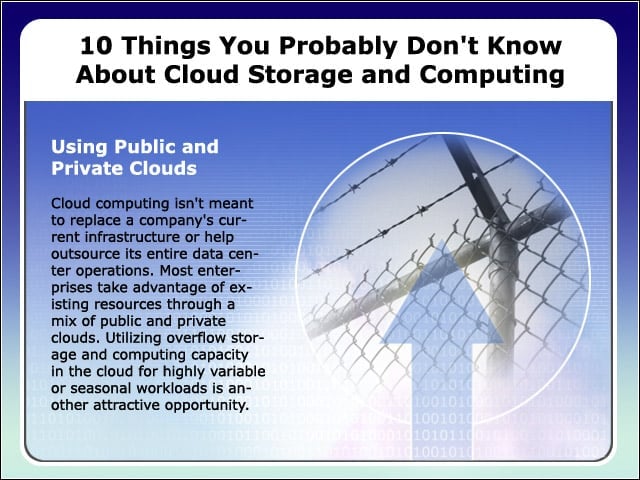
Cloud computing isn’t meant to replace a company’s current infrastructure or help outsource its entire data center operations. Most enterprises take advantage of existing resources through a mix of public and private clouds. Utilizing overflow storage and computing capacity in the cloud for highly variable or seasonal workloads is another attractive opportunity.
Where to Put It to Work
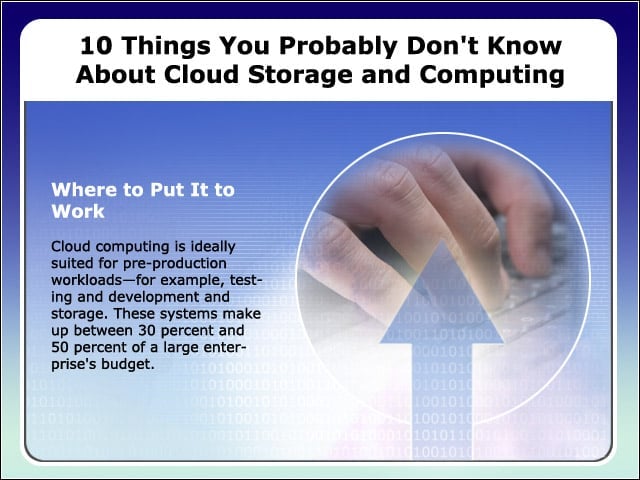
Cloud computing is ideally suited for pre-production workloads—for example, testing and development and storage. These systems make up between 30 percent and 50 percent of a large enterprise’s budget.
One Size Doesnt Fit All
Cloud computing models should be built to take into account a company’s specific business challenges and needs. Clients, for example, in the financial services or public sector, who are especially concerned about governance, security, data protection and reliability, might consider evaluating a private or hybrid cloud approach.
Where It Fits in an IT Strategy
Cloud computing is an important part of a company’s IT strategy and needs to be handled as such. This entails having a common architecture for cloud deployments, a workload analysis of what is applicable to a cloud, ROI studies to ensure that you will get a good return on your cloud investment, and an integration strategy to tie in cloud services and storage with other IT services.
It Takes Planning
Cloud computing isn’t just about signing up for a service and getting it. You need to have a sophisticated system management platform in place. You have to think about problems that will arise and how you’ll diagnose them in real-time.
A Delivery Model, Not a Black Box
Cloud computing is a delivery model, not a technology. It represents the combination of some now-mature technologies (taken from prior initiatives such as grid computing, utility computing, SAAS [software as a service] and online storage) in order to create a paradigm shift in how IT is delivered.
Its Not Just for Small Players
Cloud computing isn’t strictly an SMB play. Many large enterprise customers are consuming a mix of services from public and private cloud models—a hybrid approach—to support business resiliency, information protection and collaboration services.
Self-Service Computing Capacity
Cloud computing is similar to ATMs in the banking industry. Years ago, banks looked to see which transactions they could make “self-service” to help reduce the amount of tellers and other staff that are required in a branch. The ATM was born to handle certain types of transactions: withdrawals, deposits, etc., in a self-service model.
Standardizing Business Processes
Cloud computing isn’t just about improving efficiencies by maximizing capital expenses and reducing operating expenses. Consider how standardized business processes can be an enabling force to expand or invent services that can address the world’s biggest problems, helping to create a more connected, smarter planet.
Choose the Right Workload
Cloud computing is appropriate for many workloads, but not all. Workloads that are complex in nature, have high compliancy requirements and/or are mission critical may not be appropriate for the cloud delivery model. Conversely, infrastructure services (computing, storage), applications such as e-mail and data analytics, and developer platforms will migrate to a cloud model quite nicely.