




Six Strategies Database Administrators Need to Know for 2010
by Brian Prince
Right Database for the Right Application
Enterprises should disregard the idea of general-purpose RDBMS (relational DBMS) to solve their data management problems.”This is most obviously happening in the data warehousing space where a variety of analytical database startups are challenging Oracle, IBM and Microsoft, but we’ve also seen increasing interest in specialist databases such as MarkLogic Server for XML and in-memory databases for real-time data,” said Matt Aslett, an analyst with The 451 Group.
NoSQL, No Problem
For Internet scale analytics, the NoSQL movement has clear benefits, said Burton Group analyst Marcus Collins. “For those organizations with a requirement for complex processing-beyond what SQL can offer-over large volumes of semiconsistent data, NoSQL should be evaluated. As this technology matures and standards emerge, expect this type of processing to become mainstream.”
Cloud Databases as an Option
2009 saw Microsoft enter into this area with the SQL Azure Database, which brings a true SQL engine into the game as opposed to the comparatively limited functionality of Amazon SimpleDB. “Prior to [SQL Azure], cloud databases lacked the functionality required by mainstream developers. With a fully functional SQL engine now available, developers can develop rich applications with a cloud delivery model,” said Collins.
Intelligent Use of Business Intelligence
2010 is the year when real-time business intelligence will come of age, and will offer enterprises an opportunity to immediately access business-critical information to improve decisions, Forrester Research analyst Noel Yuhanna speculated. In addition, businesses should look to adopt a tiered approach to feeding their data warehouses that is tailored to the organization’s business requirements, competitive environment and customer demands.
Database Virtualization Can Improve Efficiency
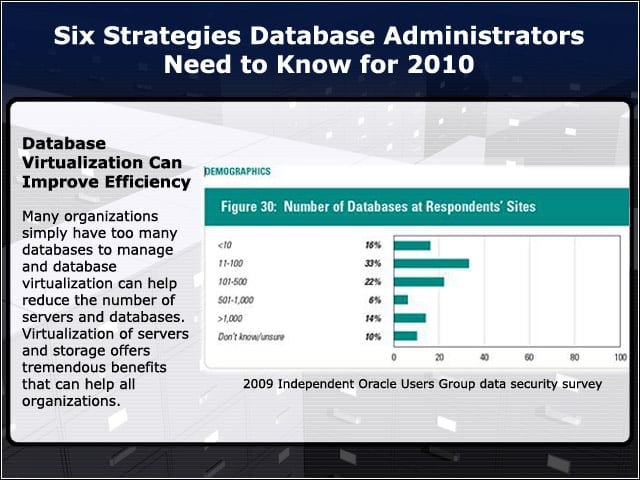
Many organizations simply have too many databases to manage, and database virtualization can help reduce the number of servers and databases. Virtualization of servers and storage offers tremendous benefits that can help all organizations.
Data Archiving on Tap
Enterprises should look to archive data to cut down on the amount of data they need to manage. As Yuhanna points out, a large database “takes more time to tune, administer and back up” and in addition uses more CPU and storage.