




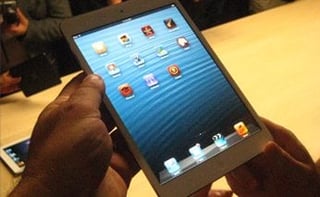
Seventy-five percent of doctors have purchased an Apple mobile device, according to a report by Manhattan Research, and the new Apple iPad Mini could fit nicely in doctors’ pockets. But the space on the 7.9-inch screen could prove to be too small to enter clinical data, according to an analyst.
A recent poll by medical app developer Epocrates revealed that one in three physicians plan to purchase the iPad Mini, which began shipping Nov. 2. In addition, 90 percent of respondents said the iPad Mini’s size would be easier to tote around between exam rooms and hospital rounds than the larger 9.7-inch Apple tablet.
Doctors are using the larger iPad model to send appointment reminders and explanations of lab tests. They can use the device to send streaming video or text-based treatment instructions to patients.
“A lot of our providers want something that can fit in their lab coat,” Ash Shehata, senior executive director of health care for Cisco, told eWEEK. “The Mini provides the perfect form factor for that.”
Cisco makes the networking hardware infrastructure for wireless service providers such as AT&T and Verizon.
“This is the perfect companion for doing rounds in a lab coat,” said Daniel Kivatinos, co-founder of Drchrono, which has developed an electronic health record platform and patient check-in app for the iPad. Kivatinos blogged about the iPad Mini on Nov. 5.
Gregg Malkary, founder and managing director of Spyglass Consulting Group, had another view. “I don’t think this is the right form factor,” Malkary told eWEEK. “The screen size is too small for most clinical applications.”
Although the iPad Mini can fit in a lab coat, hospital IT prefers to access applications through a virtualized desktop environment, “which makes it incredibly awkward to access applications,” said Malkary.
With the virtual keyboard taking up a large part of the screen, doctors could have a hard time entering health record data on the iPad Mini, Malkary noted.
Doctors could even need to carry around a Bluetooth keyboard to use with the iPad Mini, Malkary suggested.
“You could potentially do chart review for read-only applications, but that’s only as good as the applications that have been provided to you by the EHR vendor,” said Malkary. “They haven’t really provided very compelling applications at this juncture [for the iPad].
An exception could be Drchrono’s platform built for the Apple devices, he suggested. “They minimize the information and don’t overwhelm the doctor or nurse,” he said.
Malkary also noted Drchrono’s use of gesture computing in its apps.
“If all you’re going to be doing is accessing reference tools through the drug database, it could be an excellent tool,” said Malkary. “For those that require data entry, there has to be a better way.”
In addition to screen size issues, taking the device out constantly from a pocket and keeping the device clean can be difficult, said Malkary.
Still, the iPad Mini could fit into a converged tech infrastructure as part of the workflow of health care professionals, according to Shehata.
The iPad Mini presents voice, video and data all together, Shehata noted.
The smaller viewing area on the iPad Mini will lead IT departments to create new applications with simple views of the data, said Shehata.
“We’re seeing a major transition in the way devices use the screen real estate and interfaces,” said Shehata.
The iPad Mini could also be a valuable device for health professionals as a reference resource to look up symptoms and info on medications. It can also be used by doctors for emailing and texting, Malkary noted.
“I think docs will love it for personal content consumption and communication,” said Malkary. “They’ll be able to utilize it for wellness-management tools and reference tools and management,” he said.
Malkary noted the use of the larger-size iPad by Mayo Clinic to develop an application to educate patients about their heart conditions and surgical procedures.