




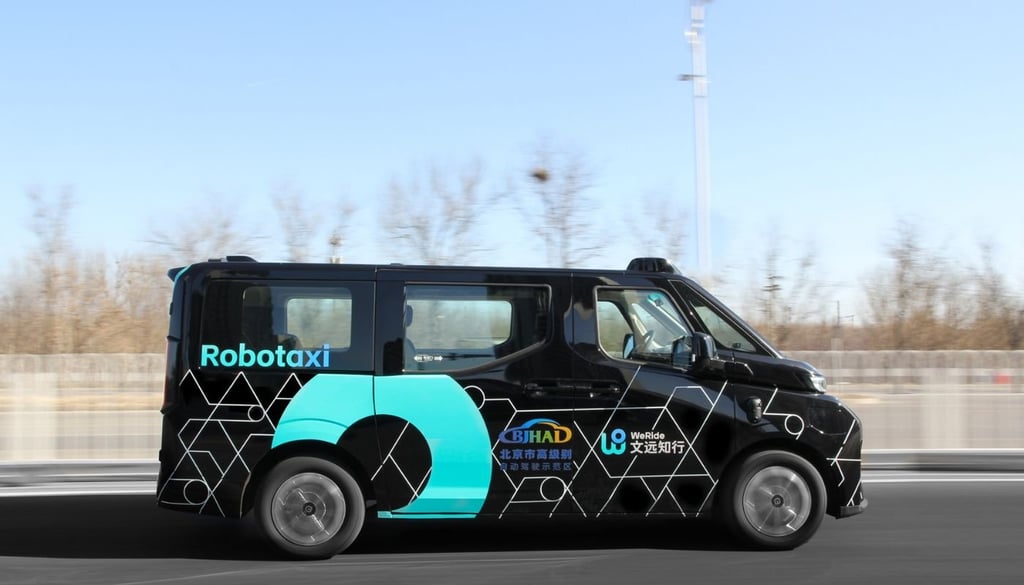
China’s robotaxis are gliding through city streets with no one behind the wheel… and barely a jolt to remind passengers they’re in a machine. The rides are smooth, quiet, and startlingly humanlike, showing just how far the country’s driverless technology has advanced.
In a recent The Wall Street Journal account, reporter Peter Landers recounted a seamless trip through Beijing in self-driving cars from WeRide and Pony AI, noting he “almost forgot a computer program was doing the driving.”
His firsthand look offers a rare glimpse into a market where autonomous taxis have already moved beyond pilot tests and into everyday traffic.
Luxury seats and steady turns
Landers described settling into a WeRide car with executive-style seats and a broad armrest where a steering wheel would normally dominate the view.
The robotaxi moved with quiet precision through the morning traffic, braking gently, then easing forward as if guided by instinct rather than code. When a double-parked driver stepped out ahead, the car tapped the brakes, waited, and slipped past without hesitation.
The smoothness was matched by comfort touches — ample luggage space, voice commands, and even a seat that can play Taylor Swift on request. Landers observed that the car handled obstacles with the poise of an experienced driver, not an algorithm on edge.
Cheaper to build, faster to scale
Baidu, Pony AI, and WeRide now run thousands of commercial robotaxis across China, with Baidu alone logging more than 14 million driverless trips by August.
Each company is racing to expand, deploying fleets in Europe, the Middle East, and Southeast Asia, while US rivals like Tesla and Waymo remain limited to a few cities and testing zones.
The advantage is cost: “Our vehicle’s hardware cost is much, much lower than Waymo’s,” said Leo Wang, Pony AI’s chief financial officer. Lower prices and domestic EV supply chains let Chinese firms add comfort and style, such as massage seats, touchscreens, and in-car entertainment, without breaking budgets.
As WeRide’s marketing chief, Maeve Zhang, put it, “It’s not just about the tech, it’s about the passenger experience.”
US robotaxis face bumps on the road to trust
In the US, progress has come with dents and data logs.
According to figures compiled by Pierce Skrabanek, the National Highway Traffic Safety Administration (NHTSA) has recorded more than 630 crashes involving Waymo’s autonomous vehicles and 1,745 incidents tied to Tesla’s driver-assist systems since 2021. By early 2025, California alone had filed 781 autonomous collision reports, the highest in the country.
In May, Waymo recalled 1,200 self-driving cars after a string of minor collisions, Reuters reported. Tesla’s robotaxis, meanwhile, have been involved in four crashes since September, according to the NHTSA.
Yet not all the numbers paint a grim picture. A peer-reviewed study published in September found that Waymo’s driverless cars reduced the likelihood of suspected serious injuries by 85%, with 96% fewer intersection crashes, 92% fewer pedestrian crashes, and 82% fewer cyclist and motorcycle crashes compared with human drivers. This suggests that safety headlines may not always align with the statistics.
The power of being unremarkable
In Beijing’s traffic, the robotaxi feels unremarkable in the best way possible — steady, silent, and sure. The absence of drama is the point: automation that works so well it fades from notice.
With millions of trips already completed and more markets on the horizon, China’s robotaxi operators are proving that large-scale autonomy can work smoothly and safely.
Another Chinese automaker is joining the race to redefine mobility, with XPENG revealing its upcoming driverless fleet alongside airborne vehicles in development.