




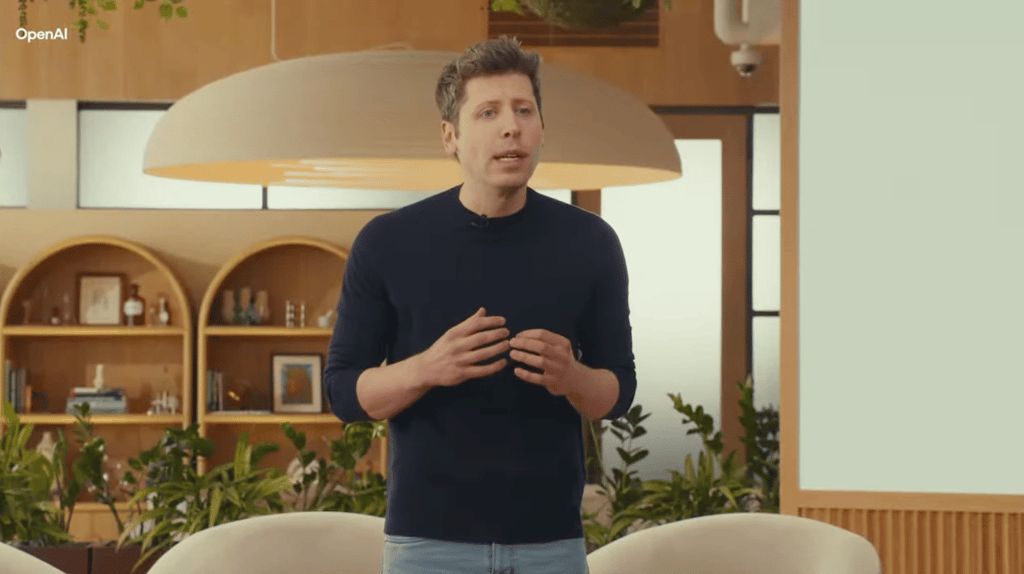
OpenAI released its much-anticipated advanced generative AI model, GPT-5, on Thursday, with several variants for developers to choose from. The generative AI model is available now to all ChatGPT users at the Free, Plus, Pro, and Team tiers, with Enterprise and Edu plan holders gaining access next week. Free users may be redirected to GPT-5-mini if they hit a usage limit. Developers can find GPT-5 in the OpenAI API today.
“It can write an entire computer program from scratch to help you with whatever you’d like, and we think this idea of software on demand is going to be one of the defining characteristics of the GPT-5 era,” OpenAI CEO Sam Altman said in the announcement livestream on Thursday.
GPT-5 writes code in minutes
GPT-5 offers enhanced agentic capabilities and reasoning, OpenAI said, enabling it to take multi-step actions on the user’s behalf. For example, the company demonstrated in a livestream how GPT-5 created a moving visualization in Canvas, with the model taking a few minutes to write more than 400 lines of code to produce the finished product.
Instead of the user choosing whether to use deep reasoning or not, GPT-5 will intuit if the question needs a reasoning model.
“This simplifies deployment, improves consistency, and reduces operational overhead; however, it may introduce cost opacity,” said Gartner VP analyst Chirag Dekate in an email to TechRepublic. “Combined with improved reliability in high-risk domains like as health and law, GPT-5 moves closer to meeting enterprise requirements.”
Users can also prompt the model to think harder in order to activate deep reasoning, or paid users can choose deep reasoning from a drop-down menu.
“It aims to think just the perfect amount to give you the perfect answer,” said OpenAI Chief Research Officer Mark Chen in the announcement livestream.
Three variants are available in the API depending on need. They are:
- GPT-5: Frontier AI model designed for logic and multi-step tasks.
- GPT-5-mini: A lightweight version of the model at a lower cost.
- GPT-5-nano: A version optimized for speed, best suited for applications requiring low latency.
Developers can also choose ‘minimal,’ an option for the fastest and most latency-sensitive applications, and can dial ‘verbosity’ up or down.
“This shift aligns with how large organizations scale: standardized defaults, optional overrides, and reduced decision fatigue across use cases,” Dekate said.
Other recent updates to ChatGPT include being able to set a color and personality for chats, better understanding of spoken instructions and a more natural voice, a study mode, and integrations with Gmail and Google Calendar (available to paid users).
GPT-5 is more flexible for enterprise and commercial uses
OpenAI dominates the consumer AI space with its ChatGPT chatbot, as well as offering plans tailored to government and enterprise needs.
“GPT-5 represents a fundamental shift in commerce technology,” said Max Sinclair, CEO and co-founder of generative AI search engine optimization firm Azoma, in an email to TechRepublic. “We’re looking at AI that doesn’t just process transactions, it builds genuine customer relationships through memory and context that spans months, even years of interactions.”
GPT-5 defies theory of gen AI progress plateau
There are some suggestions that generative AI progress may have reached a plateau, with newer models showing less dramatic improvements over their predecessors. However, Dekate said, GPT-5 defies that idea.
“It delivers measurable gains in reasoning, domain accuracy, and hallucination control,” he said. “Improvements appear driven less by scale and more by system design, especially routing and specialization. This points to a new curve in performance, not an end to progress.”
For a deeper dive into GPT-5 including wild demos, read TechnologyAdvice writer Grant Harvey’s guide on our sister site The Neuron.
Editor’s note: This GPT-5 news article was first published on our sister site TechRepublic.
It’s been a big week for the Silicon Valley darling. OpenAI also announced two open-weight models, gpt-oss-120b and gpt-oss-20b, the smaller of which can be run on a laptop or phone.