




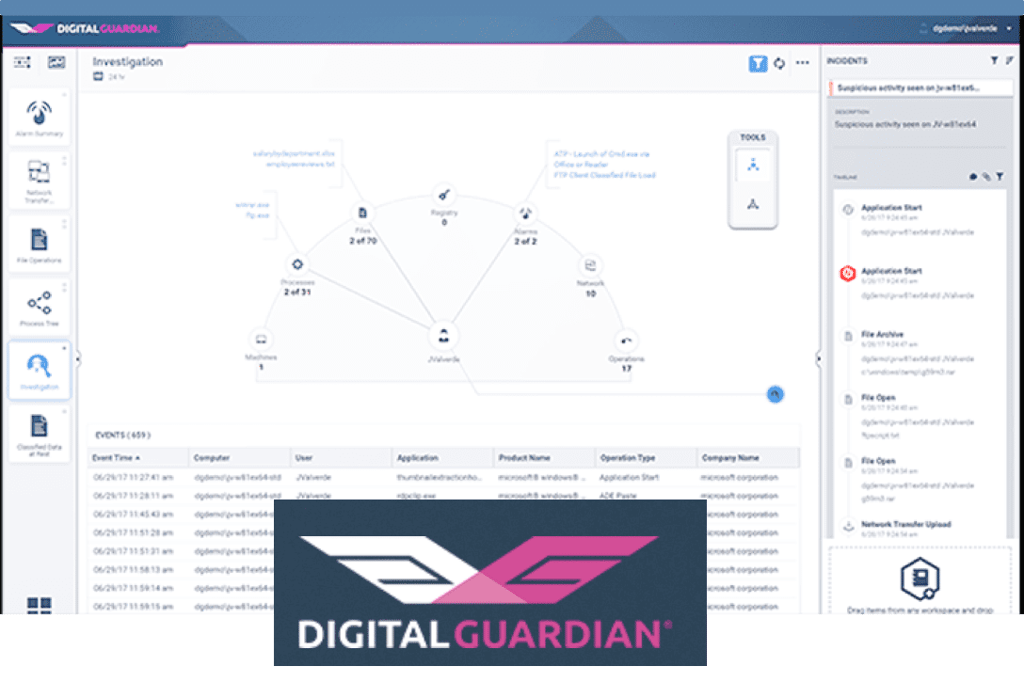
Digital Guardian will announce on Aug. 6 that it is bringing user and entity behavior analytics (UEBA) capabilities to its Data Protection Platform.
The new UEBA capabilities will complement the data loss prevention (DLP) features in Digital Guardian’s platform, enabling organizations to more closely align identity and user behavior with security policy and enforcement. The UEBA feature makes use of machine learning to gain insight into user behavior to identify potential malicious actions.
“With the new UEBA capability, we’re now bringing together DLP with EDR [endpoint detection and response] into a single platform,” Dave Karp, chief product officer at Digital Guardian, told eWEEK. “We’re using a single agent, pulling information from our network appliances as well as cloud visualization, and wrapping around that a set of very intuitive workflows that allow security operators to have better visibility into what has taken place within their environments.”
Digital Guardian is known for its core DLP platform, which helps organizations protect important data from loss. The company raised a $66 million Series D round of funding in December 2015 to expand the capabilities of the platform. In the last two years, Digital Guardian has added cloud-based DLP options as well as threat-aware data protection capabilities.
The UEBA engine helps identify potential anomalous activity, which is then enhanced by Digital Guardian with additional context and visualization as part of an executive risk dashboard, Karp said. The executive risk dashboard integrates information from points of risk across all the entities that Digital Guardian measures, which includes login information, web activity, email utilization, removable media usage and peer group analysis, he added.
Identity
UEBA technology is reliant on understanding user identity, a capability that is also at the core of what helps to enable DLP.
“We have built upon the foundation of what we’ve always done, which traditionally had been linked back into Active Directory,” Karp said.
There are many approaches for connecting with enterprise identity, according to Karp. He said Digital Guardian’s agents get information on individual user activity based on the user logged into the system, as well as the permissions and privileges that the user has available to him or her at login time.
Remediation
Currently, Digital Guardian does not include a fully automated remediation capability, though Karp said the company plans to develop one in the future.
“We refer to that capability as adaptive security, where the results of the risk scores will influence the security policies that get applied,” he said. “We do have some rapid, one-click capabilities when administrators are in the console to impact changes on a system.”
In early deployments of the UEBA capability, beta customers have already been able to detect activities that previously they were not aware of, according to Jaimen Hoopes, vice president of Cloud Services at Digital Guardian. In one particular case, Hoopes said a beta customer was able to identify non-classified data that was being exfiltrated.
“Our DLP lets us classify sensitive information in an organization, but most of it is up to administrators to define what is sensitive and classified,” Hoopes said.
Hoopes said that the UEBA capability discovered that a particular user was printing a pair of files and then was sending himself the same file via Gmail. The baseline activities for the file and the user did not show that as normal behavior, and no one else in the organization was printing or using Gmail to email the file.
“So it popped up as an anomaly in the behavioral analytics engine dashboard,” Hoopes said. “We were able to drill into it and take it back to the company, and they said that it was actually a file they cared about.”
Sean Michael Kerner is a senior editor at eWEEK and InternetNews.com. Follow him on Twitter @TechJournalist.