




COPENHAGEN, Denmark—Google is extending its container security capabilities with an expansion of the Cloud Security Command Center (SCC) via integrations with five container security vendors.
The announcement was made at the KubeCon and CloudNativeCon Europe 2018 event here on May 3. The five container security vendors that are part of the initial integration are Aqua Security, Capsule8, Stackrox, Sysdig Secure and Twistlock.
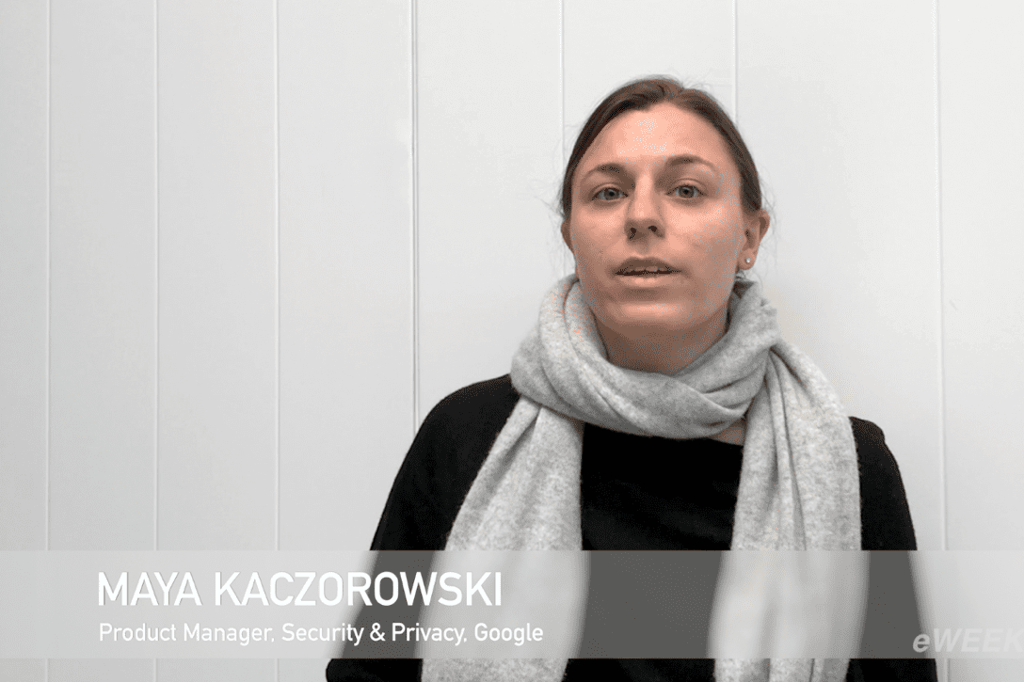
In a video interview with eWEEK, Maya Kaczorowski, product manager of security and privacy at Google, explains what the SCC expansion is all about and why Google decided to partner rather than build its own capabilities for additional container security.
The Google Cloud Platform (GCP) has the SCC capability, which lets users see any potential security incidents occurring across their container deployments, according to Kaczorowski. SCC is now being expanded to provide insight into Google Kubernetes Engine (GKE). As part of the new partner integrations, results from Aqua Security, Capsule8, Stackrox, Sysdig Secure and Twistlock container security investigations will now be available to users inside of SCC.
Google has taken multiple steps to help keep GKE users secure, and the new integrations provide an additional layer of security.
“I’d argue that nothing is ever 100 percent secure,” Kaczorowski said. “We obviously try to have secure default in GKE and make it easy for users to properly configure their clusters.”
Kaczorowski said the new container security partner integrations solve a parallel problem to the one that Google has been working on to secure GKE infrastructure. She said Google thinks about GKE security in terms of infrastructure, software supply chain and runtime security. The focus for the partner integrations is on the runtime security component.
Runtime security is about users being able to monitor and detect if a running container is acting badly and then enabling the user to react, according to Kaczorowski. She noted that even if an organization has everything perfectly configured, an attacker could still start crypto-mining on a cluster and there needs to be a way to detect that.
As to why Google decided to integrate with third-party vendors for container security, Kaczorowski said it’s all about time to market.
“This is a need that people are asking for right now,” she said.
Watch the full video interview with Maya Kaczorowski above.
Sean Michael Kerner is a senior editor at eWEEK and InternetNews.com. Follow him on Twitter @TechJournalist.