







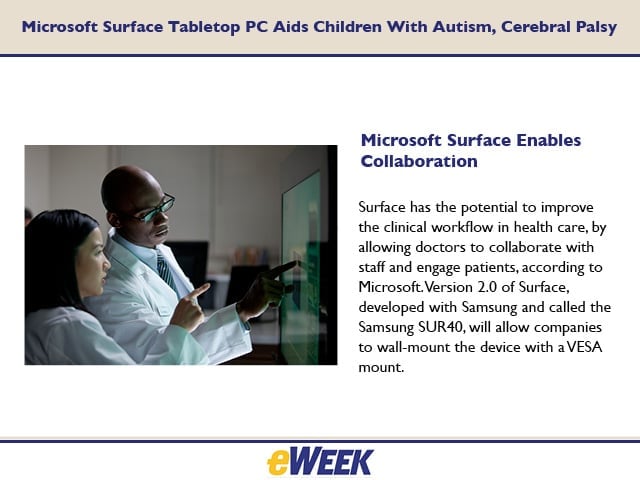
Microsoft Surface Enables Collaboration
Surface has the potential to improve the clinical workflow in health care, by allowing doctors to collaborate with staff and engage patients, according to Microsoft. Version 2.0 of Surface, developed with Samsung and called the Samsung SUR40, will allow companies to wall-mount the device with a VESA mount.
Samsung, Microsoft Reduce Price Point on SUR40
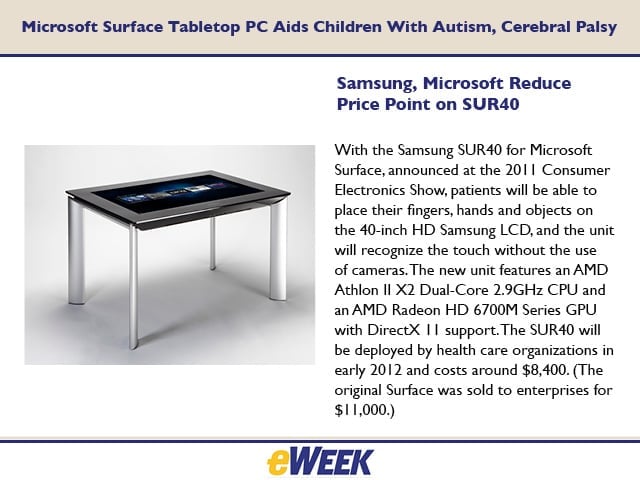
With the Samsung SUR40 for Microsoft Surface, announced at the 2011 Consumer Electronics Show, patients will be able to place their fingers, hands and objects on the 40-inch HD Samsung LCD, and the unit will recognize the touch without the use of cameras. The new unit features an AMD Athlon II X2 Dual-Core 2.9GHz CPU and an AMD Radeon HD 6700M Series GPU with DirectX 11 support. The SUR40 will be deployed by health care organizations in early 2012 and costs around $8,400. (The original Surface was sold to enterprises for $11,000.)
Surface 2.0 Adds PixelSense
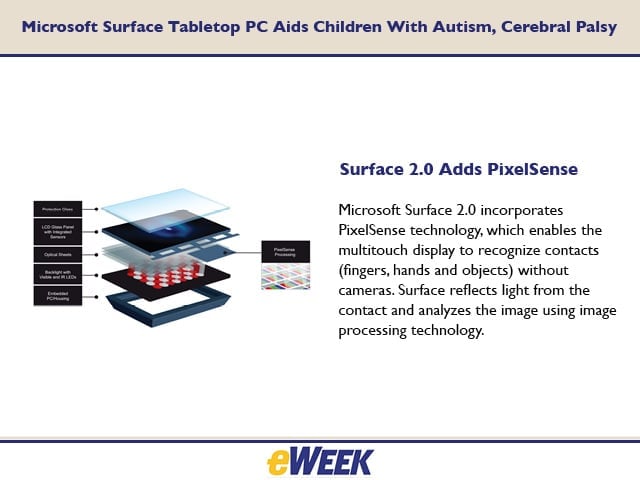
Microsoft Surface 2.0 incorporates PixelSense technology, which enables the multitouch display to recognize contacts (fingers, hands and objects) without cameras. Surface reflects light from the contact and analyzes the image using image processing technology.
Catch the Butterflies
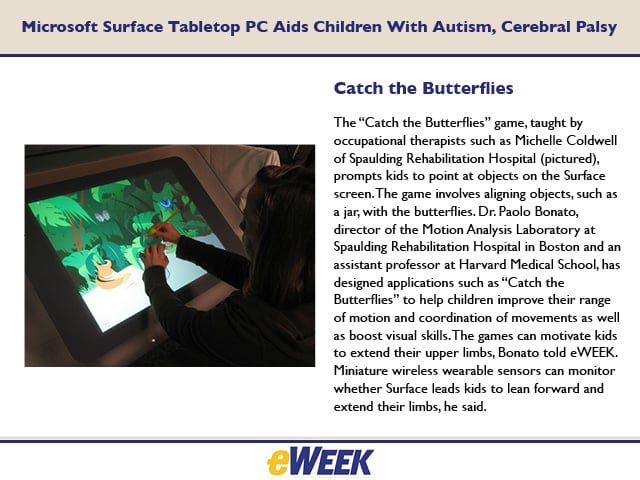
The “Catch the Butterflies” game, taught by occupational therapists such as Michelle Coldwell of Spaulding Rehabilitation Hospital (pictured), prompts kids to point at objects on the Surface screen. The game involves aligning objects, such as a jar, with the butterflies. Dr. Paolo Bonato, director of the Motion Analysis Laboratory at Spaulding Rehabilitation Hospital in Boston and an assistant professor at Harvard Medical School, has designed applications such as “Catch the Butterflies” to help children improve their range of motion and coordination of movements as well as boost visual skills. The games can motivate kids to extend their upper limbs, Bonato told eWEEK. Miniature wireless wearable sensors can monitor whether Surface leads kids to lean forward and extend their limbs, he said.
Autitouch and Autism
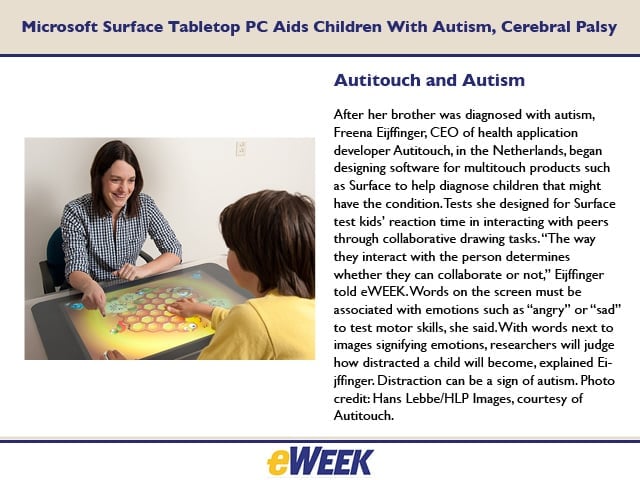
After her brother was diagnosed with autism, Freena Eijffinger, CEO of health application developer Autitouch, in the Netherlands, began designing software for multitouch products such as Surface to help diagnose children that might have the condition. Tests she designed for Surface test kids’ reaction time in interacting with peers through collaborative drawing tasks. “The way they interact with the person determines whether they can collaborate or not,” Eijffinger told eWEEK. Words on the screen must be associated with emotions such as “angry” or “sad” to test motor skills, she said. With words next to images signifying emotions, researchers will judge how distracted a child will become, explained Eijffinger. Distraction can be a sign of autism. Photo credit: Hans Lebbe/HLP Images, courtesy of Autitouch.
Cerebral Palsy Treatment
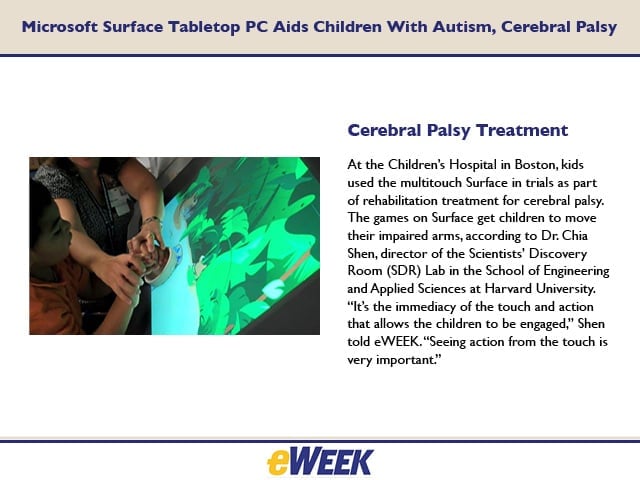
At the Children’s Hospital in Boston, kids used the multitouch Surface in trials as part of rehabilitation treatment for cerebral palsy. The games on Surface get children to move their impaired arms, according to Dr. Chia Shen, director of the Scientists’ Discovery Room (SDR) Lab in the School of Engineering and Applied Sciences at Harvard University. “It’s the immediacy of the touch and action that allows the children to be engaged,” Shen told eWEEK. “Seeing action from the touch is very important.”
Transitioning to the Samsung SUR40
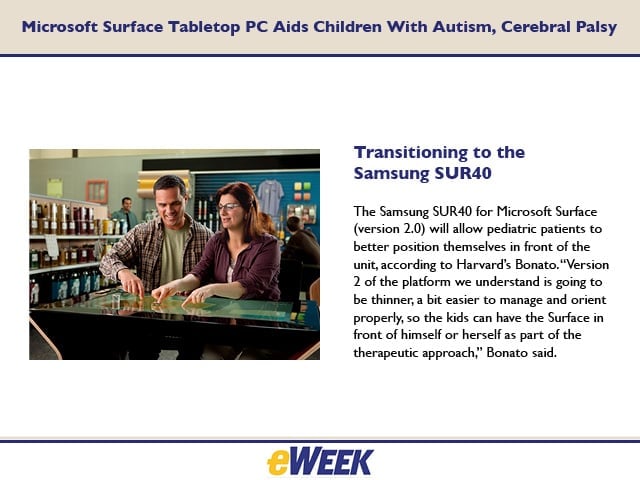
The Samsung SUR40 for Microsoft Surface (version 2.0) will allow pediatric patients to better position themselves in front of the unit, according to Harvard’s Bonato. “Version 2 of the platform we understand is going to be thinner, a bit easier to manage and orient properly, so the kids can have the Surface in front of himself or herself as part of the therapeutic approach,” Bonato said.