






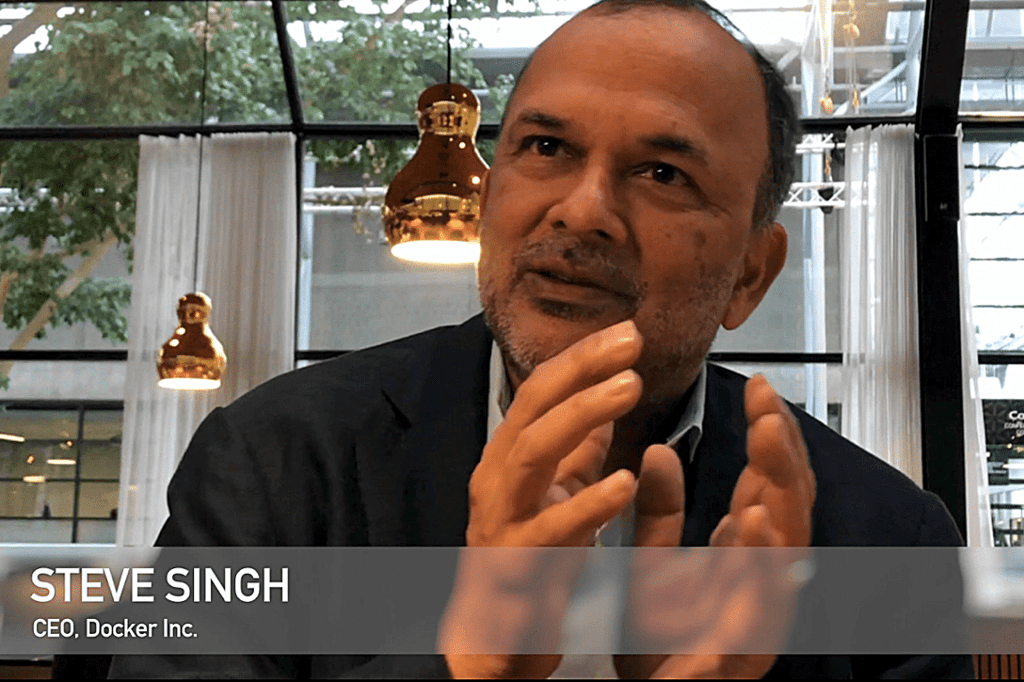

COPENHAGEN, Denmark—Steve Singh has ambitious plans for Docker Inc. that are nothing less than transforming the world of legacy applications into a modern cloud-native approach.
Singh was named CEO of Docker on May 2 and hosted his first DockerCon event here Oct. 16-19. The highlight of DockerCon EU was the surprise announcement that Docker is going to support the rival open-source Kubernetes container orchestration system.
In a video interview with eWEEK, Singh explained the rationale behind the Kubernetes support and provided insight into his vision for the company he now leads.
Despite having its own container orchestration system called Swarm, Docker decided to support Kubernetes. Singh said he doesn’t expect the move to drive revenue; rather, he expects new revenue to be driven by his company’s Modernize Traditional Apps (MTA) efforts.
“What embracing Kubernetes does for us is it removes any potential confusion or any potential conflicts,” Singh said. “We have customers that love Kubernetes; we have customers that love [Docker] Swarm. My view is we shouldn’t force the customer to make a choice between one or the other—we should give them the choice to use whatever they want.”
The container marketplace, especially the Kubernetes area, is highly competitive, with offerings including CoreOS Tectonic and Red Hat OpenShift, among others. Singh said he’s glad there is competition because that means there is a market and money to be made.
“Our hope is that every application company in the world builds and delivers their products on the Docker platform in Docker containers,” Singh said.
The reason why Singh hopes all applications move to Docker isn’t just self-serving, but rather because moving to a container model makes it easier for organizations to manage software. With containers, software is highly portable and can be run on-premises or in any cloud. Singh said that at this point in time, he doesn’t need to explain to organizations what Docker containers are. What he does do is try to get organizations to understand how to use containers and the Docker platform to drive economic benefits.
That’s where the Docker MTA program plays a pivotal role.
“[MTA] allows you to take legacy applications, without refactoring, put them on the Docker platform and deploy them anywhere you want,” Singh said. “That way you can accomplish a real business objective, which is to reduce your cost structure.”
Sean Michael Kerner is a senior editor at eWEEK and InternetNews.com. Follow him on Twitter @TechJournalist.