







SAN FRANCISCO — Computers, data centers, cars, planes, smartphones and myriad other important items have operating systems. So why not houses?
Google has thought long and hard about this disparity and has come up with its answer: Project Brillo.
Introduced at the Google I/O 2015 conference here at Moscone West on May 28, Project Brillo is what amounts to Google’s operating system platform for running connected devices inside a household or business. It aims to connect and centrally control just about everything that can be connected in a living space, including thermostats, door locks, yard sprinklers, refrigerators, washing machines, water heaters, security systems, home entertainment systems, and so on.
The idea is that this new home operating system will enable better and more efficient control of energy, security and water use, and that’s to everybody’s benefit. Pieces of this exist now, but not in the entirety that Google envisions.
Full Support via Android
“Because this (Brillo) is derived from Android, it gets full operating system support,” Google Vice President of Products Sundar Pichai told Google I/O attendees in the Day 1 keynote. “It will use connectivity from Bluetooth and Wi-Fi. And working with Nest (the Google-owned in-home control system), we’re adding support for low-power wireless connectivity. Since it’s Android, it can scale, and many, many device manufacturers can use it. They can update the software easily — it’s an end-to-end operating system.”
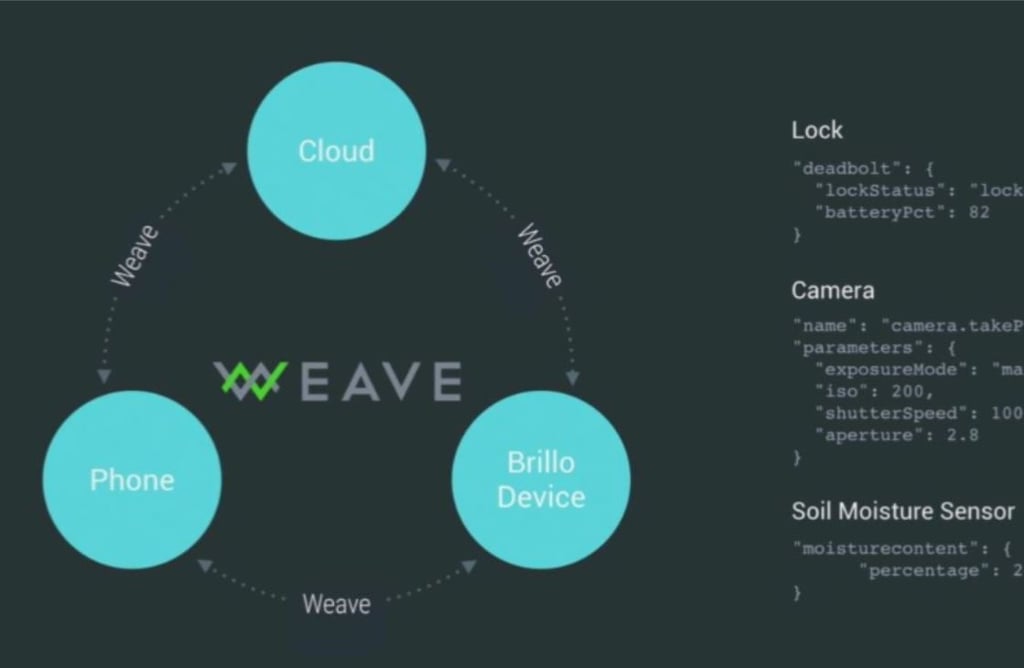
Google still needed a connecting fabric to spread the Brillo/Android control around, so it has developed a common communications language for devices called Weave. Weave links users’ Android phones to the cloud and then to the correct Brillo device. This is an indicator that Google expects its customers to use Android-powered phones as the primary hub for running their local Internet of Things.
Thus, as can be done in piecemeal fashion now with individual point products, people will use their phones to control all those items noted above.
Connecting Fabric: Weave
Brillo and its connecting fabric, Weave, would give Google a strong entry point into the expanding connected device ecosystem. Weave would compete directly with Apple’s forthcoming HomeKit, which can work independently of Brillo and enable individual devices to talk to each other, apart from human intervention.
For example, if a Nest thermostat determined the house was getting too chilly, it might turn up the heat, but it might also think that nighttime is here, and thus instruct the front porch lamp to turn itself on.
“Weave is available cross-platform,” Pichai said. “You can have Brillo and Weave together or you can have Weave alone. Voice interface will also be part of the package, Pichai said. Users won’t even have to find their smartphones to get things done — they can simply order it.
Brillo will go into developer previews later this year, Pichai said.
From the look of things, we’re still a few years away from common IoT usage of systems like Brillo and HomeKit, but they also appear to be inevitable.